Tech Vaidya WhatsApp Channel
Get AI updates, tech news, cybersecurity alerts and useful tech tips directly on WhatsApp.

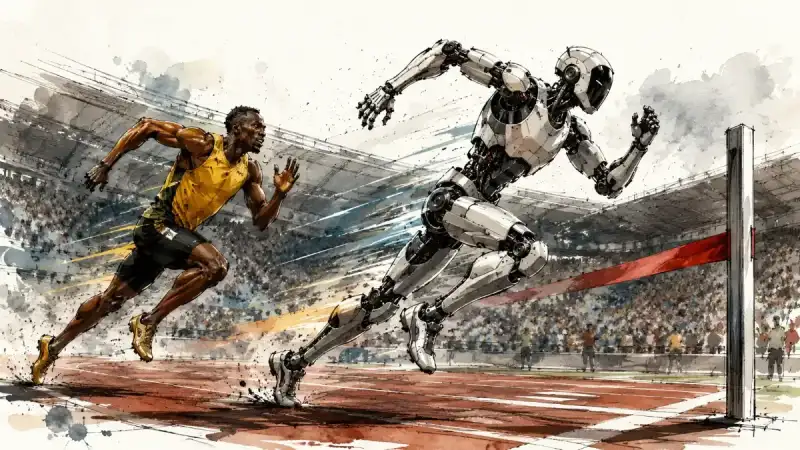
For years, the 100-metre sprint has been one of the clearest measures of the limits of human speed. Usain Bolt pushed that limit to an extraordinary 9.58 seconds at the 2009 World Athletics Championships in Berlin, a mark that remains the men’s 100-metre world record. Now, a humanoid robot has run the same distance faster than that time. At the 2026 World Humanoid Robot Games in Beijing, China’s Tiangong Ultra completed a 100-metre preliminary heat in 9.39 seconds, while Honor’s Lightning finished in 9.47 seconds. On a stopwatch, the machines have crossed a line that once seemed exclusively human. But the most revealing part of the story happened after they crossed it.
There is an important distinction behind that headline. Tiangong Ultra has not broken the official human 100-metre world record, because robot competitions and human athletics are measured under completely different rules and conditions. Bolt’s 9.58 seconds remains the official men’s 100-metre world record, while 9.39 seconds is a benchmark recorded in a humanoid robot competition. Still, the comparison matters because sprinting is not simply about having powerful motors. A bipedal machine must coordinate its legs, body position, balance, acceleration and movement control at extraordinary speed. Reaching a time below the fastest official human sprint therefore demonstrates a remarkable advance in robotic mobility, even if it is not an athletics record in the formal sense.
The number that may be even more revealing than 9.39 is 21.50. That was the time Tiangong Ultra needed to complete the 100 metres at the inaugural World Humanoid Robot Games in 2025. One year later, the same platform has reached the sub-10-second range in competition, showing just how quickly the technology is improving. Every step of a humanoid robot changes its centre of gravity, forcing its control system to continuously adjust the body and prepare the next movement. Motors provide the physical power, but sensors, computing and control algorithms have to coordinate that power without allowing the machine to lose balance. The leap from 21.50 seconds to 9.39 seconds is therefore not just a story about faster motors; it is a story about increasingly sophisticated machine control.
And then comes the part that makes this story much more interesting than a simple “robot beats Bolt” headline. The machines were remarkably good at reaching the finish line, but stopping gracefully was another problem. Reports from the event said Tiangong Ultra and Lightning crashed into safety barriers or mats after their runs, highlighting the difficulty of controlling a humanoid body after a high-speed sprint. The image is almost comical: a machine manages a speed that beats a human world-record time, then struggles with the very human-looking task of coming to a controlled stop. But behind that awkward moment is a serious engineering problem. A robot that can move extremely fast but cannot reliably control its momentum is still far from being a dependable machine in the real world.
That contrast tells us something important about the current state of humanoid robotics. Humans do not consciously calculate every adjustment needed to slow down after a sprint; our nervous system, muscles, balance and reflexes handle much of that automatically. A robot has to sense its position, estimate what will happen next and command its motors to make the necessary correction. At high speed, even a small error can turn into a stumble or collision. This is why a robot’s maximum speed tells only a small part of the story. The more difficult question is whether it can control that speed reliably when the environment is not a perfectly straight running track.
That is where the real challenge begins. A running track gives a robot an unusually simple world: the surface is predictable, the direction is obvious and the goal is fixed. A warehouse is different because people can suddenly walk across its path, boxes can be left in unexpected places and objects can fall onto the floor. A home is even more complicated, because the robot may need to open a door, identify an object, pick it up without damaging it and decide where it belongs. These tasks require perception, balance, manipulation, planning and safety to work together. Running 100 metres quickly is impressive, but making the same machine useful for eight hours in an unpredictable workplace is a much harder test.
The scale of this year’s World Humanoid Robot Games shows why the development deserves attention. The second edition in Beijing has brought together 2,056 robots from 666 teams representing 16 countries, with 51 competition events. The programme goes beyond sports such as sprinting, jumping, football and boxing, and includes scenario-based challenges designed around practical work. Organisers have said these scenarios are being moved into settings such as factories, hotels and model homes, bringing the machines closer to real-world applications. That shift is significant because the industry is gradually moving the question from “Can a robot perform a spectacular movement?” to “Can a robot perform useful work?”
The choice of a humanoid shape also makes more sense when viewed from that perspective. Much of the built environment already assumes a human body: doors have handles, stairs have steps, tools are designed for human hands and workplaces are arranged around human movement. A robot with a human-like body could, in principle, work inside these environments without requiring everything around it to be redesigned. But having two arms, two legs and a human-like frame does not automatically give a machine human-like versatility. It still has to understand what it sees, decide what to do and execute the action without falling, damaging something or creating a safety risk. The sprint shows how far the physical side of that equation has progressed, while the crash after the sprint shows how much remains unresolved.
 Goodbye Chemo? Scientists Built a Smart DNA Sniper That Kills Only Cancer Cells — The 2026 Breakthrough Explained
 Apple’s New Mac mini and Mac Studio Aren’t Just Faster Macs — They’re Built for the AI Agent Era
 What Did Starship Prove on Its 13th Test Flight? A Milestone, or Just Another Step Forward?
 AI Won't Replace Doctors. But the Hospital You Visit Five Years From Now Could Look Completely Different
 One of WhatsApp's biggest privacy changes in over a decade could reshape how billions connect online.
There is another detail that makes the current competition especially revealing. Tiangong Ultra was not the only humanoid robot to move beyond Bolt’s 9.58-second mark, with Lightning recording 9.47 seconds in the competition. Reuters also reported that Lightning had reached an even faster 9.32 seconds in testing, while the competition itself produced the 9.39-second result for Tiangong Ultra. This suggests that the improvement is not simply one lucky run by one machine. Multiple platforms are now pushing toward a level of robotic mobility that would have seemed extraordinary only a short time ago. The more interesting race, therefore, may no longer be between a robot and Usain Bolt, but between different approaches to building machines that can move through the physical world.
That competition is increasingly connected to the commercial ambitions of the robotics industry. The 2026 Games include practical tasks alongside sporting events, reflecting a broader effort to demonstrate humanoid robots in manufacturing, logistics, hospitality and household environments. Some challenges are designed to test abilities such as assembly, handling and other forms of physical manipulation. Those tasks may look less spectacular than a robot sprinting at record speed, but they are much closer to the questions businesses will eventually ask. A company will not buy a humanoid robot because it can run 100 metres in 9.39 seconds. It will buy one if the machine can reliably perform useful work, safely and repeatedly, at a cost that makes economic sense.
This is where artificial intelligence becomes just as important as motors and mechanical design. A humanoid robot needs more than physical strength; it needs to interpret its surroundings, understand what it is being asked to do and continuously adjust its movements. Running itself involves a repeated cycle of sensing, predicting, moving and correcting, and more complicated tasks multiply those demands. The better these systems become at connecting perception with physical action, the more capable robots can become outside controlled demonstrations. The future of humanoid robotics will therefore depend on the combination of AI, sensors, computing, batteries, motors and mechanical design rather than on any single breakthrough. A fast robot is interesting, but a robot that can understand and safely respond to a changing environment is far more valuable.
This is why the moment after the finish line may ultimately matter more than the 9.39-second headline. The spectacular part is easy to understand: a machine covered 100 metres faster than the time recorded by the fastest human sprinter in history. The uncomfortable part is more revealing: the machine still struggled with what came next. Technology often progresses by solving one difficult problem and exposing another, and humanoid robotics appears to be entering exactly that stage. The industry has shown that machines can now move at astonishing speeds. The next challenge is turning that speed into controlled, repeatable and useful physical intelligence.
For ordinary people, that distinction is important because humanoid robots are eventually expected to leave controlled demonstrations and enter real workplaces and everyday environments. That does not mean every home is about to get a robot assistant, and a single sporting event cannot justify such a prediction. But the direction of development is becoming clearer as robots are tested not only on tracks but also in tasks that resemble actual work. Manufacturing, logistics, inspection and repetitive physical jobs are among the areas where such machines could eventually find practical applications. The closer robots get to operating safely and independently in messy environments, the more their progress will matter to workers, employers and consumers. The stopwatch may create the headline, but reliability will determine whether the technology actually changes daily life.
The comparison with Usain Bolt also teaches us something broader about technology. A machine outperforming a human on one measurement does not mean the machine is generally better than the human. Humans are remarkably versatile because the same body can run, stop, climb, pick up objects, communicate, improvise and adapt to unfamiliar situations. Engineers can build machines that outperform us in specific tasks, but creating a machine that can match the breadth of ordinary human adaptability is a far harder problem. That is why the next major milestone in humanoid robotics may not involve another sprint record at all. It could involve a robot completing a difficult shift without losing balance, damaging equipment or requiring a human to intervene.
So what should we actually remember about the 9.39-second run? Yes, a humanoid robot has now completed 100 metres faster than Usain Bolt’s 9.58-second human world record, and that is an extraordinary demonstration of robotic mobility. Yes, Tiangong Ultra’s improvement from 21.50 seconds in 2025 to 9.39 seconds in 2026 shows how quickly this technology is advancing. But the stumble after the finish is just as important as the number on the clock because it exposes the gap between spectacular movement and dependable physical intelligence. The machines are becoming faster, but speed is only one piece of the puzzle. The real race has moved beyond proving that robots can run. It is now about proving that they can work.
And perhaps that is the real story behind the robot that outran Usain Bolt. The important question is no longer whether a machine can beat a human at one carefully defined task. It is whether that machine can understand everything happening before, during and after the task, and respond without needing someone to rescue it. A 9.39-second sprint proves that the physical ceiling of humanoid robotics is moving rapidly. The crash after the finish proves that the ceiling is not the only problem that matters. The next chapter will be written in factories, warehouses, homes and other environments where there are no perfectly straight tracks and no guaranteed second chances. The robot has learned to run; the much bigger test is whether it can learn to work.

No Comment Yet.
Stay informed with breaking news, trending stories, and in-depth analysis.