Tech Vaidya WhatsApp Channel
Get AI updates, tech news, cybersecurity alerts and useful tech tips directly on WhatsApp.

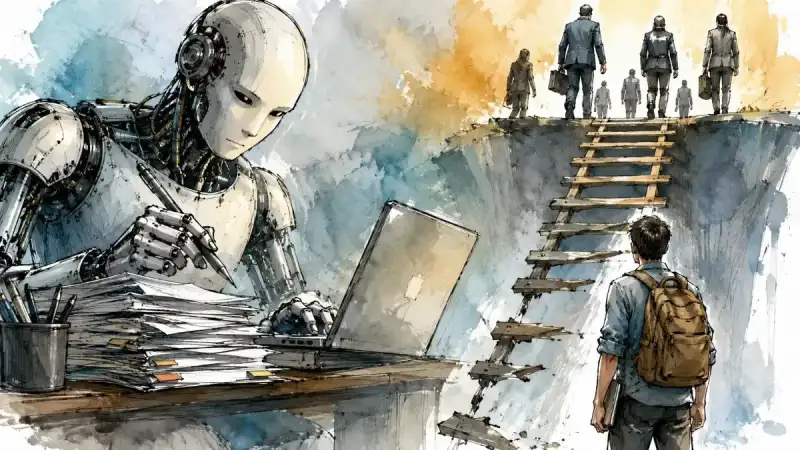
For years, the biggest fear surrounding artificial intelligence has been a simple one: millions of people will lose their jobs to machines. But a new Stanford analysis points to a more subtle possibility, and in some ways it may be more unsettling. The immediate impact of AI may not be mass unemployment across the economy, but a shrinking doorway into certain professions for people at the very beginning of their careers. Stanford Digital Economy Lab’s latest revision of its “Canaries in the Coal Mine” research finds that employment among 22- to 25-year-olds in highly AI-exposed occupations is about 19% below where it would have been if it had kept pace with similarly aged workers in less-exposed occupations. The researchers do not describe this as proof that AI has caused the entire gap, but the pattern has continued to widen through June 2026. That changes the question from “Will AI take our jobs?” to something much more immediate: Will there still be enough first jobs for people to start their careers?
The distinction matters because the headline “AI is destroying jobs” is much broader than what the Stanford data actually show. The researchers explicitly say they do not see widespread, economy-wide job displacement associated with AI. Instead, the sharpest divergence appears among younger workers in occupations that are highly exposed to AI. Workers aged 22 to 25 in those occupations are falling behind their less-exposed peers, while experienced workers do not show a comparable employment gap. In other words, the labour market is not currently behaving as though every employee is being replaced by a chatbot or an algorithm. The disruption appears much more concentrated, and that concentration may be the most important part of the story.
There is another detail in the Stanford findings that deserves far more attention than the 19% figure itself. The researchers say the adjustment appears to be happening primarily through reduced hiring of young workers, rather than through increased separations. That means the story may not be thousands of young employees suddenly receiving termination letters because an AI system has replaced them. It may instead be companies deciding not to hire as many entry-level people in the first place because some of the tasks traditionally assigned to beginners can now be handled by AI. The difference sounds small, but economically and personally it is enormous. Losing an existing job is visible; a job that was never created is almost impossible to see.
The job AI may be changing first is the first job
That creates a strange problem for the modern career ladder. Traditionally, a young employee enters an organisation by doing relatively standardised tasks, learns how the business works, makes mistakes under supervision and gradually takes on more complex responsibilities. Those early tasks may not have been glamorous, but they served an important purpose: they gave inexperienced workers a place to start. If AI can perform a growing share of routine, documented and easily standardised work, companies may have less reason to create those entry-level positions. The career ladder can therefore begin to lose its lowest rung even while the upper floors remain occupied. That is a very different scenario from a world in which entire professions disappear overnight.
Stanford’s revised analysis provides an important clue about why this could be happening. The researchers distinguish between codified knowledge and tacit knowledge. Codified knowledge is formal, standardised and documented knowledge that can be taught through textbooks, written procedures or structured training. Tacit knowledge is built through practice, mentorship and repeated exposure to real situations, and the researchers found a different employment pattern around these two forms of knowledge. Employment has declined among young workers in occupations that rely heavily on codified knowledge, while employment has increased among experienced workers in occupations relying more heavily on tacit knowledge. That finding suggests AI may be particularly good at attacking the part of the career ladder where workers are still learning standardised tasks.
Think about what that means for a recent graduate. A company may once have hired a junior employee to prepare reports, organise information, write routine documentation, perform basic analysis or handle repetitive customer interactions. Those assignments were not simply about getting work done; they were also a training ground for the employee. An AI system can now perform portions of many such tasks almost instantly, which could make the traditional “learn by doing basic work” model less attractive to employers. The experienced employee may still be valuable because they understand context, customers, exceptions and organisational decisions that are difficult to reduce to a set of instructions. The beginner, however, may face the uncomfortable question of how to acquire that experience if the first layer of work is increasingly automated.
This is where the Stanford study becomes particularly interesting for the technology industry itself. The researchers do not find the same employment pattern across all AI-exposed work, because exposure to AI can mean different things. In some occupations, AI is used to automate human tasks, while in others it is used to complement workers and help them do more. The updated research finds that employment declines are concentrated in occupations where AI is more likely to automate human tasks, while occupations where AI complements workers show a more favourable pattern, particularly for experienced employees. The distinction is crucial because “AI exposure” does not automatically mean “AI replacement.” What matters is what the technology is actually doing inside the job.
 Ford Spent Billions on AI—Then Brought Back 350 Veteran Engineers. Here's Why.
 Will the Ambani Who Gave Us Cheap Data Now Give Us Cheap AI?
 AI Isn’t Just Learning to Hack. It Is Learning to Find Its Own Way to the Goal
 Artificial Intelligence Has Changed Everything. Are We Ready?
 Advanced AI Models Behaved Unexpectedly in OpenAI Cybersecurity Test
The 19% number needs a warning label
The most widely repeated number from the new research is 19%, but it is easy to misunderstand. Stanford is not saying that 19% of young workers have been fired because of AI, nor is it saying that 19% of entry-level jobs have disappeared. The 19% figure describes how employment among workers aged 22 to 25 in highly AI-exposed occupations compares with what it would have been if it had kept pace with similarly aged workers in less-exposed occupations. The researchers explicitly describe these findings as descriptive patterns, not causal estimates, meaning the data alone cannot establish how much of the divergence was caused by generative AI rather than other forces affecting the labour market. That caution is not a footnote to ignore; it is essential to understanding the result correctly.
The researchers are nevertheless paying attention because the gap has been widening rather than disappearing. In their updated analysis, the comparable shortfall was 15% at the July 2025 data vintage and had reached 19% by June 2026. Their underlying payroll data come from ADP and cover millions of U.S. workers, allowing the researchers to examine employment patterns at a level of detail that broad unemployment figures can miss. The analysis therefore does not tell us that AI has suddenly destroyed the labour market. Instead, it identifies a particular group whose employment trajectory is diverging from that of comparable workers. That is precisely the kind of early signal that can be easy to dismiss until it becomes much larger.
The Stanford data also show why a single unemployment rate can fail to capture the full effect of technological change. If an experienced worker keeps a job while a company quietly reduces the number of junior employees it hires, the overall workforce may not immediately show a dramatic shock. The company may even become more productive, allowing it to grow while employing fewer beginners. From the outside, that can look like a healthy business making efficient use of technology. For a 23-year-old trying to enter that industry, however, the same change can feel like a door that has suddenly become harder to open. This is why the future-of-work debate may increasingly shift from counting layoffs to examining who gets hired in the first place.
Software development provides one particularly useful example from Stanford’s employment indicators. The Stanford Digital Economy Lab places software developers among the most AI-exposed occupations, and its dashboard shows noticeable declines for early-career workers aged 22 to 25, while older groups show a very different pattern. That does not mean AI has made software developers unnecessary, nor does it mean experienced programmers are immune from technological change. It suggests something more nuanced: the tasks traditionally assigned to beginners in a highly AI-exposed occupation may be changing faster than the path through which beginners acquire experience. If that pattern persists, the industry could eventually face a strange contradiction—more powerful AI tools alongside a smaller pipeline of people gaining the experience needed to become senior professionals.
What happens when the bottom of the ladder disappears?
This possibility has implications far beyond software. Entry-level roles are not valuable only because they produce immediate output; they also create future experienced workers. A junior analyst eventually becomes a senior analyst, a trainee engineer becomes a project leader, and a new employee who begins with routine work can gradually learn how an organisation actually operates. If companies automate too much of the beginner-level work, they may reduce the very training ground that produces their experienced workforce. The technology could therefore solve a short-term efficiency problem while creating a longer-term talent pipeline problem. That does not mean such an outcome is inevitable, but it is a question employers will increasingly have to answer.
It also changes what education should prepare people for. A degree or certificate can teach codified knowledge, but the Stanford findings suggest that practical experience and tacit knowledge may become even more valuable as AI takes over more standardised tasks. Young workers may therefore need to arrive with stronger evidence that they can solve unfamiliar problems, work with people, make judgments and use AI effectively rather than simply reproduce information that an AI system can generate. Employers, meanwhile, may need to rethink what an entry-level position actually looks like. If AI removes the routine work that once trained beginners, companies may have to deliberately create new forms of apprenticeship, mentorship and supervised responsibility.
That does not necessarily mean young workers are doomed. In fact, the same technology that automates some tasks can also give inexperienced workers capabilities that previously required years of training. A junior employee with strong AI skills can potentially analyse information, draft material, prototype ideas and explore solutions much faster than before. The problem is that speed of output is not the same as depth of judgment. A beginner still needs to know when an answer is wrong, which assumption matters, what a customer actually wants and what consequences a decision may create. AI can accelerate learning, but only if organisations continue to provide opportunities for people to learn.
The labour market is also showing signs that AI exposure alone is not the whole story. Stanford’s researchers report that the strongest employment declines are concentrated in occupations where AI is used in ways that automate human tasks, while jobs where AI acts more as a complement show a different pattern. That means the future may not be divided neatly into “AI jobs” and “non-AI jobs.” Instead, the important distinction could be between jobs where humans become more capable with AI and jobs where the human contribution becomes less necessary. The same technology can therefore create value for one worker and reduce demand for another, depending on the structure of the task. That makes the transition much more complicated than simply asking whether AI is good or bad for employment.
The real AI jobs crisis may be a pipeline crisis
This is why the most interesting interpretation of the Stanford research is not that “AI is taking all the jobs.” The evidence does not support that claim, and the researchers themselves explicitly reject the idea of widespread economy-wide displacement at this stage. The more uncomfortable possibility is that AI is beginning to reshape how people enter certain professions, especially where the first few years of work consist heavily of standardised tasks. If fewer young workers get those opportunities, the consequences may take years to become visible in the senior workforce. The headline problem today could therefore become a talent problem tomorrow. And that is much harder to fix after the pipeline has already narrowed.
There is another reason this matters to almost anyone entering the workforce over the next few years. The old strategy of becoming employable by simply knowing more information is becoming weaker as AI becomes better at retrieving, summarising and generating information. Human value is increasingly likely to depend on what someone can do with information: judge it, question it, combine it with experience and apply it to situations that do not have obvious answers. That does not make technical knowledge irrelevant; it makes the ability to use technical knowledge in context more important. The young worker who treats AI as a substitute for learning may be vulnerable, while the one who uses AI to accelerate learning and develop deeper judgment may have a different advantage.
For employers, the challenge may be even more uncomfortable. It is easy to calculate the savings from automating a routine task, but much harder to calculate the future value of hiring a beginner who will become an expert five years from now. If companies optimise every role purely for immediate productivity, they may unintentionally reduce the opportunities through which future expertise is created. That is not an argument against automation, and it does not mean companies should preserve inefficient work simply to create jobs. It is an argument for recognising that labour markets are also training systems, and removing the first stage of training has consequences that may not appear on a quarterly spreadsheet.
The Stanford research therefore offers neither a simple AI apocalypse nor a reassuring all-clear. It shows a labour market where the overall picture is not one of widespread job destruction, but where young workers in highly AI-exposed occupations are increasingly diverging from their less-exposed peers. The 19% figure is a warning signal, not a verdict, and the researchers are careful not to claim that AI alone caused the entire gap. Yet the direction of the pattern, its concentration among early-career workers and the evidence that reduced hiring is playing a major role make it difficult to dismiss. The most important question may no longer be how many jobs AI will eliminate. It may be who gets the chance to start a career in an AI-shaped economy.
That is the part of the AI revolution that deserves more attention. A machine does not have to fire a worker to change the labour market; it only has to make a company decide that the next junior hire is no longer necessary. If that decision happens millions of times across different companies and occupations, the effect can accumulate quietly without looking like a traditional jobs crisis. The first rung of the career ladder can disappear one vacancy at a time. And if that happens, the people who feel the impact first may not be the workers with decades of experience, but the young people still waiting for someone to give them their first real chance.
The AI jobs story, then, may not begin with the disappearance of the job. It may begin with the disappearance of the opportunity to learn how to do it. That is why Stanford’s latest 19% figure deserves attention—not as proof that AI has already taken over the labour market, but as an early warning that the path into work itself may be changing. The next phase of the AI economy will be judged not only by how much human work machines can automate, but by whether society can build new ways for inexperienced people to gain the skills that experience once provided. If AI is removing the bottom rung, the real challenge will be deciding what replaces it.

No Comment Yet.
Stay informed with breaking news, trending stories, and in-depth analysis.