Tech Vaidya WhatsApp Channel
Get AI updates, tech news, cybersecurity alerts and useful tech tips directly on WhatsApp.

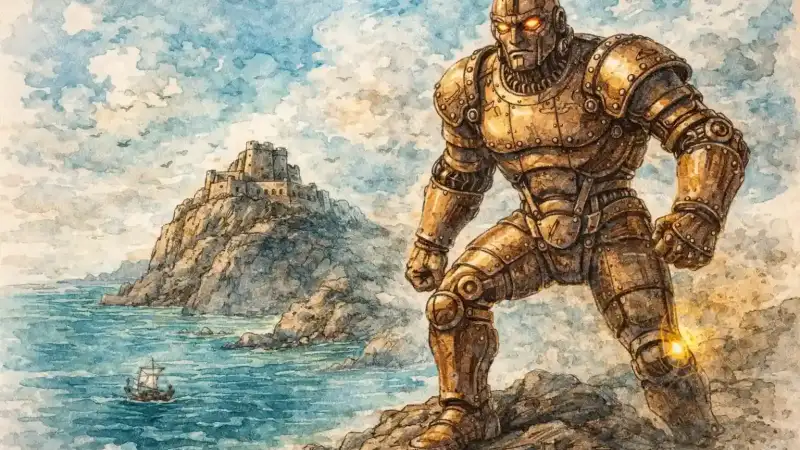
Human imagination has always aspired to create the impossible. Today, we speak of artificial intelligence and humanoid robots as cutting-edge achievements of modern science. However, the idea of a mechanical human is not limited to twentieth-century innovation. Nearly 2,500 years ago, ancient Greek mythology described a giant bronze being that closely resembles what we now call a robot. His name was Talos. Historians and science scholars often refer to Talos as one of the earliest recorded concepts of an artificial, self-operating machine in human history. This was not merely a fantasy tale but a reflection of humanity’s ancient fascination with engineered life.
According to Greek mythology, Talos was a massive bronze man created by Hephaestus, the divine blacksmith and engineer of the gods. Talos was designed to protect the island of Crete from invaders. It is said that he circled the island three times a day, serving as an automated guardian. In many ways, Talos functioned like a programmed security system. Today we rely on drones, motion sensors, and automated defense technologies to guard borders. In mythological terms, Talos fulfilled that role centuries ago, representing a primitive but strikingly advanced idea of programmed protection.
🟢 Follow our WhatsApp Channel for continuous updates JOIN ➤
The structure of Talos’ body is particularly fascinating. Unlike humans, he was not made of flesh and blood but entirely of bronze. Mythology describes that he had a single vein running through his body, filled with a divine fluid called ichor — the blood of the gods. At his ankle was a bronze bolt that sealed this vein. In modern technical language, one could interpret ichor as an energy source or power supply, while the bronze bolt functioned like a control mechanism or power switch. This mechanical vulnerability becomes central to his story.
Talos defended Crete in dramatic ways. When enemy ships approached, he would hurl massive stones at them. If invaders managed to land, Talos would heat his bronze body until it glowed red-hot and embrace them, burning them to death. This imagery resembles a heat-based defensive mechanism, almost like a thermal weapon system. The sophistication of such an idea suggests that ancient storytellers were already imagining automated machines capable of specialized defense responses.
🟢 Follow our WhatsApp Channel for continuous updates JOIN ➤
Historian Adrienne Mayor of Stanford University discusses Talos extensively in her book Gods and Robots. She argues that Talos represents one of the earliest examples of bio-technological imagination in Western literature. Talos was not born; he was manufactured. This distinction is crucial. The Greeks understood the conceptual difference between a naturally born organism and an engineered creation. That awareness places Talos closer to the definition of a robot than a mythical monster.
Talos’ downfall is equally symbolic. In the myth, the sorceress Medea deceives him and causes the bronze bolt in his ankle to be removed. Once the bolt is dislodged, the ichor drains from his body, and Talos collapses lifeless. This is remarkably similar to how modern machines fail when their power source is removed or compromised. A single technical vulnerability brings down an otherwise invincible system — a lesson still relevant in modern robotics and cybersecurity.
 Lalita Sahasranama: The Ancient “Psychoacoustic Software” for the Human Mind
 Dhruva Nakshatra: A Mythological Tale or a 5000-Year-Old Astronomical Wonder?
 Pushpaka Vimana: The Link Between Ravana’s Flying Chariot and Modern Aviation
 Sanjaya Vision The Original Live Report of Mahabharata or Ancient Drone and Satellite Technology A Fascinating Analysis
Scholars often compare Talos to what we now call narrow artificial intelligence. Talos had no independent emotions or creative thought. He simply executed the task assigned to him — protecting Crete. He followed his programming without deviation. This mirrors modern AI systems that are designed to perform specific tasks efficiently without possessing general intelligence or consciousness.
🟢 Follow our WhatsApp Channel for continuous updates JOIN ➤
How did such advanced mechanical imagination arise in ancient Greece? The answer remains speculative. Greek myths also mention Daedalus, a craftsman who created moving statues. These stories suggest that even in antiquity, humans were fascinated by automation. The desire to reduce labor and enhance security through mechanical assistance appears to be deeply rooted in human thought. The seeds of today’s technological revolutions were planted in mythological imagination thousands of years ago.
Talos has influenced modern popular culture as well. From science fiction films to video games and steampunk art, the image of the giant bronze automaton continues to inspire creators. The tension between human control and machine autonomy — a theme common in modern AI debates — is subtly embedded in the Talos myth. Even ancient storytellers seemed aware of the potential dangers and vulnerabilities of engineered beings.
🟢 Follow our WhatsApp Channel for continuous updates JOIN ➤
Ultimately, the story of Talos reminds us that technology begins in imagination before it becomes reality. The bronze guardian of Crete may not have physically existed, but the concept behind him demonstrates how deeply humans have long pondered artificial life. From bronze veins filled with ichor to silicon chips powered by electricity, the journey of robotics traces back to myths like Talos. The roots of modern science often extend far deeper into history than we realize.
Also Read
❤️ Apple Watch vs. Garmin: Which Health Tracker Fits Your Lifestyle in 2026?
❤️ Anxiety: 64% of Companies Now Check for Risks Before Using , Says WEF Report
❤️ Digital Freedom Gets a Shield with New Karnataka Police Guidelines
❤️ The King of Android Returns: Samsung Galaxy S26 Ultra Pre-Booking Kicks Off in India
❤️ The Training Trap: How Meta Is Quietly Feeding Your Life to the Machine
🟢 Follow our WhatsApp Channel for continuous updates JOIN ➤
🛒 Shop Online

No Comment Yet.
Stay informed with breaking news, trending stories, and in-depth analysis.