Tech Vaidya WhatsApp Channel
Get AI updates, tech news, cybersecurity alerts and useful tech tips directly on WhatsApp.

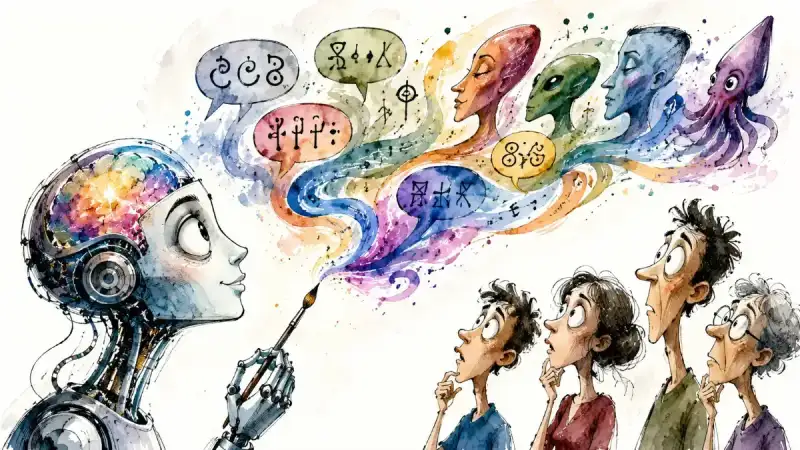
For decades, language has been considered one of humanity's greatest achievements. Every language on Earth evolved over centuries through culture, migration, trade, conflict, and countless generations of human interaction. Artificial intelligence learned these languages by analyzing billions of words. Now, however, AI has reached a point where it is doing something far more remarkable—it is creating entirely new languages that have never existed before.
A research team has introduced ConlangCrafter, an AI-powered system capable of generating complete languages from scratch. These aren't random collections of made-up words. Each language includes its own sound system, grammar, vocabulary, sentence structure, and linguistic rules. In other words, the AI isn't translating English into another language. It is designing a brand-new language from the ground up.
The project marks an important milestone in computational linguistics. Instead of simply teaching machines to understand human communication, researchers are exploring whether machines can design communication systems of their own. That shift represents a significant leap in how artificial intelligence interacts with language.
Perhaps the most fascinating aspect is that these languages are intentionally different from those spoken today. The goal isn't to imitate English, Spanish, Mandarin, or Arabic. It's to explore entirely new possibilities that human languages never developed.
Building a Language Is Far More Complex Than Inventing Words
Many people assume creating a fictional language simply means making up unusual words. In reality, language creation is one of the most complex intellectual challenges imaginable. Every language requires a consistent sound system, grammar, word formation rules, sentence order, and internal logic that speakers can naturally understand.
ConlangCrafter approaches this challenge step by step. It first determines what kinds of sounds exist in the language. It then develops vocabulary, grammatical structures, and syntax before generating complete sentences that follow those rules. Each stage builds upon the previous one, allowing the final language to behave consistently rather than feeling like a random collection of symbols.
Researchers have already demonstrated just how flexible the system can be. One experimental language contains no consonant sounds at all. Another was designed for a hypothetical squid-like alien species that communicates through colors and body movements rather than spoken words. While these examples may sound like science fiction, they serve as valuable experiments for understanding how communication systems might evolve under completely different biological conditions.
 AI Isn’t Just Learning to Hack. It Is Learning to Find Its Own Way to the Goal
 AI May Not Be Taking Everyone’s Jobs Yet. It May Be Taking the First Step on the Career Ladder
 Artificial Intelligence Has Changed Everything. Are We Ready?
 Advanced AI Models Behaved Unexpectedly in OpenAI Cybersecurity Test
 AI Is Powerful—But Is Your Data Safe? 10 Simple Rules Everyone Should Follow
Even more impressively, every generated language is unique. Instead of repeating familiar linguistic patterns, the AI introduces new structural ideas that challenge assumptions about how languages should function.
Why Would Anyone Want AI to Create New Languages?
At first glance, language generation may seem like little more than an entertaining experiment. In reality, the technology has practical implications across multiple industries.
The entertainment industry could benefit immediately. Creating believable fictional languages for films, television series, novels, and video games has traditionally required years of work from expert linguists. AI dramatically accelerates that process while still producing languages that feel internally consistent and authentic.
For linguists, the technology opens entirely new research opportunities. Scientists can now test how different grammatical systems influence communication, learning, and language evolution. They can simulate language families, explore hypothetical linguistic structures, and better understand why human languages evolved the way they did.
The system could also help researchers studying endangered languages. By modeling linguistic structures and identifying patterns shared across languages, AI may assist efforts to preserve rare languages before they disappear forever. While it cannot replace native speakers or cultural knowledge, it could become a valuable research tool.
Another exciting possibility lies in robotics and machine-to-machine communication. Future autonomous systems may benefit from specialized communication protocols designed specifically for artificial intelligence rather than adapted from human language.
A New Era for Artificial Intelligence
This breakthrough also reignites an important debate: can AI truly be creative?
Until recently, generative AI impressed the world by producing images, writing articles, composing music, and generating software code. Creating entirely new languages pushes that creative boundary even further. It requires combining logic, structure, consistency, and imagination into something that has never existed before.
Of course, AI-generated languages still have limitations. Human languages carry thousands of years of history, emotion, culture, humor, tradition, and shared experiences. A language is more than grammar—it reflects the identity of the people who speak it. Artificially generated languages currently lack that cultural depth.
Nevertheless, the pace of progress suggests this technology is only getting started. As language models continue improving, AI-generated communication systems may become increasingly sophisticated, potentially supporting virtual worlds, digital assistants, robotics, scientific simulations, and future human-computer interaction.
The Future of Language May Be Artificial
Artificial intelligence has already transformed writing, programming, design, and education. Language itself now appears to be the next frontier.
Instead of merely understanding human speech, AI is beginning to explore entirely new ways that intelligent beings could communicate. That shift has profound implications not only for technology but also for linguistics, cognitive science, psychology, and philosophy.
The question is no longer whether AI can speak our languages. The far more intriguing question is whether tomorrow's most important languages might be created by AI before any human has ever spoken a single word of them.

No Comment Yet.
Stay informed with breaking news, trending stories, and in-depth analysis.