Tech Vaidya WhatsApp Channel
Get AI updates, tech news, cybersecurity alerts and useful tech tips directly on WhatsApp.

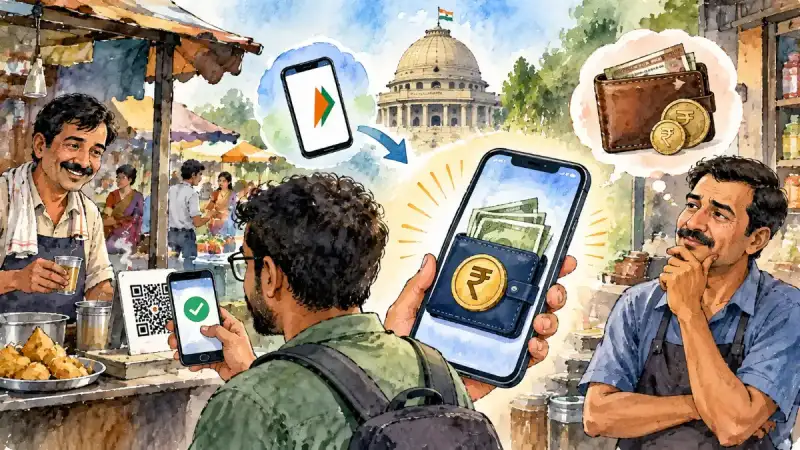
The possibility of charges being introduced on UPI payments has created concern among small merchants and frequent digital payment users. For a customer, paying ₹20 for tea or ₹50 for snacks may seem insignificant. But for a shopkeeper handling hundreds of small transactions every day, even a small charge on every payment could affect monthly earnings. As digital payments become a regular part of everyday life, the question is no longer whether people will use digital payments, but how much they may have to pay for using them.
One possible alternative is already available in India — the Digital Rupee. The Reserve Bank of India introduced the Digital Rupee several years ago as a digital form of currency. It is designed to work more like digital cash, allowing users to hold money in a digital wallet and use it for payments. While UPI mainly enables the transfer of money between bank accounts, the Digital Rupee represents the money itself in digital form.
The difference may sound technical, but it can have practical implications for both consumers and merchants. UPI transactions usually move money directly from one bank account to another. Every small payment can appear separately in the bank statement. With a Digital Rupee wallet, users can transfer a larger amount from their bank account into the wallet and then use that balance for smaller payments. The transfer into the wallet may appear in the bank statement, while the individual payments made from the wallet are recorded inside the Digital Rupee application.
What Exactly Is the Digital Rupee?
The Digital Rupee is India’s central bank digital currency, issued by the Reserve Bank of India. It is not the same as a cryptocurrency and it is not simply another banking application. It is a digital representation of the Indian rupee, designed to support digital payments through a wallet-based system.
Users can access the Digital Rupee through supported banks and financial institutions. After registering on the relevant application, they can add money to the wallet and use it for payments. Depending on the system and merchant support available, users may scan a QR code and complete a payment much like they do through UPI.
In simple terms, UPI is a payment rail, while the Digital Rupee is a digital form of money. UPI helps move money from one account to another. The Digital Rupee allows users to hold and spend digital currency through a wallet. This difference becomes important when people start looking for alternatives to bank-account-based payments.
Why Did the Digital Rupee Not Become Popular Earlier?
 Should You Buy a Laptop or Is a Tablet Enough? The Answer Has Changed in 2026
 Lost Your Phone? Here's How to Find It Using CEIR and Google's New Offline Tracking
 Why Is Your 5G Data Draining So Fast? Try These Android Settings
 Paying for Gigabit but Getting Kbps? The 5-Minute Secret to Unlocking Your Wi-Fi
 Did You Know Your Money Is Locked in NPCI Servers for 45 Minutes Before Reaching the Recipient?
When UPI was free and cashback offers were common, most users had little reason to explore another payment method. Apps such as Google Pay, PhonePe and Paytm made UPI extremely convenient. Cashback, rewards, simple interfaces and widespread QR code acceptance helped UPI become part of daily life.
The Digital Rupee did not receive the same level of attention. Many users were not aware of its practical advantages, while others found no compelling reason to change their payment habits. If a UPI payment is already quick, easy and widely accepted, a new wallet may not appear necessary.
However, some users have already been using the Digital Rupee for a different reason. Their bank statements contain numerous small transactions — tea, snacks, groceries, transport and other daily expenses. By transferring money into a Digital Rupee wallet and using that balance for small purchases, they can keep the bank statement less cluttered. The detailed record of those smaller payments remains available inside the Digital Rupee application.
This does not mean that Digital Rupee transactions are unrecorded. The payments still exist within the digital system and can be tracked through the relevant wallet or service records. The difference is that every small purchase may not appear as a separate entry in the bank account statement.
Can You Pay Through QR Codes?
The Digital Rupee supports QR-based payments, making it familiar to people who already use UPI. In certain supported arrangements, users can also make payments by scanning QR codes used by merchants. This reduces the learning curve because customers do not have to completely change the way they pay.
But acceptance remains a major challenge. UPI is already available at almost every type of business — from tea stalls and vegetable shops to restaurants, petrol stations, online stores and transport services. Digital Rupee acceptance is still not as widespread.
The success of the Digital Rupee will therefore depend not only on its technology but also on its reach. Customers need to have the wallet, merchants need to accept it and the payment process must be as simple as UPI. Unless all three conditions are met, the Digital Rupee may remain a useful option for a limited group of users rather than becoming a mass-market payment method.
Could It Help Merchants Avoid MDR?
MDR stands for Merchant Discount Rate. It is the fee charged to a merchant for processing certain digital payments. At present, many regular UPI transactions do not attract MDR, which has made UPI particularly useful for small businesses.
If charges are introduced on some UPI transactions in the future, merchants may begin searching for lower-cost alternatives. This is where the Digital Rupee could become important. Digital Rupee transactions do not operate in exactly the same way as regular UPI payments. Therefore, the fee structure applicable to UPI cannot automatically be assumed to apply in the same manner to Digital Rupee transactions.
For small merchants, this could offer a potential advantage. If Digital Rupee payments can be accepted without transaction charges, or at a lower cost, shopkeepers may be able to reduce the financial burden of receiving digital payments. This could be especially relevant for businesses that handle a large number of low-value transactions every day.
However, merchants should not assume that every Digital Rupee service will always be completely free. The actual cost may depend on the bank, service provider, payment device, software and commercial agreement. The transaction fee structure and other service conditions must be checked before adopting it as a business payment option.
Why Cashback Could Make a Difference
One of the biggest reasons behind UPI’s popularity was the cashback and reward culture created by payment applications. Even a reward of ₹1 or ₹2 encouraged users to make more digital payments. Over time, the habit became so strong that people began choosing UPI without thinking about other payment methods.
The Digital Rupee has not yet created a similar consumer incentive. A user may ask a simple question: if UPI is already easy and widely accepted, why should I install another application and maintain another wallet?
The answer must come through convenience, wider acceptance, better financial control or some other clear benefit. If banks and service providers make Digital Rupee payments easier and more attractive, adoption could increase. Without a strong reason to switch, most users may continue with the payment apps they already know.
What Could It Mean for Small Businesses?
Small businesses often depend on high-volume, low-value payments. A tea shop, bakery, street vendor, grocery store or local service provider may receive hundreds of digital payments in a single day. Even a small charge on each transaction could become a significant monthly expense.
A widely accepted Digital Rupee system could help such merchants receive payments at a lower cost. It could also provide another payment option alongside cash and UPI. Merchants would not have to depend entirely on one payment network.
But Digital Rupee should not be seen as an immediate replacement for UPI. At present, UPI has a much larger user base, stronger public awareness and broader merchant acceptance. The Digital Rupee will need time to build the same level of trust and convenience.
For merchants, the practical approach may be to support multiple payment methods. Cash, UPI and Digital Rupee can coexist. The choice can depend on customer preference, transaction cost and the availability of suitable payment infrastructure.
What Should Consumers Know Before Using It?
Consumers interested in the Digital Rupee should first check whether the service is available through their bank or a supported financial institution. The application should be downloaded only from an official source. Users should avoid unknown links, suspicious applications and messages asking for OTPs or banking details.
Before adding money to a Digital Rupee wallet, users should understand how the wallet works, how money can be transferred back, what payment limits apply and where customer support is available. They should also check whether the merchants they frequently visit accept Digital Rupee payments.
Digital payments may be convenient, but basic security precautions remain essential. Users should protect their phone, wallet access and authentication details. No payment system should be treated as risk-free simply because it is supported by a bank or a regulated institution.
Is Digital Rupee the Future of Payments?
UPI changed the way India pays. It made instant bank-to-bank transfers simple and accessible to millions of people. The Digital Rupee is trying to create a different model — a digital version of cash that can be stored in a wallet and used for everyday payments.
The two systems should not be viewed as direct competitors in every situation. UPI is useful when money needs to move between bank accounts. Digital Rupee may be useful when users want to hold a digital balance and spend it like cash. Both can serve different needs within the same digital payment ecosystem.
If the discussion around UPI charges becomes more serious, the Digital Rupee could receive renewed attention. Small merchants may examine it as a way to reduce payment costs, while consumers may consider it for managing everyday expenses and keeping their bank statements less crowded.
As journalist Krishna Bhat pointed out in a Facebook post that brought attention to this issue, the Digital Rupee is not a future concept waiting to be invented. It is already available as a payment option, although its acceptance is still limited. Whether it becomes a mainstream alternative will depend on merchant adoption, user convenience, incentives, technical reliability and the cost of transactions.
The future of digital payments may not belong to one single system. UPI, Digital Rupee and other payment methods may continue to exist side by side. The system that offers the best combination of simplicity, affordability, security and widespread acceptance is likely to receive the greatest public attention.
For now, the important point is this: if UPI charges become a concern, users and merchants already have another digital payment option to explore. The Digital Rupee may not replace UPI overnight, but it could become an important part of India’s next phase of digital payments.

No Comment Yet.
Stay informed with breaking news, trending stories, and in-depth analysis.