Tech Vaidya WhatsApp Channel
Get AI updates, tech news, cybersecurity alerts and useful tech tips directly on WhatsApp.

By Nagaraj Vaidya | Editor, Tech Vaidya Global
"For many jobs, humans won't be needed anymore."
For the last two years, that prediction has echoed across boardrooms, conferences, and social media. AI writes articles, generates software, analyzes medical scans, creates images, and automates customer service. Companies across industries have trimmed workforces while investing billions in artificial intelligence. At times, it genuinely felt as though the future belonged almost entirely to algorithms.
Then came a decision from Ford that forced the technology industry to pause.
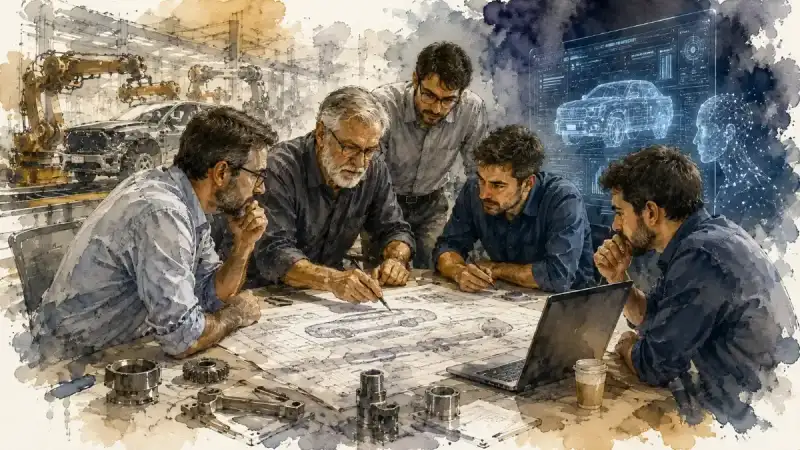
The American automaker, after investing heavily in AI-driven engineering and automated quality systems, quietly began bringing back around 350 highly experienced engineers. Some had retired. Others had moved to suppliers or different companies. Inside Ford, many of these veterans are affectionately known as the "Gray Beards"—not because of their age, but because of the decades of engineering wisdom they carry. That decision wasn't a rejection of AI. It was an admission that experience still solves problems machines cannot.
This isn't another "AI has failed" story. It is something far more important. It is the story of one of America's biggest manufacturers discovering where artificial intelligence excels—and where human judgment still has no substitute.
Imagine a modern automotive factory. Thousands of cameras inspect every component. AI analyzes millions of data points in seconds. Automated systems measure, compare, verify, and approve parts at incredible speed. Yet somewhere in that sea of data, a tiny defect slips through. An engineer with three decades of experience notices it within minutes. That is where this story truly begins.
Machines Saw Everything... Except What Really Mattered
 AI May Not Be Taking Everyone’s Jobs Yet. It May Be Taking the First Step on the Career Ladder
 X Is Cutting Off the Money Behind AI War Videos. Here’s Why That Matters
 770 Billion Parameters! Tencent’s New AI Model Is Huge — But Size Isn’t the Real Story
 AI Isn’t Just Learning to Hack. It Is Learning to Find Its Own Way to the Goal
 Is AI Becoming a Hacker? The New Cybersecurity Threat Emerging From AI Agents
Over the past several years, Ford accelerated its digital transformation. AI became deeply integrated into vehicle design reviews, manufacturing analysis, automated inspections, and quality control. Computer vision systems could compare thousands of images in moments. Automated inspection systems could detect measurement variations impossible for the human eye to catch. On paper, it looked like the factory of the future.
Reality turned out to be far more complicated.
Building a vehicle isn't simply about measuring dimensions or checking specifications. Sometimes two perfectly manufactured components create a problem only after they are assembled together. Sometimes a design passes every digital simulation but behaves differently in real-world conditions. In other cases, a barely noticeable vibration or unusual sound becomes the first warning sign of a defect that may not appear until thousands of miles later. Those subtle relationships are difficult to teach an algorithm using design documents alone.
Ford Chief Operating Officer Kumar Galhotra later acknowledged that the company had become increasingly dependent on automated quality systems but wasn't getting the results it expected. Certain defects weren't being detected until much later in the production process, increasing warranty costs and contributing to expensive recalls. The technology wasn't broken—but the assumption that technology alone was enough proved costly.
That realization triggered an uncomfortable question inside the company.
"We trained AI using thousands of engineering rules. But when did we train it with decades of engineering experience?"
Ford didn't immediately have an answer. Instead, it started searching for the people who did.
Why Ford Went Looking for the "Gray Beards"
The engineers Ford brought back weren't ordinary hires. Many had spent 30 to 40 years solving manufacturing problems, diagnosing quality issues, reviewing designs, and preventing failures long before they reached customers. Their knowledge wasn't stored in manuals. It lived in instinct developed through decades of seeing what works—and what eventually breaks.
A veteran engineer may hear the sound of a closing vehicle door and immediately suspect that something isn't quite right. A tiny steering vibration or an unusual engine resonance may remind them of a failure they witnessed twenty years earlier. Ask them exactly how they knew, and they may struggle to explain it mathematically. Their decisions aren't driven only by formulas. They come from thousands of hours spent solving real engineering problems.
Ford Vice President of Vehicle Hardware Engineering Charles Poon summarized the lesson perfectly.
"Artificial intelligence is a fantastic tool, but it's only as good as the information you use to train it."
Ford had trained AI with design specifications, engineering requirements, and historical documentation. What it hadn't fully captured was the practical knowledge accumulated by experienced engineers over entire careers. That gap became impossible to ignore.
Today, those returning engineers aren't simply reviewing vehicle designs. They mentor younger engineers, participate in design reviews, identify issues AI overlooked, and help improve the very AI systems that once struggled without their expertise. Instead of replacing human knowledge, artificial intelligence is now learning from it.
This Isn't AI vs Humans. It's AI Plus Humans
Some headlines portrayed Ford's decision as proof that AI had failed. That misses the point entirely.
AI continues to outperform humans in repetitive analysis, large-scale comparisons, and processing enormous amounts of engineering data. It never gets tired. It never loses concentration after reviewing thousands of drawings. It excels at identifying patterns across millions of records in seconds.
Where AI still struggles is judgment.
Engineering decisions often involve incomplete information, conflicting priorities, trade-offs, and experience gained from mistakes made years earlier. Predicting how a design decision might affect durability five years down the road isn't always something an algorithm can calculate from historical datasets alone.
Ford's new approach reflects this reality.
AI performs the first layer of analysis. Experienced engineers validate the findings, challenge questionable conclusions, investigate edge cases, and make final decisions. Every mistake AI misses becomes new training data, making future models smarter. Instead of replacing engineers, AI is becoming a more capable engineering assistant.
Across manufacturing, healthcare, aerospace, and enterprise technology, many organizations are moving toward the same philosophy. Industry analysts increasingly describe it as the hybrid workforce—where human expertise and artificial intelligence complement rather than compete with one another.
The Results Changed the Conversation
The impact wasn't visible overnight. There was no dramatic announcement saying Ford had "fixed" its quality problems. Instead, the improvements appeared gradually—fewer warranty claims, fewer production issues, stronger collaboration between engineering teams, and better consistency throughout the manufacturing process. It was the kind of progress that doesn't make headlines immediately but transforms a company over time.
Then came the industry's biggest validation.
In the 2026 J.D. Power U.S. Initial Quality Study, Ford ranked No. 1 among mainstream automotive brands, marking its best performance in roughly 16 years. The company significantly reduced the number of reported problems per 100 vehicles, while models like the F-150, Mustang, and Super Duty led their respective segments. Quality didn't improve because Ford abandoned AI. It improved because Ford learned where AI should lead—and where experienced engineers needed the final word.
That achievement carries an important lesson far beyond the automotive industry. Modern businesses often view digital transformation as a technology project. Ford's experience suggests something different. Successful transformation isn't just about deploying smarter software. It's about making better decisions, and better decisions still depend on people who understand problems beyond what historical data can explain.
The company's quality reset also challenged another common assumption. Many executives have treated experienced employees as expensive legacy talent. Ford demonstrated that veteran professionals aren't a cost to be minimized—they're an intellectual asset capable of preventing mistakes that technology alone may overlook. Sometimes the most valuable investment isn't buying a better AI system. It's retaining the people who know how to use it wisely.
The Lesson Every Business Should Pay Attention To
Ford's story isn't just about manufacturing cars. It reflects a challenge facing almost every industry adopting artificial intelligence.
Hospitals are introducing AI-assisted diagnostics. Banks are relying on machine learning for fraud detection. Law firms are using generative AI to review contracts. Software companies are writing code with AI copilots. Newsrooms are experimenting with AI-assisted reporting. Every sector is discovering the same reality: AI dramatically improves productivity, but productivity isn't the same as judgment.
Experience remains difficult to replicate because it isn't simply stored as information. It develops through thousands of decisions, failures, unexpected situations, customer feedback, and lessons learned over decades. AI can recognize patterns from historical data, but experienced professionals often recognize situations they've never formally documented. That's a fundamentally different capability.
This explains why many global companies are beginning to invest not only in artificial intelligence but also in knowledge preservation. Organizations are documenting institutional expertise, recording engineering decisions, building internal knowledge bases, and ensuring that decades of experience aren't lost when senior employees retire. The next competitive advantage may not come from owning the most powerful AI model. It may come from teaching that model with the best human expertise available.
The Future Isn't AI or Humans—It's AI With Humans
The biggest misunderstanding surrounding artificial intelligence is that it creates a competition between machines and people.
Ford's experience suggests the opposite.
The companies most likely to succeed over the next decade won't be those replacing employees with AI at every opportunity. They'll be the ones building teams where artificial intelligence handles speed, scale, and analysis while experienced professionals provide context, judgment, creativity, and accountability.
That changes how future careers should be viewed.
Tomorrow's engineers won't simply need to use AI—they'll need to verify AI's conclusions. Doctors won't just read AI-generated reports—they'll interpret them within the complexity of individual patients. Journalists won't merely generate content—they'll investigate what algorithms miss. Managers won't stop making decisions. Instead, they'll make better decisions because AI will deliver stronger information faster. The most valuable professionals in the AI era won't be the people competing against machines. They'll be the people who know exactly when to trust AI—and when not to.
For the past two years, headlines have largely focused on one question: Will AI replace humans? Ford answered a different question—one that may be far more important. Can AI reach its full potential without human experience? Its answer appears to be no.
Artificial intelligence can process extraordinary amounts of information. It can identify patterns beyond human capability. It can accelerate design, automate inspections, and improve productivity across industries. But experience remains something entirely different. It represents intuition built over decades, judgment refined by failure, and decisions shaped by situations no dataset has fully captured.
Ford didn't abandon artificial intelligence. Instead, it rediscovered something even more valuable. The future doesn't belong to AI alone. It belongs to organizations that combine the speed of algorithms with the wisdom of people. And perhaps that's the biggest reality check the AI revolution has delivered so far.

No Comment Yet.
Stay informed with breaking news, trending stories, and in-depth analysis.