Tech Vaidya WhatsApp Channel
Get AI updates, tech news, cybersecurity alerts and useful tech tips directly on WhatsApp.

| M. Krishnaprasad Bhat, Maddadka
From the very first day of Navratri, my Messenger inbox was flooded with a barrage of messages. "Sir, please write something about the Lalita Sahasranama, explain its inner essence in your own style" - dozens of dear readers lovingly pursued me. But due to business, the daily hustle and severe lack of time, I could not write even a single line about this during those auspicious days of Navratri, so please, let no one be upset. Isn't there a saying, "Better late than never"?
Even if it is late, it is with the longing to fully reveal this wonderful secret of the Mother of the Universe that I am now sitting before you.
I am presenting before you, as simply as I can to the best of my knowledge, some scientific, psychological and spiritual pearls that I have dived and picked up from the great ocean called Lalita Sahasranama. Come, let us together descend into this wonderful journey of knowledge.
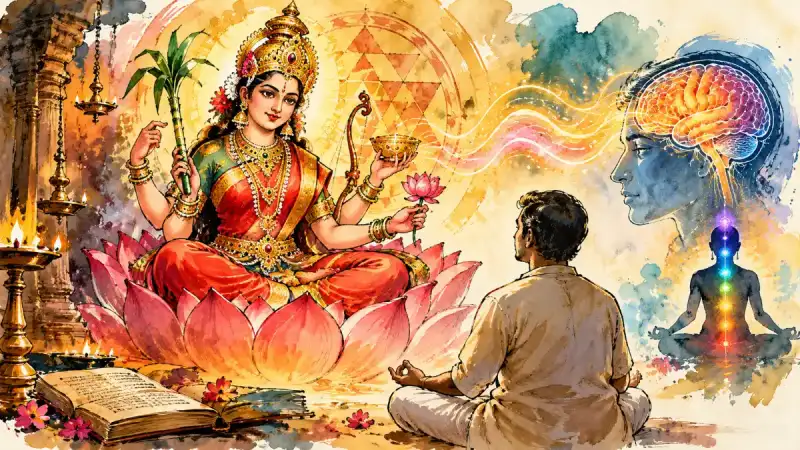
What might be happening inside the skull of a person sitting with eyes closed in a quiet room at that moment? To an outsider, he may appear to be just sitting quietly, folding his hands and moving his tongue, uttering a few Sanskrit words. But deep inside the brain, in the branches of the subtle nervous system, in every beat of the blood vessels, an invisible storm would have arisen. That storm is not destructive; rather, it is a wonderful alchemy that repairs the disordered cells one by one. A great cluster of sounds created thousands of years ago by sages in the mysterious foothills of the Himalayas and in the hermitages of the dense forests of South India has not remained merely as an object of worship. It is a precise psycho-acoustic software. Its name is Lalita Sahasranama. This is the exact and ancient answer given by Indian consciousness to the whirlpool of mental stress, depression, nervous weakness and anxiety that the whole world is worried about.
The very history of Lalita Sahasranama is a wondrous narrative. It is a conversation that takes place between Hayagriva and Sage Agastya in the Uttarakhanda of the Brahmanda Purana. Although he knew all knowledge, Sage Agastya's mind was troubled by some restlessness. He stands before Hayagriva with folded hands, asking what is the permanent solution to all the sorrows of the world, to man's perverted desires, to mental delusion. Then Hayagriva teaches the thousand secret names of the Mother of the Universe, Mahatripurasundari. What is special is that these Sahasranamas were not composed by Hayagriva himself, nor by the gods. Instead, they are sound waves uttered simultaneously in a meditative state by eight Vagdevatas like Vagmini, Vashini, Kameshwari, Aruna, Jayini and others, as per the order of Goddess Lalita. That is, it is the highest mantra design composed together by the very lords of the nervous system that control the speech power of man.
Ancient scriptures beautifully depict the divine form of the Mother at the beginning of this Sahasranama.
| Sinduraruna vigraham trinayanam manikya mauli sphurat
Taranayaka shekharam smitamukhim apina vakshoruham
Panibhyam alipurna ratna chashakam raktotpalam bibhratim
Saumyam ratna ghatastha raktacharanam dhyayet paramambikam |
 Dhruva Nakshatra: A Mythological Tale or a 5000-Year-Old Astronomical Wonder?
 Talos of Greek Mythology: Was This the World’s First Robot Concept?
 Pushpaka Vimana: The Link Between Ravana’s Flying Chariot and Modern Aviation
 Sanjaya Vision The Original Live Report of Mahabharata or Ancient Drone and Satellite Technology A Fascinating Analysis
The traditional meaning of this shloka is very delightful.
It is the scriptural description that one should meditate on the Parambika, who has a body of the colour of sindoor like the rising sun, who has three eyes, who wears the moon on her crown studded with gems, who has a smiling face, who holds in her hands a jeweled vessel full of honey and a red lotus, and who has placed her red feet on a jeweled pot. In the path of devotion, this is a beautiful process of bringing the form of the Goddess before one's eyes.
But when we move aside the veil of this shloka and look at it in the light of modern psychology and neuroscience, the truth that is revealed is astonishing. It is a truth discovered by cognitive science that the human brain does not easily distinguish between imagination and reality. When the red colour, the serene face, and the sparkle of gems are intensely imagined in the mind with eyes closed, the occipital lobe of the brain works as if it is seeing a living scene. The red colour has the power to create alertness and vitality in the cells. At the same time, the gentle smile on the face stimulates the mirror neurons in our brain and sends a message to every cell in the body that we are safe. This visualization lays the foundation for the nerves that were trembling in anxiety to rest in a fraction of a second.
The next dhyana shloka takes us to an even deeper principle.
| Dhyayet padmasanastham vikasita vadanam padmapatrayatakshim
Hemabham pitavastram karakalita lasad dhema padmam varangim
Sarvalankara yuktam satatam abhayadam bhakta namram bhavanim
Shrividhyam shantamurtim sakala sura nutam sarva sampat pradatrim |
The words Shantamurti and Abhayada in this shloka are like a direct tonic for our mental state. When the belief that the Mother is giving fearlessness to the devotees and bestowing all wealth takes root in the mind, the feeling of insecurity and fear of death that always haunts man begins to dissolve. The famous Austrian psychoanalyst Sigmund Freud propounded that the root of every fear of man lies in internal insecurity. But the assurance of fearlessness that the devotee gets here immediately calms the fear center hidden in the amygdala part of the brain.
The most mysterious and thrilling secret of the weapons of Lalita Sahasranama is revealed in this line.
| Manorupekshu kodanda pancha tanmatra sayaka
Raga swarupa pashadhya krodhakara ankushojjwala |
The scriptural meaning of this is as follows. The Mother has four weapons in her hands. Her bow is a sugarcane bow, which is the mind. Her arrows are the five tanmatras - sound, touch, form, taste and smell. The noose in her hand is the form of raga or love. Her goad is the form of krodha or anger. The Purana says that she holds these weapons to destroy the demons.
From here begins the real psychological thriller. It is his mind that controls the entire life of a man. But that mind is like a sugarcane bow. Sugarcane is excessively sweet, but so delicate that it breaks if bent and can cause injury at any moment if control is lost. The arrows that shoot from that bow are the five senses. These arrows, which are constantly shooting towards the outside world through the eyes, ears, nose, tongue and skin, pervert man. But when it is said that Lalita Parameshwari holds that bow and arrows in her hand, it means turning the control of the senses from the external world towards the internal consciousness.
Even more curious is the noose and the goad. Man's biggest weaknesses are excessive infatuation and excessive anger. The famous Swiss psychologist Carl Jung called the dark faces of man's personality as the shadow. The more a man tries to suppress his ego and anger, the more strongly it explodes. But Lalita Sahasranama does not say to destroy desire and anger. It teaches a psychological transformation to convert infatuation into the noose of divine love and anger into the goad used against unrighteousness.
Here is a wonderful cognitive behavioral therapy that does not suppress bad emotions but diverts them towards higher consciousness.
Now we must come to the science of sound. When reading the Lalita Sahasranama, not only the eyes work, but every nerve of the lungs, throat and tongue vibrates. The famous German physicist Ernst Chladni in 1787 showed the world through sand particles on a metal plate that sound waves create geometric shapes. Later, Swiss scientist Hans Jenny continued this in 1967 under the name Cymatics and proved that each specific sound has a precise shape. Each name of the Lalita Sahasranama is a sound wave that creates specific geometric lines of the Sri Chakra inside our body.
Observe the movement of our tongue. In Sanskrit there are sound divisions like Kanthya, Talavya, Murdhanya, Dantya and Oshthya. When the first line of Lalita Sahasranama begins as Shrimata Shrimaharajni Shrimat Simhasaneshwari, the tongue tightly touches the middle part of the upper jaw. There are sensitive nerve endings on the human palate. When the tongue rhythmically taps that spot, a direct signal is transmitted to the hypothalamus and pituitary glands located at the base of the brain. This is the master gland that controls all the hormones of the body. You are not just reciting a hymn, you are resetting your brain's chemical factory.
There is another amazing neuroscientific truth here. The tenth cranial nerve that travels from the human neck to the abdomen is called the Vagus nerve. In 1921, German-born scientist Otto Loewi discovered that nerves use chemicals to communicate with each other and received the Nobel Prize for that research. He showed that when he stimulated the Vagus nerve, it released a calming fluid called acetylcholine. The anusvaras and deep vowels in Lalita Sahasranama create a vibration of 100 to 120 Hertz in the vocal cords of the throat. This frequency directly awakens the Vagus nerve. When the Vagus nerve starts working, the heartbeat comes to equilibrium, blood pressure comes under control and the turmoil of the mind cools down on its own.
The hymn continues and describes the original form of the Mother as follows.
| Chidagni kunda sambhuta deva karya samudyata
Udyad bhanu sahasrabha chaturbahu samanvita |
Scripturally, it is the story that when the gods performed a great yajna to destroy the great demon named Bhandasura, the Mother of the Universe appeared from the Chidagni kunda with the radiance of crores of suns.
But in the insight of psychology, who is Bhandasura? Bhanda means shameless, inert, lazy and pessimistic tendency. When inertia envelops a man, when negative thoughts begin to rule us, our entire personality shrinks. That is called the rule of Bhandasura. To destroy that darkness, mere worldly power is not enough. Chidagni means the fire of consciousness. The radiance of crores of suns means the hundred billion neurons of the brain shining at once at full capacity. The famous American psychologist William James in the 1890s warned that man uses only a small fraction of his brain's capacity. That an unparalleled flame of consciousness is needed to burn the internal inertia is the hidden truth of the line Chidagni kunda sambhuta.
The most precise science hidden in Lalita Sahasranama is in the names of the Kundalini principle.
| Vishuddhi chakra nilaya raktavarna trilochana
Khatvangadi praharana vadanaika samanvita
Payasanna priya tvakstha pashu loka bhayankari
Amritadi maha shakti samvrita Dakinishwari |
Thus the shlokas describe step by step how the Goddess resides in the Vishuddhi, Anahata, Manipura, Swadhishthana, Mooladhara and Ajna chakras as the presiding deity of those dhatus.
Traditionally, these are the yogic powers of the Mother.
It is surprising when we closely observe Endocrinology or the science of internal secretions of modern medical science. The six chakras and the Sahasrara chakra mentioned by the ancients are like a mirror to the major glands of our body. Mooladhara is directly connected to the adrenal gland, Swadhishthana to the sex glands, Manipura to the pancreas, Anahata to the thymus gland, Vishuddhi to the thyroid gland, Ajna chakra to the pituitary gland and Sahasrara to the pineal gland.
In the Vishuddhi chakra, the Sahasranama says that the Mother rules the dhatu of the skin as Tvakstha. Medically, if there is a fluctuation in thyroid hormone, the first thing affected is the human skin. If the thyroid does not work properly, the skin dries up and itching occurs. How did the ancient sages know thousands of years ago the connection between the energy center in the neck and the health of the skin? This is not a coincidence, it is the supreme science that knew the body like the palm of the hand.
EEG machines today give a clear picture of brain waves. In a normal state, the human brain is in Beta waves, i.e., at a speed of 13 to 30 Hertz. In this state, man is haunted by work pressure, anxiety and competitive fears. But fifteen minutes after starting to clearly recite a long, orderly and rhythmic hymn like the Lalita Sahasranama, the brain automatically descends to the Alpha wave state, i.e., a frequency of 8 to 12 Hertz.
In 1924, German psychiatrist Hans Berger introduced to the world that electrical waves flow in the human brain. When in the Alpha state, both hemispheres of the brain start working in the same rhythm. The logic of the left brain and the creativity of the right brain unite.
The recitation of Sahasranama not only calms a person, it increases his decision-making ability and memory power a hundredfold.
Look at another wonderful line of names in the Sahasranama.
| Sarvopadhi vinirmukta Sadashiva pativrata
Nirguna nishkala shanta nishkama nirupaplava
Nitya mukta nirvikara nishprapancha nirashraya
Nitya shuddha nitya buddha niravadya nirantara |
Every word here starts with the negative prefix Nir. She who is without upadhis, who is without the boundaries of gunas, who is without desires, who is without distortions. From the scriptural point of view, this is a description of Parabrahma Swarupini.
But on the psychological ground, this is a supreme mindfulness process. Professor Jon Kabat-Zinn of the University of Massachusetts in America introduced the treatment method called Mindfulness Based Stress Reduction to the world in 1979. What is the cause of human sorrow? Labels like I am a doctor, I am a businessman, I am poor, I am a loser. The scriptures call these labels as Upadhi. When reciting these lines of the Sahasranama, consciousness becomes free from all its external identities. When the deep awareness dawns that I am pure consciousness beyond caste, religion, gender, defeat and victory, the inferiority complex and depression that have been squeezing the mind for years turn to ashes in an instant.
In Indian philosophy, Goddess Lalita is described as sitting in the lap of Kameshwara. Kameshwara means attributeless, immovable, peaceful consciousness. Shiva is static. Lalita is dynamic, energetic movement. Their union is creation. This reminds us of the quantum theory propounded by Max Planck, the father of quantum physics, in 1900 and the principle of complementarity later presented by Nobel laureate Niels Bohr. Matter and energy are not different, they are two sides of the same coin. There is no Shakti without Shiva, and no existence for Shiva without Shakti. Worshipping Lalita Sahasranama means bringing our internal inert consciousness and dynamic energy into balance.
The lines calling the Goddess at the concluding stage of the Sahasranama are thrilling.
| Mahapadmatavi samstha kadamba vana vasini
Sudha sagara madhyastha Kamakshi Kamadayini |
She who resides in the forest of great lotuses, who lives in the Kadamba forest, who sits on a jeweled island in the middle of an ocean of nectar. Figuratively, this is the beauty of nature. But according to neuroscience, there is a Sahasrara chakra in the crown part of the human brain that looks like a lotus with a thousand petals. When that center is awakened, nectar-like chemicals of bliss are secreted in the body. Dopamine, serotonin and oxytocin, the happy hormones, flow like a flood in the brain. The ocean of nectar is nowhere else, it is in the depths of your own skull.
This is not just a question of faith. It is a confluence of biology, physics and psychology. The nervous system of a person who recites the Lalita Sahasranama daily with understanding and clear pronunciation transforms anew day by day. In neuroscience, this is called Neuroplasticity. Old bad thought neural pathways close and new positive neural pathways are built.
Ancient sages did not just write mantras and leave. They gave us the most subtle engineering of the human interior in the form of a poem, with a coating of devotion. For the modern man who is tired and exhausted in the artificial noise pollution of the outside world and in the rat race of mechanical life, Lalita Sahasranama is a valley of rejuvenation. It is not just a hymn to pray with folded hands. It is a divine code left by our ancestors to climb to the highest peak of consciousness and to extract the wonderful power of the brain. Just close your eyes, straighten your spine, take a deep breath and expose yourself to the wave of those thousand sounds, your inner dark demons will kneel on their own, and great wisdom will dawn.
There is a saying in the scriptures: "Gurumukhena labdhas tu mantrah siddhipradayakah" — That is, any Vedic mantra or divine secret worship like Shrividya gets its consciousness awakened only when it comes in the form of instruction from the Guru's mouth. Learning by looking at books is only literal knowledge, while receiving from the Guru is like the touch of electricity. A sadhaka who wishes to receive the instruction must first take shelter of a Sadguru who is ascetic, virtuous and knowledgeable in the scriptures. On the day of instruction, the sadhaka should fast, become pure through cleanliness and bath, wear new white or sattvic clothes, and with fruits, flowers and dakshina, prostrate before the Guru's feet and seek mantra initiation.
At that moment, a wonderful transmission of energy takes place between the Guru and the disciple. If the Guru sits facing east or north, the disciple should sit in front of them with a humble feeling. The Guru makes the disciple perform achamana, pranayama and sankalpa, and secretly, with very clear pronunciation, instructs the mantra three times in his right ear (there is also a tradition in many places that it is the right ear for men and the left ear for women). They explain the exact rules of who is the Rishi of that mantra, what is the Chandas, who is the deity and how to chant that mantra (Nyasa, Mudra, Japa number). The Guru transfers a small spark of his penance to the disciple's consciousness through that mantra, this is called 'Shaktipata'. Only when a mantra received from the mouth of a Sadguru in this way is kept extremely secret and chanted daily in a disciplined manner, the presiding deity of that mantra becomes pleased and bestows on the sadhaka Vak Siddhi, mental stability and spiritual upliftment.
The procedure for reciting the Lalita Sahasranama in a scriptural manner must be with utmost discipline and devotion. Before recitation, after finishing bath, wearing clean sattvic clothes, one should sit in a pure place in the puja room of the house on a seat or a stool. One should never recite sitting on bare ground for any reason. It is a scripturally accepted procedure to light a ghee or sesame oil lamp and sit facing east or north in front of the picture of the Mother of the Universe or the Sri Chakra. The spine, neck and head should be straight. First perform achamana, remember Lord Ganesha, salute the Guru lineage, make a sankalpa and visualize the divine form of Lalita Parameshwari in the mind through dhyana shlokas.
There are strict rules in the scriptures for the style of recitation and the rhythm of the sound. It is forbidden to read the shlokas very quickly in haste or to drag them very slowly. Every letter, conjunct and anusvara must clearly emerge on the tongue. It is best to recite in a medium voice in the serious rhythm of the Chandas, without taking a raga as if singing a song. It should sound melodious to those nearby or should be pronounced so that it is clearly audible only to us. Talking in between the hymn, yawning, letting the eyes wander everywhere or stopping the recitation midway and getting up and leaving is a fault according to the scriptures. After completing the full Sahasranama, one should close the eyes for at least five minutes and experience those peaceful waves within, and finally salute the Goddess and offer a prayer for forgiveness.
There is also a time determination in the scriptures as to when the hymn should be recited. Every day, the early morning Brahma Muhurta (before sunrise) or the evening Pradosha Kala (time of sunset) is the most excellent time for reciting the Lalita Sahasranama. If recited before the day's hustle begins or in the evening when light falls on the house, the brain and nervous system immediately reach a meditative state.
In the calculation of special days, Friday and Tuesday are the most powerful days for the worship of the Mother. In addition to this, every month's full moon (Purnima), the nine days of Navratri, and the Ashtami, Navami and Chaturdashi tithis of the Shukla Paksha are the times that are directly Siddhi-prada for the recitation of Lalita Sahasranama, as Hayagriva himself clearly told Sage Agastya in the Phalashruti of the Uttarakhanda of the Brahmanda Purana.
In the hustle and bustle of modern life, for women who are in the midst of office duties or busy household chores, Lalita Sahasranama is an inner Sanjeevini. Women who do not have time to sit according to the scriptures, light a lamp and recite for half an hour need not be disappointed. For the Mother's love, the devotion of the child's mind is more important than the shackles of rules. It is enough for working women to just listen to the audio of Sahasranama by wearing earphones during their commute to office by bus, train or metro. As the ancients said, the power of 'Shravana' is immense compared to recitation, those sacred sound waves descend through the ears to the neurons of the brain and remove all stress, anxiety and fatigue of the day and fill it with new vitality.
One can also worship the Mother through mental chanting while at the workplace or in the kitchen. If it is not possible to say the shlokas loudly, mentally remembering the names without moving the lips is the most excellent 'Manasa Puja' from the scriptural point of view. When extreme stress, anger or confusion haunts you in the middle of work, just closing your eyes for two minutes where you are, taking a deep breath and remembering one or two names of the Mother like 'Shrimata' or 'Shantamurti' will immediately bring the mind back to a peaceful state. For women, the workplace itself is Karmabhoomi. A moment of meditation done with a pure mind in that place bestows as much sacred fruit as reciting the entire Sahasranama.
Medical Clarification:
The neuroscience, psychology and physiological matters mentioned in this article are only for the purpose of information and study to understand the scientific dimensions behind the ancient hymn, and are not a substitute for any kind of official medical advice, diagnosis or treatment. Those who have severe mental stress, depression, anxiety or any physical or neurological health problems must compulsorily contact skilled doctors and expert psychiatrists and get appropriate treatment and medicines. Mantra recitation, meditation or listening can only be a mental peace and complementary spiritual practice, and cannot be used as a substitute for professional medical treatment.
All rights of this article: © 2026 M. Krishnaprasad Bhat Maddadka | All Rights Reserved.

I wholeheartedly resonate with the ideas presented in this article. 🙏 From my professional and personal experience, I have observed that the regular recitation of Sanskrit mantras can have a meaningful influence on the mind, emotional well-being, and inner peace. Spiritual experience has its own value, while scientific evidence has its own standards. It is important to respect both while clearly distinguishing personal experiences and beliefs from scientifically established findings. I have a deep conviction that regular Mantra Pārāyaṇa (recitation) and Japa-yajña (disciplined mantra repetition), practised with faith and concentration, deserve serious attention from the perspective of psychosomatic health. 🙏🌺 As a practising physician, I believe that the potential role of these practices in different dimensions of human life—particularly mental, emotional, spiritual, and psychosomatic well-being—should be investigated through rigorous scientific research. One especially important area of study is their potential contribution to improving Health-Related Quality of Life (HRQoL) among people living with chronic health conditions. Although personal and spiritual experiences suggest possible benefits, robust scientific evidence evaluating the specific health effects of these practices through appropriate research methods remains limited. In today's evidence-based world, it is essential not only to respect lived experiences but also to document and investigate them systematically. In my view, studying the health-related effects of Mantra Pārāyaṇa and Japa-yajña is more than a research endeavour. It is an opportunity to preserve our experiential knowledge and transmit it to future generations supported by scientific evidence. 🙏🌺 May the grace of Śrī Lalitā Tripurasundarī Devī be upon everyone. 🙏❤️
Stay informed with breaking news, trending stories, and in-depth analysis.