
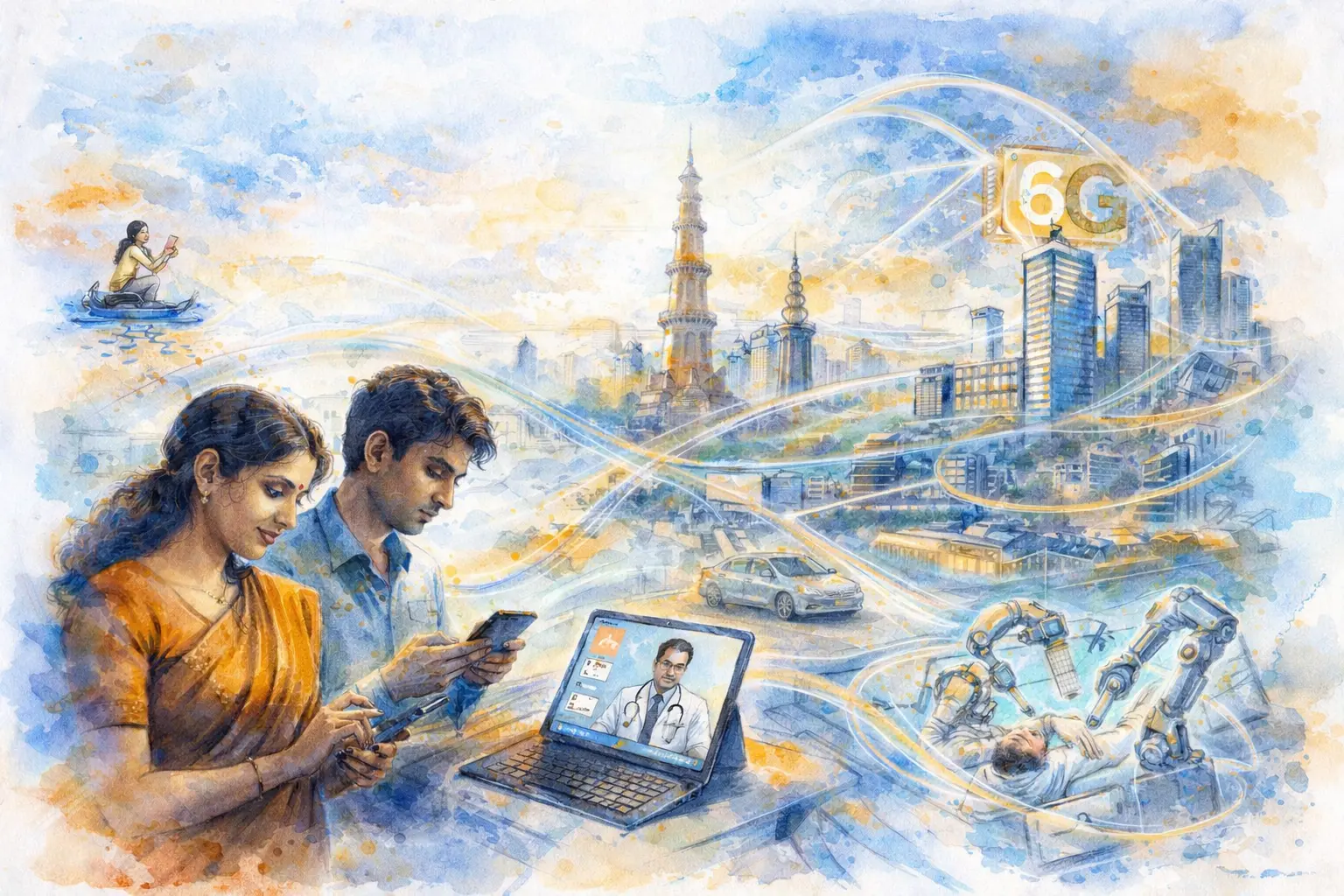
India has emerged as one of the fastest growing nations on the global technology map. Following the successful nationwide implementation of 5G technology, the country has now firmly set its sights on the 6G horizon. The Department of Telecommunications has granted permissions to conduct pilot tests across various regions, marking the beginning of the next chapter in technological evolution. This shift is expected to do more than just increase internet speeds; experts predict it will fundamentally transform the lifestyle and productivity of the average citizen.
The 6G technology is designed to operate at speeds approximately 100 times faster than current 5G networks. Its data transfer rates are expected to reach the level of terabytes per second. To put this into perspective, downloading a high-definition movie that currently takes minutes might soon be accomplished in mere milliseconds. This extraordinary capacity will create a revolution in the field of data exchange, serving not just personal entertainment needs but becoming a necessity for advanced industrial applications.
Technically, 6G utilizes terahertz frequencies and sub-millimeter waves to function. This allows for a much higher volume of data to be transmitted with extremely low latency. Indian scientists and engineers are already actively securing patents related to this technology. This proactive approach will help uphold India's technological sovereignty in the global market. Furthermore, the development of indigenous technology will provide significant economic advantages by reducing reliance on foreign intellectual property.
In the medical field, the impact of 6G will be profound and life-saving. It will enable specialist doctors in urban centers to perform surgeries via robotic instruments on patients located in remote villages. The near-zero latency of 6G is essential for such sensitive operations where even a millisecond of delay could be critical. As a result, healthcare services can transcend geographical barriers, reaching the most marginalized individuals in the country and marking a milestone in the digital health ecosystem.
Education is another sector poised for a radical makeover through 6G. Through holographic telepresence, teachers can appear to be physically present in front of students even if they are thousands of miles away. This technology will make virtual and augmented reality learning experiences feel entirely natural. Classrooms will no longer be confined to four walls, as 6G acts as a bridge to provide local students with access to world-class educational experiences in real-time.
In the era of autonomous vehicles or self-driving cars, 6G will function as the central nervous system. Thousands of vehicles traveling on the road need to communicate with each other every second to ensure safety. With the help of 6G, it becomes possible to prevent accidents and scientifically manage traffic congestion. This will fully realize the concept of smart cities, where transportation is synchronized, efficient, and significantly safer for all residents.
Developing the infrastructure for 6G in India presents a significant challenge. It requires a vast network of small cells and fiber connectivity to be spread across the entire country. The government is already moving in this direction by fostering partnerships with private entities. A primary goal of this mission is to close the digital divide between rural and urban areas by ensuring that high-speed internet is not a luxury but a utility accessible to every village.
From the perspective of green technology, 6G is being designed with sustainability in mind. It aims to be more energy-efficient, performing more work with less power consumption. Scientists are researching ways to reduce the energy footprint of telecommunication towers by integrating green technologies. This approach will assist India in reaching its sustainable development goals while minimizing the environmental impact of a more connected society.
Security and privacy will receive heightened focus in the 6G architecture. By utilizing quantum encryption, it will become nearly impossible for hackers to steal data. Online transactions and personal information will be extremely secure within this new network. This will further strengthen public trust in the digital economy. Security features are being integrated into the technology from the design phase rather than being added as an afterthought.
Economically, 6G will create a plethora of new job opportunities in India. There will be a massive demand for experts in fields like AI, IoT, and advanced communications. This allows Indian youth to secure global-level jobs within their own country. Furthermore, local startups will have the opportunity to introduce 6G-based products to the world market, providing a fresh impetus to the Make in India initiative.
The 6G era will lead to the emergence of the sensory internet or the internet of senses. This involves transmitting not just sights and sounds, but also the sensation of touch through digital media. This will revolutionize e-commerce and gaming. For instance, consumers might be able to experience the texture of a product digitally before making a purchase. The days of such immersive digital experiences are no longer far off.

India's 6G mission is no longer just a concept; research centers have been established in premier academic institutions like the IITs to conduct experiments. The encouragement provided by the government has filled researchers with new energy. This has enabled India to play a major role in determining global 6G standards, allowing the nation to compete on equal footing with technological powers like the United States and China.
Ultimately, 6G is more than just fast internet; it is a medium that technologically links humans, machines, and nature. By 2030, full-scale 6G services are expected to be available in India. Until then, every pilot test conducted will serve as a stepping stone toward India's dream of becoming a digital superpower. This new wave of technology will undoubtedly accelerate the pace of national development and individual empowerment.
ಈ ಲೇಖನಗಳನ್ನೂ ಓದಿ
❤Union Budget 2026 Will it Power Up India's Tech Sector Dreams of AI and Semiconductors
❤ Pushpaka Vimana: The Link Between Ravana’s Flying Chariot and Modern Aviation
❤Hell Freezes Over: Apple Partners with Google to Bring Gemini AI to the iPhone
❤eSIM Explained: Why You Should Ditch Physical SIMs for International Travel in 2026

No Comment Yet.
Stay informed with breaking news, trending stories, and in-depth analysis.