Tech Vaidya WhatsApp Channel
Get AI updates, tech news, cybersecurity alerts and useful tech tips directly on WhatsApp.


Cancer was never just a disease. It was a civil war happening inside your own body. For 50 years, we fought it with one brutal strategy. We carpet-bombed the entire city to kill one hidden enemy. That carpet bombing had a name. Chemotherapy. It killed the tumor, yes, but it also killed your hair follicles, your white blood cells, your gut lining. Imagine burning down your whole neighborhood to catch one intruder. That was the best we had.
But what if you could send a sniper instead of a bomber? What if a drug could float through your bloodstream, ignore every healthy organ, and explode only inside a cancer cell? Scientists have built exactly that. They call it a Smart DNA Drug. It is not a pill. It is a programmable micro-robot made of DNA itself. And on April 1, 2026, it got a major upgrade that changes everything.
There is a catch that makes this new version almost impossible to fail. It no longer opens with one key. It needs two. Like the two-factor authentication on your bank account. Miss one, and it stays locked forever. How does a drug think like a computer? Keep reading.
The Real Problem: Why 50 Years of Chemo Was a Dilemma
Killing a cancer cell is easy. Any strong poison can do it. That was never the real challenge. The real dilemma was how to kill the cancer cell without killing the 37 trillion healthy cells around it. Your body makes millions of new healthy cells every day. Chemo cannot tell the difference between good and bad. It attacks everything that divides fast.
That is why you lose hair, feel extreme fatigue, vomit constantly, and lose immunity during treatment. The tumor may be shrinking, but you are suffering more than the disease itself. For decades, oncology was trapped in this trade-off. Give a high dose and you risk killing the patient. Give a low dose and the cancer survives. Doctors had to choose between two bad options every single time.
The dream for 20 years has been targeted therapy. A medicine that delivers poison only to the diseased cell. That dream is now real, and the material scientists are using is not some rare chemical. It is the most familiar molecule in your body. Your own DNA.
What Is Smart DNA Drug? The Magic of DNA Origami
 Apple’s New Mac mini and Mac Studio Aren’t Just Faster Macs — They’re Built for the AI Agent Era
 The Robot Beat Usain Bolt’s 100-Metre Time. What Happened After the Finish Is More Important
 What Did Starship Prove on Its 13th Test Flight? A Milestone, or Just Another Step Forward?
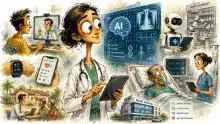 AI Won't Replace Doctors. But the Hospital You Visit Five Years From Now Could Look Completely Different
 One of WhatsApp's biggest privacy changes in over a decade could reshape how billions connect online.
Forget what you learned in school about DNA just being a code for your genes. In this technology, DNA is not information. It is a building brick. Scientists call this DNA origami. Like Japanese origami where you fold paper into a crane, they fold long strands of synthetic DNA into a tiny box, just 100 nm wide. You cannot see it with your eyes. It is 1000 times smaller than a human hair.
Inside that box, they hide an extremely powerful chemo drug. Then they put a molecular lock on the door. When that locked box is injected into the bloodstream, it travels through your heart, your brain, your liver. Nothing happens. The door is shut. The poison stays inside. Zero damage to healthy tissue. This alone solves 100% of collateral damage, because healthy organs do not have the key.
So where is the key? Cancer cells wear a different uniform. Their surface has specific proteins and molecular markers that healthy cells never have. Scientists design the molecular lock so that only those cancer markers can open it. It is like a smart locker that opens only with a criminal's fingerprint. When the box bumps into a cancer cell, the marker fits perfectly, the lock clicks, the box opens, and the drug detonates inside. Neighboring healthy cells do not even know a battle happened.
The 2026 Upgrade: The 2-Lock System That Thinks Like a Computer
This is where 2026 changes the story completely. A single key can still make mistakes. A healthy cell might accidentally have one similar marker. So a team from the University of Geneva, led by Prof. Nicolas Winssinger, built a system that needs 2 keys at once. Their work was published on April 1, 2026, in Nature Biotechnology.
They call it DNA-Drug Conjugates, or DDCs. There is no single big box anymore. Instead, there are 2 separate DNA strands floating separately in the blood. Each strand carries a different cancer-targeting binder plus a drug payload. Alone, each strand is harmless. They do nothing by themselves, floating quietly through your body.
The magic happens only at the tumor. Only when 2 specific cancer proteins appear together on the same cancer cell — for example EGFR and PD-L1 — do those 2 strands self-assemble right there. Once assembled, they trigger a hybridization chain reaction that dumps hundreds of times more drug in one spot. It is exactly like two-factor authentication for your bank. One password is not enough.
Scientists call this an AND logic gate. As Prof. Winssinger said, until now computers helped us design drugs. Now the drug itself can compute and make intelligent decisions based on biological signals. In January 2026, a separate study in Advanced Materials also showed left-handed chiral DNA tubes can double the killing power for tough cancers like acute myeloid leukemia.
Why It's 10 Times Better Than Antibody-Drug Conjugates
You may have heard of antibody-drug conjugates, or ADCs, the most advanced targeted therapy today. So why is this DNA system better? There are 3 reasons. First is size. ADCs are huge, bulky proteins. They cannot penetrate deep into a solid tumor. They stay on the outer edge. DNA strands are 10 times smaller and dive straight into the core.
Second is payload. ADCs can carry very little poison. The new DDC system, through its hybridization chain reaction, amplifies and releases hundreds of times more drug at a single point. It is not a slow leak. It is an internal explosion. Third is precision. ADCs look for one marker, which sometimes appears on healthy cells too. The new system requires 2 markers together, so the chance of hitting a healthy cell drops to almost 0%.
In lab tests, the technology identified cancer cells with specific marker combinations and killed only them, while nearby healthy cells remained completely unharmed. Researchers also showed they can combine multiple therapeutics in the same dose to prevent drug resistance. That was impossible with old chemo and very hard with ADCs. This is not an improved version of old medicine. It is a new species of medicine.
Where Are We Now? From Mice to Humans
Right now, this technology has shown massive success in mice. Tumors shrank dramatically with no hair loss, no fatigue, no immune crash. After the April 2026 publication from Geneva, the system moved into final preclinical stages and is now preparing for human clinical trials.
It will still take 2 to 3 years to go from the lab to a regular hospital. Like any breakthrough technology, the initial production cost is high, because folding DNA with atomic precision is not cheap. But costs will fall quickly once mass manufacturing begins, just like it happened with mRNA vaccines. Think about what that means for a patient.
For decades, cancer treatment meant months in a hospital bed, losing your hair, unable to work or live normally. With Smart DNA Drugs, a patient could theoretically get an infusion and continue daily life with no visible side effects. The treatment happens silently inside the bloodstream, like a fleet of invisible snipers doing their job.
What Happens Next? This Is Bigger Than Cancer
Here is the real reason this is not just a cancer story. The biggest power of this platform is that it is programmable medicine. Just like a developer rewrites a few lines of code to make an app do something completely different, scientists can reprogram the molecular lock for a completely different disease. You just change the lock design.
By changing the lock to match a different target, the same sniper system can be trained to hunt HIV, or superbugs that no longer respond to antibiotics, or autoimmune diseases where your own immune system attacks you. You just design a lock that matches the surface of that virus or that rogue immune cell. This moves medicine from a mechanical process to true bio-computing.
When technology and biology merge like this, science stops just understanding nature and starts rewriting it using nature's own material. The era of filling your entire body with poison to treat one sick organ is ending. A new era where your medicine can think, compute, and decide where to act has officially begun. In 10 years, our children might hear the word chemo and ask what that old barbaric treatment was.

No Comment Yet.
Stay informed with breaking news, trending stories, and in-depth analysis.