Tech Vaidya WhatsApp Channel
Get AI updates, tech news, cybersecurity alerts and useful tech tips directly on WhatsApp.

By Nagaraj Vaidya, Editor, Tech Vaidya Global
Your phone number was never meant to become your digital identity. But somewhere along the way, it did. Every online purchase, marketplace listing, freelance client, delivery app, or new contact leaves another copy of it somewhere. Once it's out, you rarely get it back.
Over time, most of us have handed our numbers to hundreds of people we barely remember. And then come the calls you never asked for. The spam that clogs your inbox. The messages from strangers who somehow got your number and won't stop texting.
This has been the quiet cost of using WhatsApp for the last 15 years. The app's foundational rule was simple: if you didn't have someone's phone number, you couldn't talk to them. That was the deal. No number, no conversation.
Now, for the first time, that rule is changing. Meta's WhatsApp is rolling out usernames. You will soon be able to start conversations without ever sharing your phone number. This sounds small. It isn't.
A 15-Year-Old Rule That Outlived Its Usefulness
For years, WhatsApp has been an outlier in the messaging world. Telegram had usernames. Signal had usernames. Even older platforms like Skype had usernames. But WhatsApp held firm to the phone number as the only identifier.
It was stubborn, but also deliberate. The phone number was a kind of trust signal. It made spam harder. It kept the app closed and private, not public and open. That philosophy worked for a long time.
 Stop Sharing Your Phone Number: WhatsApp’s Biggest Privacy Update is Here!
 Goodbye Chemo? Scientists Built a Smart DNA Sniper That Kills Only Cancer Cells — The 2026 Breakthrough Explained
 Apple’s New Mac mini and Mac Studio Aren’t Just Faster Macs — They’re Built for the AI Agent Era
 The Robot Beat Usain Bolt’s 100-Metre Time. What Happened After the Finish Is More Important
 What Did Starship Prove on Its 13th Test Flight? A Milestone, or Just Another Step Forward?
But the world changed. WhatsApp is no longer just for friends and family. It's a business tool. It's a customer service channel. It's a marketplace, a classroom, a community hub. People now use it for work, sales, freelancing, and professional networking.
As the platform expanded, sharing a phone number became a liability. It forced users to open their personal lives to strangers. And once shared, there was no easy way to take it back. The username change is WhatsApp's acknowledgment that its identity system needed to catch up.
What Actually Changes — and What Doesn't
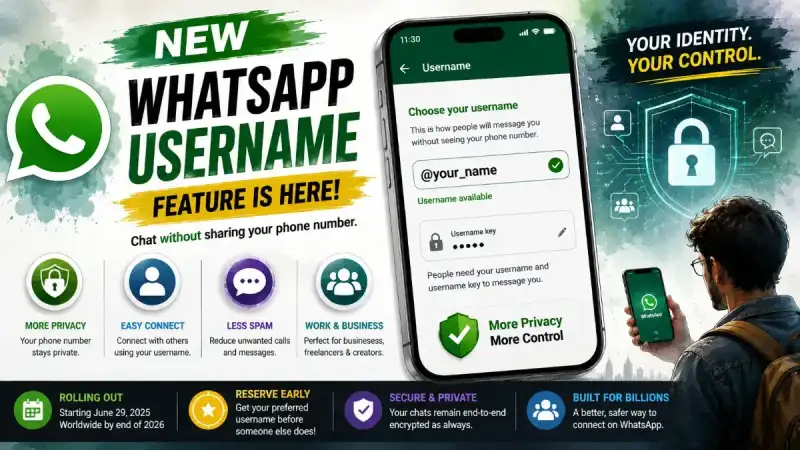
Here's what changes with this new system. You can choose a unique username. You share that username instead of your phone number. New contacts can reach you through that username. Your phone number stays hidden.
Here's what stays the same. Your account is still tied to your mobile number. Old chats, groups, contacts, and encryption don't change. Nothing about your existing conversations is affected. The username is simply a new way for people to find you.
But there's a critical distinction here. On Telegram, if someone knows your username, they can message you directly. No permission needed. It's open by default. On WhatsApp, that's not how it works.
Knowing your username doesn't automatically give someone access to your inbox. There's an additional layer of control. WhatsApp is expected to add an additional verification layer that limits unsolicited contact, although the exact implementation may evolve before the global rollout.
Who Benefits the Most from This Change?
Freelancers and small business owners are at the top of the list. If you sell on Instagram, Facebook Marketplace, or your own website, you've probably had to give your personal number to strangers. After the transaction is done, the messages often keep coming. Sometimes weeks or months later.
A username means you can separate your work identity from your personal life. Customers can reach you. Your number never leaves your hands. That's a big shift for anyone who does business online.
For women and anyone concerned about online safety, this could be a meaningful improvement. Online harassment often starts with a phone number. For many women, sharing a number with someone they've just met online feels uncomfortable. But it was often necessary for business, work, or everyday transactions.
A username allows initial conversations to happen without that first step of vulnerability. It's not a complete solution to online harassment — nothing is — but it removes one of the most common entry points. That alone makes it significant. And for billions of users, small improvements add up.
Why This Matters for Creators and Job Seekers
Content creators, YouTubers, podcasters, writers, and public figures have long struggled with this. Put your number online, and you invite spam. Don't, and you make it harder for people to reach you. A WhatsApp username solves that. It creates a public-facing identity without exposing a private phone number.
For designers, editors, writers, photographers, and digital marketers, it's a practical game-changer. Instead of giving every new client your personal number, just share your WhatsApp username. Professional contact stays clean. Personal space stays separate.
Even job seekers can benefit. Resumes often include phone numbers. Some people hesitate to post their number publicly. A WhatsApp username on a resume or LinkedIn profile offers a safer first point of contact. It's a small change that could make a real difference for career mobility.
The common thread across all these groups is control. The rollout puts control back in the hands of the user. You decide who gets your number. You decide when to share it. And you decide when to keep it private.
The 'Username Key' — WhatsApp's Privacy Twist
WhatsApp didn't stop at usernames. It added another layer: the Username Key. Here's the simplest way to understand it: having someone's username doesn't mean you can just message them. Think of it like knowing someone's address. It doesn't mean you can walk into their house.
WhatsApp is expected to add an additional verification layer that limits unsolicited contact, although the exact implementation may evolve before the global rollout. This is the fundamental difference between WhatsApp and Telegram. On Telegram, a username is public access. On WhatsApp, it's an invitation-only system wrapped in an easy-to-find identity.
The goal isn't to make WhatsApp more like a social network. The goal is to make private communication less dependent on phone numbers. This extra layer might seem like a small detail. But it's exactly what keeps WhatsApp different from every other messaging platform.
It's not trying to be open. It's trying to be safe. And for a platform with over two billion users, that distinction matters enormously. The Username Key is WhatsApp's way of saying: you can be found, but only on your terms.
Why Is This Happening Now?
The easy answer is: because everyone else already has usernames. The more honest answer is: because WhatsApp has changed. It's not just a messaging app anymore. Over the past decade, WhatsApp has quietly evolved in ways that would have seemed unlikely a decade ago.
WhatsApp Business now has over 200 million monthly users, according to Meta's latest earnings report. Payment features are live in several countries. Channels let public figures broadcast to followers. Communities bring group chats together. AI assistants are being tested.
None of these features fit neatly into the old "phone number only" model. A business owner doesn't want to give their personal number to thousands of customers. A public figure doesn't want strangers calling them directly. A freelancer doesn't want spam following them after a project ends.
The update isn't just about privacy. It's about enabling all these new use cases. It's also about keeping WhatsApp relevant. The app has grown far beyond its original purpose. Without evolving beyond phone-number-based identity, WhatsApp risked becoming less practical for the way people now use messaging apps.
How to Reserve Your Username
When the update arrives on your device, reserving your username is straightforward. First, update WhatsApp to the latest version. Then go to Settings, select Account, and you'll see a new option called Username. Enter your preferred name. WhatsApp will check if it's available.
If the name is free, you can reserve it for your account in just a few moments. But there's an important rule here: every username must be unique. Once someone takes a name, that same name cannot be used by anyone else. So if you want a specific username, timing matters.
Short, simple, and easily memorable names are likely to be taken first. According to WhatsApp's rules, a username must be between 3 and 20 characters. You can use English letters, numbers, underscores, and dots. Once a name is confirmed, you won't be able to change it frequently.
Even if you change your name, the old username will not be given to someone else for some time. So it's better to think carefully before making your first choice. This feature will not be available to everyone at once. Since WhatsApp is rolling it out in stages, some people may see it now, while others may have to wait a few weeks or months.
The Problem That Remains — Fake Accounts
Every new identity system comes with a new problem. Fake accounts. If a celebrity or major brand takes a username, can someone else take a slightly altered version? Yes, unless Meta prevents it. WhatsApp says it's building protections for high-profile names. But for the rest of us, the risk of impersonation doesn't disappear.
Suppose a prominent creator has a username. Someone else could add an underscore or a number and try to impersonate them. WhatsApp isn't fully solving this yet. They're introducing verification measures for official accounts. But the system won't catch everything.
Ultimately, users will need to check the credibility of unknown usernames. Just like they do with email addresses or social media profiles today. Another important detail: the username doesn't replace your phone number. Your account is still fundamentally tied to your number.
The username is just the public-facing layer. This means WhatsApp isn't abandoning its old system. It's adding a new one on top. The old system remains fully functional, and for people you already know, nothing changes.
Where WhatsApp Differs from Telegram (and Why It Matters)
Let's be direct about the difference. Telegram is designed for openness. If someone knows your username, they can message you. That's the point. WhatsApp is designed for privacy. Knowing someone's username doesn't guarantee access. You need permission.
This isn't a small difference. It's a fundamental design choice. Some users will complain that WhatsApp isn't making usernames as open as Telegram. But that's exactly what loyal WhatsApp users want. They don't want strangers randomly messaging them.
They want control over who can reach them. The update gives them that control. It's not about becoming Telegram. It's about staying WhatsApp — with a better way to share identity. This distinction matters because it shows that WhatsApp understands its users.
The two apps are solving different problems. Telegram prioritizes openness. WhatsApp prioritizes controlled communication. That's why they serve different audiences, and both have found their place. WhatsApp knows exactly who it's serving.
The Bigger Picture: Where WhatsApp Is Going
Here's what this update really signals. WhatsApp is separating identity from phone numbers. For 15 years, your phone number was your WhatsApp identity. Now it's not. It's still the underlying anchor for your account. But the public-facing identity is shifting toward usernames.
If this works, here's what the next few years could look like. People start putting WhatsApp usernames on their websites, business cards, and email signatures. Instead of phone numbers. WhatsApp becomes a more natural tool for professional networking. The distinction between personal and professional communication becomes clearer.
Brands, creators, and businesses build recognizable identities within WhatsApp. Meta already connects Instagram, Facebook, and WhatsApp behind the scenes. This could be a step toward a unified digital identity across all three platforms. It's not guaranteed to work. Users will need to adopt usernames.
WhatsApp will need to prevent impersonation. The security and privacy promises will need to hold up. But the direction is clear. WhatsApp is no longer just an app for people you already know. It appears to be evolving into a broader identity layer for Meta's ecosystem.
For nearly 15 years, a phone number has been the price of entry to WhatsApp. Usernames won't change that overnight. But they mark the first serious attempt to separate identity from contact information. In an era where digital privacy is becoming harder to protect, that may turn out to be WhatsApp's most important update yet.
It's not a revolution. It's not a complete privacy solution. It won't stop spam or end harassment. But it's a real improvement. And for billions of users, that's more than enough.
The question now is whether users will embrace it. Whether Meta can keep fake accounts in check. And whether this is the first step toward a larger shift in how we think about digital identity. One thing is certain: the days of sharing your phone number with every stranger you meet online may finally be numbered.
For years, a phone number was the price of entry to the world's largest messaging platform. WhatsApp is finally offering an alternative. Whether usernames become the default digital identity remains to be seen. But after 15 years, users are finally getting something they have wanted all along: the ability to decide when — and with whom — they share their number.

No Comment Yet.
Stay informed with breaking news, trending stories, and in-depth analysis.