Tech Vaidya WhatsApp Channel
Get AI updates, tech news, cybersecurity alerts and useful tech tips directly on WhatsApp.

By Nagaraj Vaidya
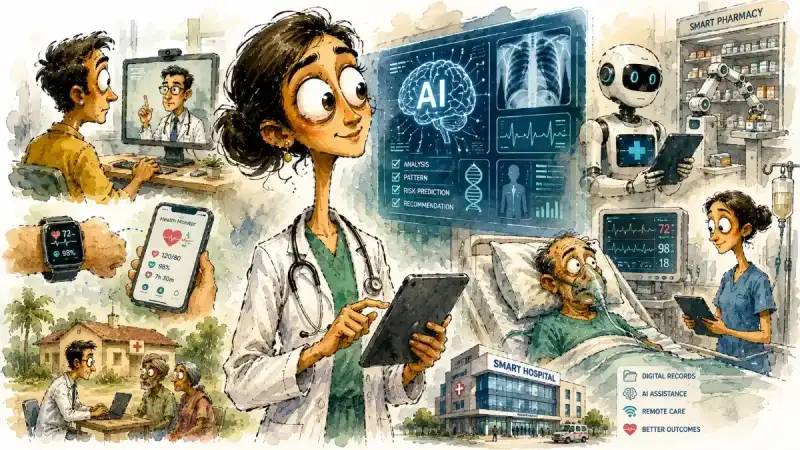
Walk into almost any hospital today, and the experience feels familiar. You register at the front desk, wait to see a doctor, undergo tests if necessary, and return later to collect your reports. It's a system that has changed very little for decades. Artificial intelligence isn't about to eliminate doctors or hospitals, but it is beginning to transform nearly every step of that journey. Over the next five years, hospitals may become smarter, faster, and more personalized than ever before—and AI will be at the center of that transformation.
Much of the public conversation around AI has focused on chatbots such as ChatGPT, Gemini, Claude, and Meta AI. Yet healthcare is quietly becoming one of the most important real-world applications of artificial intelligence. Around the world, hospitals are deploying AI to assist with medical imaging, patient monitoring, disease prediction, administrative workflows, drug discovery, and clinical decision support. Instead of replacing healthcare professionals, AI is becoming an intelligent assistant that helps doctors make faster and better-informed decisions while reducing paperwork and repetitive tasks.
The shift is already underway. Healthcare systems across the United States, Europe, and Asia are investing billions of dollars in digital health infrastructure. Electronic health records, wearable devices, connected medical equipment, and AI-powered diagnostic tools are creating a healthcare ecosystem where information moves more efficiently than ever before. Countries that successfully combine these technologies with skilled medical professionals could dramatically improve patient outcomes while reducing costs.
One of the biggest misconceptions surrounding AI is that it will eventually replace physicians. That is highly unlikely. Medicine is built on trust, empathy, communication, and clinical judgment—qualities that cannot simply be replicated by algorithms. What AI can do exceptionally well is analyze enormous amounts of medical information in seconds. It can identify patterns, compare millions of records, highlight potential risks, and surface insights that might otherwise take clinicians hours to discover. The final diagnosis and treatment decisions, however, remain firmly in the hands of trained healthcare professionals.
Hospitals Are Becoming Intelligent Systems
Modern hospitals generate an astonishing amount of information every single day. Patient histories, laboratory reports, imaging scans, prescriptions, surgical records, insurance documentation, and monitoring data all compete for physicians' attention. Managing that information efficiently has become one of healthcare's greatest challenges. AI is increasingly helping hospitals organize, prioritize, and interpret these complex data streams so doctors can spend less time searching through records and more time caring for patients.
Medical imaging represents one of AI's biggest success stories so far. AI systems can examine X-rays, CT scans, MRI images, mammograms, and retinal photographs with remarkable speed. They do not replace radiologists, but they can highlight suspicious abnormalities that deserve closer attention. By serving as an additional layer of review, AI may help reduce missed findings while accelerating diagnosis for conditions such as cancer, stroke, lung disease, and cardiovascular disorders.
 Will Robots Replace Doctors? The Hospital Revolution That's Already Changing Healthcare in 2026
 Goodbye Chemo? Scientists Built a Smart DNA Sniper That Kills Only Cancer Cells — The 2026 Breakthrough Explained
 Apple’s New Mac mini and Mac Studio Aren’t Just Faster Macs — They’re Built for the AI Agent Era
 The Robot Beat Usain Bolt’s 100-Metre Time. What Happened After the Finish Is More Important
 What Did Starship Prove on Its 13th Test Flight? A Milestone, or Just Another Step Forward?
Administrative work is another area where hospitals stand to benefit enormously. Physicians often spend hours documenting patient visits, updating medical records, processing insurance information, and completing regulatory paperwork. AI-powered documentation tools can automatically summarize conversations, generate clinical notes, organize patient records, and assist with coding. Reducing administrative burden allows healthcare professionals to focus on what matters most—the patient sitting in front of them.
AI is also improving hospital operations behind the scenes. Predictive analytics can estimate patient admissions, optimize staffing schedules, manage intensive care capacity, forecast equipment maintenance, and reduce emergency department overcrowding. Hospitals become more efficient not because machines replace people, but because routine decisions are supported by intelligent systems capable of processing vast amounts of operational data.
Your Home Could Become Part of the Hospital
Perhaps the biggest transformation won't happen inside hospitals at all. It may happen inside people's homes. Smartwatches, fitness trackers, connected blood pressure monitors, glucose sensors, and wearable ECG devices already collect continuous health information. AI can analyze these data streams in real time and detect subtle changes long before symptoms become severe enough to require hospitalization.
For patients living with diabetes, heart disease, hypertension, asthma, or chronic respiratory conditions, continuous monitoring could become the new standard of care. Instead of waiting months between appointments, physicians may receive alerts when meaningful changes occur. Early intervention often prevents serious complications, reducing both healthcare costs and hospital admissions. Preventive medicine becomes significantly more effective when AI continuously watches for warning signs.
Telemedicine will continue expanding alongside these technologies. Patients in rural communities or medically underserved regions could gain access to specialists without traveling hundreds of miles. AI-powered triage systems may evaluate symptoms before virtual appointments, helping healthcare providers prioritize urgent cases. Rather than replacing doctors, these systems ensure that medical expertise reaches more people regardless of geography.
Drug discovery is another field experiencing rapid acceleration. Developing a new medicine traditionally requires years of laboratory work and enormous financial investment. AI can rapidly evaluate millions of molecular combinations, helping researchers identify promising drug candidates much faster than conventional methods. Scientists still perform rigorous testing and clinical trials, but AI dramatically speeds up the earliest stages of pharmaceutical research.
The Challenges Are Just as Important
Despite its enormous potential, AI also raises important questions that healthcare systems cannot ignore. Patient privacy remains one of the biggest concerns. Medical information is among the most sensitive personal data anyone possesses. Hospitals adopting AI must invest heavily in cybersecurity, encryption, secure cloud infrastructure, and responsible data governance. Public trust will depend on how carefully these systems protect patient information.
Another challenge involves accountability. If an AI system recommends a diagnosis that later proves incorrect, who bears responsibility? The software developer? The hospital? The physician? Regulators around the world are still developing legal and ethical frameworks to answer these questions. AI should always function as a decision-support tool rather than an autonomous decision-maker in clinical practice.
Bias presents another important consideration. AI models learn from historical medical data. If those datasets underrepresent certain populations, the resulting algorithms may perform less accurately for specific demographic groups. Building diverse, transparent, and carefully validated medical AI systems will be essential to ensuring fair healthcare outcomes for everyone.
Healthcare professionals will also need new skills. Future physicians won't simply memorize medical knowledge—they'll learn how to interpret AI recommendations, validate algorithmic outputs, recognize potential errors, and combine technological insights with human clinical judgment. Medical education itself is likely to evolve alongside these emerging technologies.
The Next Five Years Could Redefine Healthcare
The hospitals of 2030 may look surprisingly familiar from the outside, but their internal operations could be transformed. Patient records will become smarter. Medical imaging will become faster. Chronic disease monitoring will increasingly happen at home. Administrative tasks will become more automated. Predictive analytics will help prevent medical emergencies before they occur. AI won't replace doctors, nurses, or healthcare workers—but it will reshape how they work every single day.
For patients, the biggest benefit may simply be better care delivered more quickly. Earlier diagnosis, personalized treatment plans, shorter waiting times, fewer unnecessary tests, and more proactive healthcare could become routine rather than exceptional. Hospitals may gradually evolve from places that primarily treat illness into intelligent systems focused on preventing disease before it becomes life-threatening.
Artificial intelligence should not be viewed as medicine's replacement. It should be viewed as medicine's most powerful new tool. Throughout history, healthcare has advanced whenever doctors gained better instruments—from the stethoscope to X-rays, MRI scanners, robotic surgery, and genomic sequencing. AI represents the next chapter in that evolution. The future of healthcare isn't about choosing between doctors and artificial intelligence. It's about combining the strengths of both to deliver safer, smarter, and more human-centered care.
The Biggest Healthcare Revolution May Be Invisible
When people think about medical breakthroughs, they often imagine futuristic robots performing surgeries or AI replacing physicians. The real revolution, however, is likely to be much quieter. It will happen every time a disease is detected weeks earlier than before, every time a patient avoids an unnecessary hospital visit, every time a doctor receives critical information at exactly the right moment, and every time a rural family gains access to specialist care through intelligent digital systems. Those changes may not make dramatic headlines every day, but together they could save millions of lives.
Healthcare has always evolved through better tools. The stethoscope changed medicine. Medical imaging transformed diagnosis. Electronic health records digitized hospitals. Artificial intelligence is becoming the next major milestone—not because it replaces human expertise, but because it amplifies it. Doctors will still make the final decisions. Nurses will still provide compassionate care. Patients will still need trust, empathy, and human connection. AI simply gives healthcare professionals more information, more speed, and more time to focus on what matters most.
The countries that invest wisely in digital health infrastructure today are likely to lead tomorrow's healthcare economy. AI-powered hospitals, connected medical devices, predictive diagnostics, and personalized treatment will gradually become the new standard rather than the exception. For healthcare providers, this means higher efficiency. For governments, it means better public health outcomes. And for patients, it could mean something even more valuable—earlier treatment, lower costs, and longer, healthier lives.
The question is no longer whether artificial intelligence will become part of modern healthcare. That future has already begun. The real question is how quickly hospitals, governments, physicians, and technology companies can work together to ensure AI remains ethical, secure, transparent, and centered on patient care. If that balance is achieved, the next generation may not remember AI as the technology that tried to replace doctors. They may remember it as the technology that helped doctors save more lives than ever before.

No Comment Yet.
Stay informed with breaking news, trending stories, and in-depth analysis.
