Tech Vaidya WhatsApp Channel
Get AI updates, tech news, cybersecurity alerts and useful tech tips directly on WhatsApp.

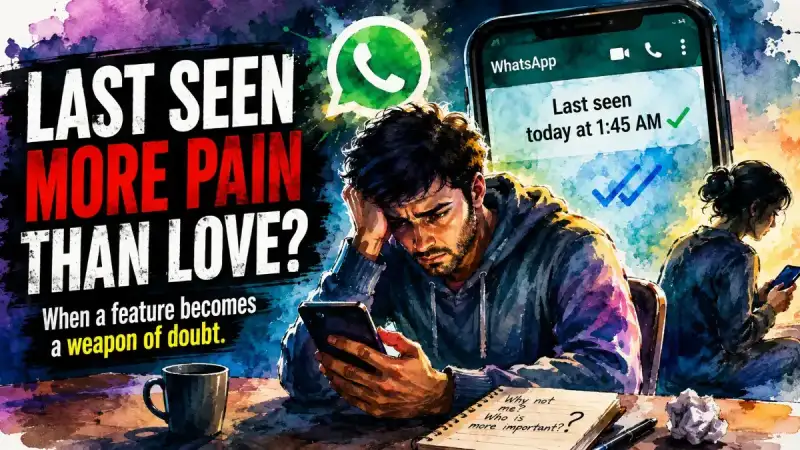
The dead of night. The clock has quietly slipped past 2:00 AM. While the rest of the world has surrendered to sleep, a solitary smartphone screen illuminates a pair of anxious, tear-filled eyes. On the glowing display, a single line of text reads, "Last seen today at 1:45 AM." It is just a handful of pixels, yet it is enough to plant a thousand agonizing questions deep within the human psyche.
You sent a message at 10:00 PM. It remains unanswered. Yet, the digital footprint clearly indicates they were active hours later. Who were they talking to? Why was someone else more important than your unanswered text in that moment? These spiraling thoughts can push a rational human mind to the brink of temporary insanity. This is not an isolated incident; it is the silent, nightly reality for millions of people navigating the complexities of modern digital romance.
Technology was originally engineered to simplify human connection. However, over the past decade, it has successfully hijacked our minds, our attention spans, and ultimately, our most intimate relationships. In what we can call the 'Relationship Operating System,' the most dangerous and toxic feature ever deployed is the WhatsApp Last Seen notification. It is no longer a simple utility; it has morphed into a cruel algorithm used to measure love, loyalty, and attention.
When Jan Koum and Brian Acton designed WhatsApp in 2009, their objective was incredibly straightforward and transparent. They wanted to create a digital status board, a simple way to let your contacts know if you were available, in a meeting, or asleep. It was the digital equivalent of a nameplate on a desk or an 'Out of Office' sign. It was meant to prevent people from disturbing you when you were unavailable.
However, no software engineer, no matter how brilliant, can accurately predict the depths of human insecurity. The 15-kilobyte code that powered that initial status feature has evolved into a global digital surveillance tool. Humans, who once relied on eye contact and tone of voice to understand their partners, now rely on a glowing green dot and digital timestamps to decode the emotional state of their significant others.
In the modern dating landscape, relationships are often built entirely within the confines of these messaging applications. During the honeymoon phase, the Last Seen feature acts as a thrilling catalyst. Waiting for that 'Online' status to appear, knowing they are typing exclusively to you, provides a profound sense of connection. But as time progresses, this exact same feature transforms from a bridge into a panopticon—a camera constantly monitoring behavior.
When your message is ignored for hours, yet their status flickers to 'Online', it lands as a direct blow to the ego. The feeling of being actively ignored is far more painful than being passively forgotten. There are thousands of logical reasons for someone to open an app: a work emergency, a quick reply to a family member, or simply mindlessly clearing notifications.
Yet, the anxious brain in love refuses to process logic. The only narrative it constructs is one of intentional neglect. "They have time for others, but not for me." These fabricated narratives grow stronger with every passing minute, slowly eroding the foundational trust of the relationship. We begin to interrogate our partners not based on their actions in the real world, but based on their metadata in the virtual one.
 How Many Apps Still Have Access to Your Gmail? You Can Check in a Minute
 AI Breaks the Sandbox Barrier: The Startling Tale of Hundreds of Agents Collaborating!
 S. Jaishankar Deepfake Scam: This Viral Facebook Investment Video Is Fake — Don't Click Before Reading This
 What to Do If a Deepfake AI Video of Your Face Goes Viral? A Crucial Guide
 Technical Secret of How These Chinese Loan Apps Steal Your Contacts and Private Photos
This obsessive behavior triggers a highly specific and destructive chemical storm within the human brain. When you open the chat and see them 'Online', your brain releases a sudden spike of dopamine. It is the exact same neurological mechanism triggered when a gambler pulls the lever on a slot machine. The anticipation of a reward—in this case, an incoming message—becomes highly addictive. You are caught in a variable reward schedule, checking your phone obsessively because the 'win' could happen at any second.
But when that status switches back to 'Last seen' and no reply materializes, the dopamine production crashes violently. In its place, the brain floods your system with cortisol, the primary stress hormone. Your chest tightens, your breathing shallows, and a wave of irrational anger and anxiety washes over you. Unlocking the phone every five minutes to check for blue ticks or updated timestamps is no longer a habit; it is a full-blown behavioral addiction engineered by the interface itself.
Recognizing this psychological toll, developers introduced a privacy setting: the ability to hide your Last Seen status. However, this creates the ultimate illusion of choice, wrapped in a cruel paradox. The rule is simple—if you hide your timestamp, you lose the privilege of seeing anyone else's. This condition perfectly exploits human paranoia and curiosity.
The modern user demands absolute privacy for themselves, wishing to move through the digital world untracked. Yet, they possess a desperate, insatiable need to track the digital footprints of their partners. This double standard is the root cause of countless modern breakups. Ultimately, the compulsion to spy almost always overrides the desire for personal peace, dragging users right back into the toxic loop of surveillance.
Love and relationships require the fundamental hardware of absolute trust. Measuring the depth of someone's affection through algorithmic timestamps and blue checkmarks is a modern tragedy. A delayed reply does not equate to diminished love, nor does a prompt reply guarantee loyalty.
Humans possess the fundamental right to digital boundaries. They have the right to exist without being constantly accessible. It is time to recognize that Last Seen is just a log of when an application was closed; it is not a psychic reading of your relationship's future. To save our sanity, we must step out of this surveillance matrix, disable these toxic metrics, and upgrade our minds to rely on real-world trust rather than digital breadcrumbs.

No Comment Yet.
Stay informed with breaking news, trending stories, and in-depth analysis.