Tech Vaidya WhatsApp Channel
Get AI updates, tech news, cybersecurity alerts and useful tech tips directly on WhatsApp.

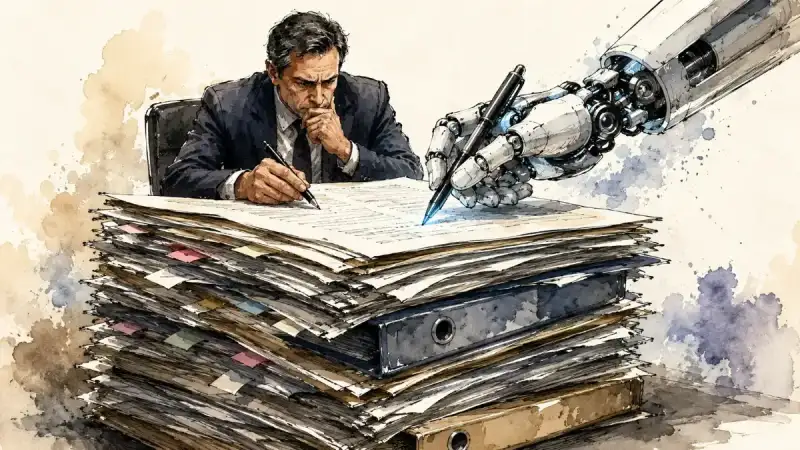
Before any new policy is implemented in government offices or universities, preparing a comprehensive, hundreds-of-pages-long report has always been the standard administrative protocol globally. Traditionally, these reports are drafted by expert committees who spend months researching, compiling data, and analyzing real-world implications to prepare a final draft. However, a recent incident in the state of Connecticut has called the credibility of this entire global administrative system into question. It serves as a glaring example of how the unchecked use of artificial intelligence can compromise the sanctity of official government documents.
Former Chancellor Terrence Cheng recently submitted a staggering 2,007-page report for the Connecticut State Colleges and Universities (CSCU) system. The report covered highly sensitive and critical subjects, including strengthening higher education, providing financial aid to students, and developing workforce skills programs. However, when Cheng admitted to utilizing artificial intelligence tools to help draft this massive document in a short time frame, it triggered a political and academic firestorm across the state. The focus of the debate immediately shifted from the actual policies inside the report to the machine that helped create it.
### The Political Tug-of-War: Support vs. Skepticism
As the controversy erupted, the Connecticut political machinery split into two distinct camps. Governor Ned Lamont strongly defended the use of AI. He argued that the report wasn't just machine-generated jargon; it contained Cheng’s personal experiences and comparative studies of successful models from other states. The Governor questioned what was wrong with using AI to gather information or polish language, pointing out that utilizing AI to streamline workloads is becoming the modern norm. On the surface, this defense seems pragmatic and forward-looking.
However, State Senator Jeff Gordon’s objection is entirely different and fundamentally logical. He thundered that it is the government's duty to be transparent about exactly how much of the 2,007-page report was generated by AI versus how much was written by a human. The question of how much the authors worked themselves versus how much they outsourced to algorithms has crossed the boundaries of administrative ethics. As the heat of this controversy rises, Terrence Cheng’s role as a special advisor is now slated to end this June.
Quantity Over Quality: The Productivity Illusion
This Connecticut incident cannot be brushed off as a mere local political spat. It raises a massive technological and ethical question that will soon haunt administrative systems worldwide: What happens when we over-rely on AI for report generation? This is the core of the analysis. For artificial intelligence, writing a 200-page report is no different than writing a 2,000-page one. It feels no fatigue. Give it a prompt, and within minutes, it will dump thousands of words onto your screen.
But an increase in page count does not equate to an increase in quality. No matter how smart AI language models seem, they are fundamentally predictive text engines. They determine which word should logically follow the next based on mathematical probabilities. If you hand over the responsibility of drafting a state's education policy to such a machine, it will scrape general information from the internet and deliver a beautifully articulated, lengthy essay. But will it possess original thought, an understanding of local ground realities, and genuine solutions to real-world problems? That remains a massive, unsettling doubt.
AI Hallucinations and the Catastrophe of Fake Data
A government policy or an academic report is not just an arrangement of alphabetical characters. It requires a deep understanding of the geographical, economic, and social realities of a specific region. AI models lack this human touch. This leads to what the tech industry calls "hallucinations." There is a very real danger of AI confidently presenting fabricated information as absolute truth.
A prime example of this occurred in the United States in 2023. Two lawyers found themselves in deep trouble after submitting a legal brief filled with fake case citations and rulings generated by ChatGPT. They trusted the AI implicitly, only to be humiliated in court and sanctioned when it was proven the cases didn't exist. This is exactly why global experts repeatedly warn against using AI in official, legally binding, or policy-making documents without rigorous human verification. Finding such hallucinations buried inside a 2,007-page government report is practically impossible for a human reviewer.
Machines Writing for Machines: The Absurdity of Modern Bureaucracy
The grand irony behind this 2,000-page report is the question of who will actually read it. In modern administration, no official or politician has the patience or the time to sit down and read 2,000 pages. It is highly likely that in the near future, the standard procedure will be to upload these massive reports into another AI tool with the command: *"Summarize this into 10 pages."*
This means a human official orders an AI to generate a massive report, only for another human to use a second AI to read it and extract a summary. The humans in the middle are reduced to mere clerks passing data between machines. In this cycle of machines writing for machines to read, human existence and the very purpose of administration fade away. Government files are not meant to be paperweights; they are compasses for utilizing taxpayer money. If bureaucrats start using AI to endlessly inflate documents just to impress their superiors and feign productivity, the administrative system will devolve into a factory of synthetic sentences.
The Ultimate Crisis: Transparency and Accountability
Today, AI is being used as a supportive tool across journalism, research, law, and software development worldwide. Using AI is certainly not a crime. But when thousands of pages of official government or academic reports are prepared with the help of AI, transparency and accountability become mandatory. If an AI was merely used to gather initial data, draft outlines, or fix grammar, it is a hallmark of ethical integrity to explicitly state this at the very beginning of the document.
The biggest question raised by the Connecticut case is one of accountability. If the recommendations in the report fail, or if AI-generated false information leads to a disastrous policy decision, who takes the fall? Is it the official who signed the report, or OpenAI? In the eyes of the law, you cannot send a machine to jail. The ultimate responsibility for the accuracy of information must rest on human shoulders. AI should be a co-pilot, never the autopilot of public administration.
The Wake-Up Call for Global Administration
The incident in America is a massive warning bell for administrative systems across the globe. Bureaucracies thrive on the continuous movement of files and the submission of committee reports. The danger of officials blindly relying on AI tools to lessen their workload is imminent. If a 100-page file is inflated to 1,000 pages using AI and placed before lawmakers, the credibility of the entire policy-making apparatus collapses. The time to establish strict, standardized guidelines for the use of AI in official and government documents has arrived.
Ultimately, artificial intelligence is an excellent tool designed to enhance efficiency, but it is not a substitute for human judgment. Simply using AI is no longer the issue; the era of transparently disclosing *how* and *how much* you used it has begun. Only those who keep technology under their strict control while governing can bring about real change in the future. Those who surrender their original thinking to machines, relying on them without transparency, are bound to lose the trust of the very system they serve.

No Comment Yet.
Stay informed with breaking news, trending stories, and in-depth analysis.