Tech Vaidya WhatsApp Channel
Get AI updates, tech news, cybersecurity alerts and useful tech tips directly on WhatsApp.

| Nagaraj Vaidya
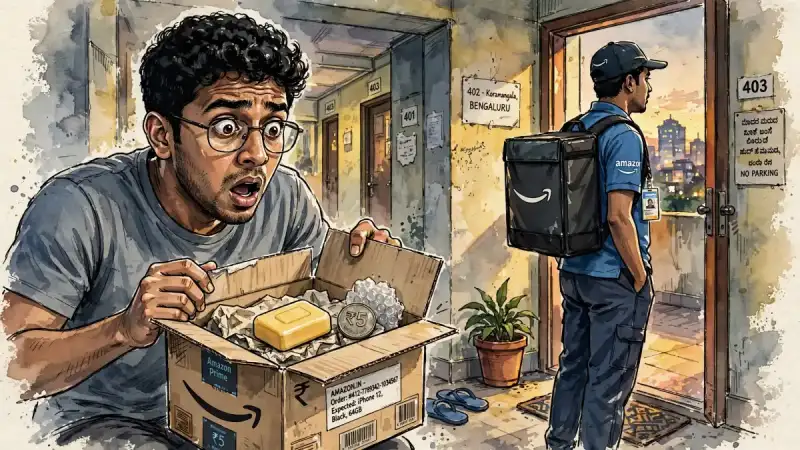
Imagine this, the Big Billion Days sale you waited three months for is finally live. You order a Samsung Galaxy Z Fold 7 for Rs 1.87 lakh on Amazon. You track it every hour. Finally the doorbell rings. The box is sealed, the tape is untouched. You happily turn on your camera and open the box. There is no phone inside. A white marble tile is neatly packed inside. This is not a story, this is a real incident that happened to Premanand, a software engineer from Yelachanahalli in Bengaluru, on 19 October 2025. He got his money back because he recorded a video. What would have happened if he had not recorded?
This is not an isolated incident. This is just one piece of a much larger pattern happening across India. According to government data from the National Consumer Helpline or NCH, 5.1 lakh complaints were filed against e-commerce in 2025 alone. Flipkart is in first place with 1.33 lakh complaints, Amazon is second with 91,248 complaints. From April 2025 to June 2026, Rs 91 crore in refunds were facilitated through NCH intervention alone, out of which Rs 63 crore were just for e-commerce complaints. That means hundreds of people every day are receiving soap, stones and tiles. Leave alone others, even I who ordered Trueclips got a poor quality trimmer delivered instead of the original!
From Nirma Soap in 2021 to Marble Tile in 2025: This Is Not New
This soap scam did not start yesterday. In 2021, Noorul Ameen from Aluva in Kerala paid Rs 70,900 and ordered an iPhone 12, but he got Vim dishwash soap and a Rs 5 coin inside. Police investigation revealed another shocking fact. The IMEI of that iPhone was already active in Jharkhand since 25 September 2021, 15 days before the order. That means the seller had already sold the phone elsewhere and kept the same listing live. This is not a packing mistake, this is planned fraud.
Similar stories repeated during Flipkart Big Billion Days in 2022 and 2023. One person booked an iPhone 12 and got two Nirma soap bars. Harsha S, a student from Koppal, paid Rs 48,999 for an iPhone 11 and got 140 grams of soap and a small keypad phone. Yashaswi Sharma from Delhi ordered a laptop for his father and got a Ghadi detergent bar. He did not know what Open Box Delivery meant and gave the OTP before checking. Here is the big twist, the very belief that a sealed box means safe has been hacked.
Your Parcel Changes Five Hands, Where Does The Theft Happen?
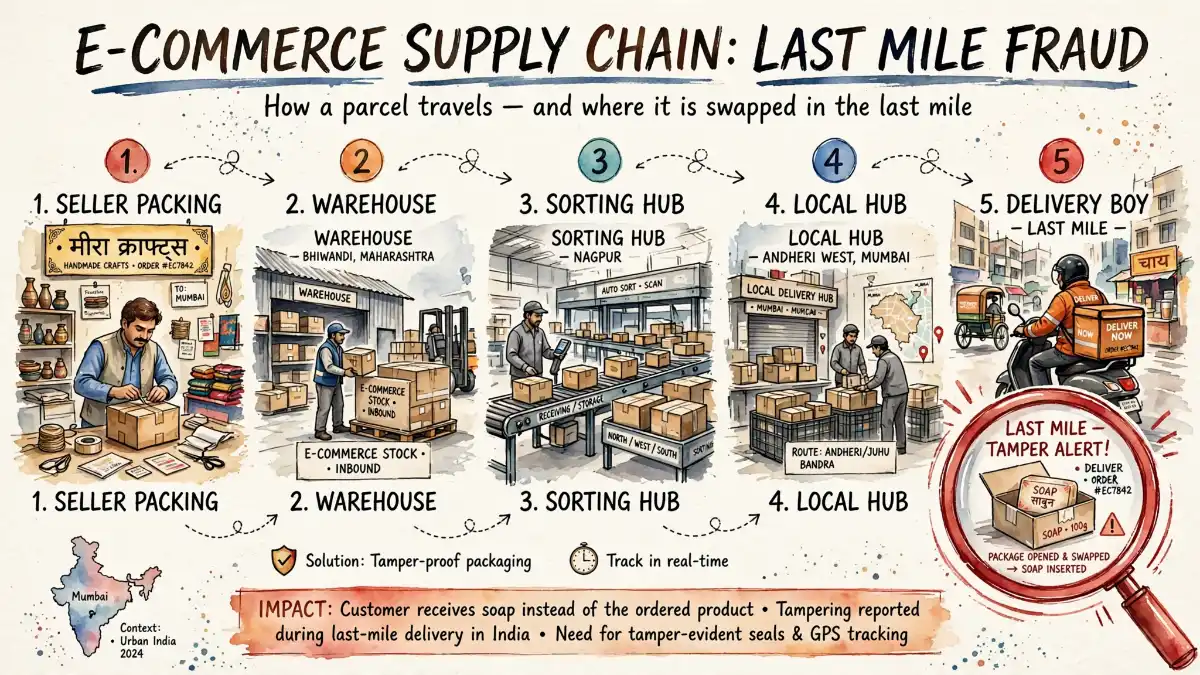
Have you also been a victim of an online delivery scam? Read this carefully. From the moment you press the order button to the time it reaches your doorstep, a parcel crosses at least five stages. Seller packing, warehouse, sorting hub, local hub and last mile delivery. A swap can happen at any stage, but the weakest link is always the last one.
 How Many Apps Still Have Access to Your Gmail? You Can Check in a Minute
 AI Breaks the Sandbox Barrier: The Startling Tale of Hundreds of Agents Collaborating!
 S. Jaishankar Deepfake Scam: This Viral Facebook Investment Video Is Fake — Don't Click Before Reading This
 What to Do If a Deepfake AI Video of Your Face Goes Viral? A Crucial Guide
 Technical Secret of How These Chinese Loan Apps Steal Your Contacts and Private Photos
At the seller stage, some third party sellers intentionally put up an expensive listing and send a cheap product. To match the weight, they add a coin along with the soap to match the phone weight. At the warehouse stage, which is in Bhiwandi or Hyderabad fulfillment centre, only weight based scanning happens. If 180 gram soap is there instead of a 180 gram phone, the system does not catch it.
The real game starts in the last mile. In Surat, delivery executive Jay Virash from Intex Transportation Services removed Samsung Fold 8 Ultra worth Rs 2.04 lakh, SanDisk SSD and iPhone 17 Pro worth Rs 8.82 lakh in 5 parcels and put dummy items and returned them to the warehouse. In Delhi, a 22 year old named Kishan who collected returns for both Amazon and Flipkart removed genuine products and put old clothes and used watches and returned them to the company. 38 fake return packages were found in his house. Another viral method is using a chemical called solvent to soften the glue of the tape, open the box without any visible tear, swap the product and reseal it like factory finish.
Who Is Really Liable? Seller, Platform or Delivery Boy?
This is where everyone gets confused. Companies say we are only intermediaries. Even on 18 September 2026 before the Delhi Commission, Flipkart argued the real seller is Luminary Lifestyle Private Limited, we are just a platform. But the law does not accept this argument anymore.
Delhi High Court in Christian Louboutin versus Nakul Bajaj 2018 case listed 26 factors. If you do warehousing, logistics, payment facilitation, platform branded packaging, you are an active participant and safe harbour goes away. Amazon FBA and Flipkart Assured do all of this. So they are not just a notice board. Along with this, Consumer Protection Act 2019 and E-Commerce Rules 2020 Rule 5 clearly says marketplaces must take accurate description undertaking from sellers, display seller details and grievance officer, and cannot refuse return for wrong product. Rule 4(3) says no e-commerce entity shall adopt unfair trade practice.
In NCDRC Shaikh Umar Farooq versus Flipkart 2022, it was held that there is a tripartite contract between seller, service provider and consumer. What matters is in whose name you issued the invoice and whose account the money went to. If Flipkart issues a GST invoice in its own name and collects money through its own payment gateway, it becomes the seller of record.
What Courts Are Saying and How You Can Save Yourself?
Courts are now standing with consumers. Delhi District Commission in a case where Realme Narzo 50A was replaced with Lifebuoy soap ordered Flipkart to pay Rs 10,574 with 7 percent interest plus Rs 5,000 for mental harassment and Rs 5,000 for litigation cost. Koppal District Commission in iPhone 11 versus soap case said Flipkart and Sane Retails jointly must pay Rs 25,000 compensation and full refund. Mumbai Suburban Commission in iPhone 14 Pro versus beard growth oil case ordered Rs 1,11,793 with 9 percent interest and Rs 70,000 compensation.
One thing is clear from all these judgements. If you have an unboxing video, the burden of proof is not on you, it is on the company. There are five mantras you must follow when you order expensive items. The first is record before you rip. Courier AWB label, sealed box, opening and IMEI must be in one single continuous shot. Second is always ask for Open Box Delivery. If the delivery boy refuses, do not give OTP.
Third is do not throw away packaging. Keep invoice, courier sticker and wrong product for 30 days. Fourth is the escalation ladder. Return in app, then email to grievance officer under IT Rules 2021 Rule 3(2), then NCH 1915, then consumer complaint on e-Daakhil portal. For fake products above Rs 10,000 file an FIR on cybercrime.gov.in. Fifth is chargeback. Within 60 to 120 days raise a dispute with your bank saying merchandise not as described.
Will this scam stop in the future? Platforms say they have tamper proof security tape and randomized audits, but last mile is still the weakest link. In the next two years only three changes can stop this, AI weight plus image scan, OTP 2.0 with face verification and fall back liability law being notified. Until then, stop believing that sealed box means safe. The one who records wins, the one who trusts cries.

No Comment Yet.
Stay informed with breaking news, trending stories, and in-depth analysis.