Tech Vaidya WhatsApp Channel
Get AI updates, tech news, cybersecurity alerts and useful tech tips directly on WhatsApp.

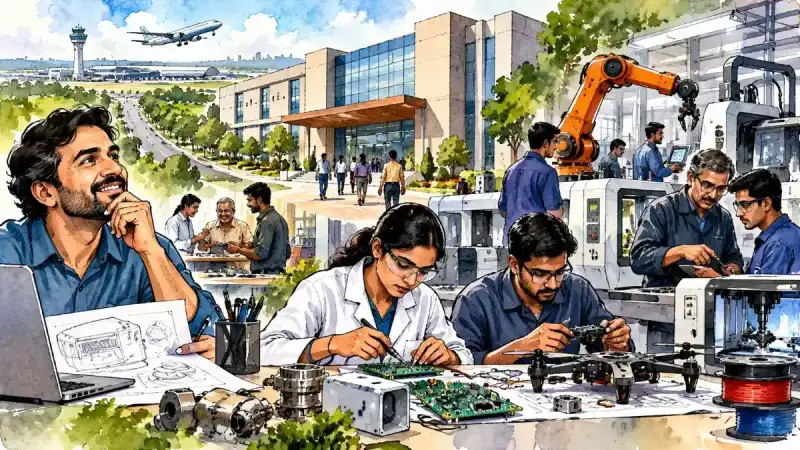
Imagine a small company developing a new electronic device. The idea is ready, the engineers are in place, and the design looks promising. But turning that design into a working product requires specialised machines, testing facilities, prototyping equipment and technical expertise that the company simply cannot afford on its own. For a large corporation, these may already exist inside its own facilities. For a small business, however, the cost of accessing such infrastructure can be enough to stop a promising product before it ever reaches the market. That is why a new ₹156 crore MSME Technology Centre in Devanahalli, on the northern edge of Bengaluru, deserves attention.
The centre was inaugurated on September 10 and has been developed with an investment of ₹156 crore on 10 acres of land provided by the Karnataka government. Built under the Union Ministry of Micro, Small and Medium Enterprises, the facility is focused on Electronics System Design and Manufacturing, or ESDM, along with advanced manufacturing and technical training. It brings together production infrastructure, prototyping capabilities, testing facilities, training and technical support under one roof. The centre is also designed to train around 10,000 people every year. Its significance, therefore, lies not merely in the size of the building or the amount invested, but in the kind of industrial capability it could make accessible to smaller companies.
The distinction matters because India's technology ambitions are changing. Bengaluru built much of its global reputation around software, IT services and digital startups. But the next phase of technology is increasingly tied to semiconductors, electronics, robotics, aerospace, industrial automation, drones and the hardware required to power artificial intelligence. In these sectors, writing software is only one part of the journey. Someone still has to design the circuit, build the prototype, test it, manufacture the components and eventually turn the idea into something that can be produced at scale. The new centre is aimed at strengthening precisely that part of the ecosystem.
This is where the technology centre could become important for smaller businesses. A startup may have the expertise to design a product but not the capital to purchase expensive CNC machines, electronics manufacturing equipment or additive manufacturing systems. It may need a particular machine only for a few days during the prototyping stage, making it commercially impractical to own one. Access to shared infrastructure can change that equation. Instead of spending heavily before a product has even proved itself, a company can potentially use specialised facilities when they are actually needed.
Bridging the Gap Between an Idea and a Product
The hardest part of building a hardware product is often not the idea itself. It is the journey between the first design and a reliable physical product. A circuit may work on paper but fail when assembled. A casing may look right on a computer screen but prove unsuitable when manufactured. A prototype may function perfectly in a laboratory and then fail under real-world conditions. Each problem requires another round of design, manufacturing and testing, and every round costs time and money.
That cycle is particularly difficult for small companies. Software can often be modified, tested and deployed with relatively little physical infrastructure. Hardware is less forgiving. A design change may require a new circuit board, a new mechanical component, a new prototype and another round of testing. When specialised equipment is difficult or expensive to access, companies may simply decide not to experiment further. A shared technology centre can reduce that barrier by making advanced manufacturing and prototyping capabilities available without requiring every company to build its own facility.
The Devanahalli centre includes facilities such as surface-mount technology infrastructure, additive manufacturing systems, three- and five-axis CNC machines and electrical discharge machining capabilities. It is also intended to provide testing, design support and technical and business consultancy. For a small electronics or engineering company, that combination can be more valuable than any single machine. The ability to move from design to prototype and from prototype to testing within the same ecosystem can shorten development cycles. More importantly, it can make experimentation less intimidating for companies that cannot afford to make large upfront investments.
 Karnataka's Big AI Push: Data Centre Policy Nears Completion, AI University and Green Data Centres Gain Momentum
 Digital Freedom Gets a Shield with New Karnataka Police Guidelines
 The Boss-less Office: Who Truly Rules Bengaluru’s 2 Lakh Delivery Partners?
 A Few Words with Readers at the Launch of Tech Vaidya
 Anthropic Appoints Irina Ghose as India MD; Bengaluru Office to Open Early 2026
Consider a small startup developing a sensor for industrial machinery. Designing the electronics may be relatively straightforward, but the company still has to build the board, create the enclosure, manufacture the first physical units, test them and identify weaknesses. If the sensor fails under certain conditions, the design has to be modified and another prototype produced. The faster and more affordably a company can repeat that process, the greater its chances of reaching a viable product. In hardware, the distance between “we have an idea” and “we have something customers can buy” is often where the biggest obstacles appear.
A Different Kind of Bengaluru Technology Story
The location of the centre is also significant. Devanahalli is no longer simply the area associated with Bengaluru's international airport. Northern Bengaluru has been developing a broader industrial ecosystem involving aerospace, manufacturing, electronics, logistics and technology infrastructure. The presence of advanced manufacturing facilities in this region could strengthen the connection between technology companies and industrial supply chains. That matters because Bengaluru's next technology story may not be defined only by software companies and office campuses. It could increasingly involve companies that design, build and test physical technology.
The centre's focus also fits into a broader shift taking place across Bengaluru's technology ecosystem. The city is seeing growing interest in deep tech, semiconductor design, aerospace, robotics, electronics and other areas where software and physical engineering increasingly overlap. Artificial intelligence itself is an example of this convergence. AI needs software, but it also depends on chips, servers, networking equipment, cooling systems and increasingly sophisticated hardware infrastructure. The same is true of robotics, drones and industrial automation. A city that wants to remain competitive in these fields needs more than talented programmers; it needs the ability to turn engineering ideas into physical products.
That is where MSMEs can become particularly important. Large corporations have the financial capacity to build dedicated research, development and manufacturing facilities. Smaller companies often cannot. Yet many innovations begin with precisely these smaller firms, startups, engineering teams and individual entrepreneurs. If they can access advanced infrastructure without carrying the full cost of owning it, the number of ideas that reach the prototype stage could increase. Over time, some of those prototypes may become products, suppliers, startups or new industrial capabilities.
The centre's training capacity adds another dimension to the story. It is expected to support around 10,000 trainees each year, with programmes covering areas such as embedded systems, PCB design and assembly, automation, robotics, maintenance and related technical skills. India's manufacturing ambitions will require not only machines but people capable of operating, maintaining and innovating around them. A modern manufacturing ecosystem cannot grow if its infrastructure expands faster than its skilled workforce. If the centre succeeds in connecting training with actual industrial demand, its impact could extend well beyond the companies that directly use its facilities.
What Does It Actually Mean for a Small Business?
For an MSME, the biggest advantage may ultimately be flexibility. Buying specialised machinery is a major capital decision, particularly when a company is still uncertain whether its product will succeed. Shared access changes the economics of experimentation. A business can potentially test an idea, produce a limited number of prototypes, identify problems and improve the design before committing to large-scale investment. That can make innovation less dependent on the size of a company's balance sheet.
The same principle applies to hardware startups. A young company working on industrial electronics, robotics or aerospace components may have strong engineering talent but limited manufacturing capacity. If it can use a professional facility during the early stages, it may be able to progress further before seeking larger investments or entering a commercial manufacturing partnership. Universities and research teams could also benefit if their ideas can move more easily from laboratory concepts to physical prototypes. The result could be a stronger connection between research, entrepreneurship and manufacturing.
But there is an important caveat. Building a technology centre does not automatically create a successful industrial ecosystem. A company still needs capital, customers, suppliers, certification, skilled employees and access to markets. The centre cannot solve all of those problems. Its role is more specific: reduce some of the infrastructure and technical barriers that stand between an idea and a manufacturable product. How effectively it performs that role will determine whether the ₹156 crore investment becomes a productive industrial asset or simply another large piece of public infrastructure.
Accessibility will therefore matter as much as technology. Small businesses need to know what facilities are available, how they can access them, what the costs are, how bookings work and what kind of technical support they can receive. The existence of advanced equipment means little if smaller firms find the system difficult to navigate or too expensive to use. The centre's long-term success will depend not just on how sophisticated its machines are, but on how widely and effectively those machines are used. Technology infrastructure creates value only when businesses can actually turn it into economic activity.
The Real Test Begins After the Inauguration
The most meaningful way to measure the centre will not be the number of people who attended its inauguration or the value of the machinery inside it. The real indicators will emerge over the next few years. How many MSMEs use the facilities? How many prototypes are developed? How many of those prototypes become commercial products? How many trainees move into skilled technical jobs, and how many new companies emerge from the ecosystem? Those numbers will tell us far more about the project's success than the ₹156 crore investment figure ever can.
There is also a larger question for Bengaluru. For decades, the city's competitive advantage was built around software talent and global IT services. That advantage remains important, but the global technology economy is becoming increasingly physical. Chips, sensors, robots, satellites, industrial systems and AI infrastructure all require engineering and manufacturing capabilities alongside software. If Bengaluru can combine its software talent with stronger hardware and manufacturing infrastructure, it could build a more diversified technology economy. Devanahalli's new centre is one small part of that much larger transition.
The transition will not happen overnight. One technology centre cannot turn Bengaluru into a global manufacturing hub by itself, just as one startup cannot transform an industry. But ecosystems are rarely built through a single dramatic development. They emerge when infrastructure, talent, capital, research, companies and supply chains gradually begin reinforcing one another. A shared manufacturing and prototyping facility can become valuable precisely because it creates another connection between those parts of the ecosystem. Its importance may therefore become visible only years after the inauguration.
Ultimately, the biggest opportunity offered by the Devanahalli centre is not the machinery itself. It is the possibility of making advanced technology more accessible to companies that previously could not afford to experiment with it. A small engineering firm should not have to think like a multinational corporation before it can build its first prototype. A young entrepreneur should be able to test an idea before spending a fortune on infrastructure. And a promising piece of research should have a realistic path from a laboratory bench to a physical product.
That is the real promise behind the ₹156 crore investment. If the centre becomes a place where engineers build their first prototypes, MSMEs test new products, startups develop hardware and young workers acquire practical technical skills, its impact will extend far beyond Devanahalli. Bengaluru's next technology story may not be about writing more software alone. It may also be about building the chips, machines, sensors, robots and devices that the next generation of technology will depend on. The building is now ready; the real question is what India will build inside it.

No Comment Yet.
Stay informed with breaking news, trending stories, and in-depth analysis.