Tech Vaidya WhatsApp Channel
Get AI updates, tech news, cybersecurity alerts and useful tech tips directly on WhatsApp.

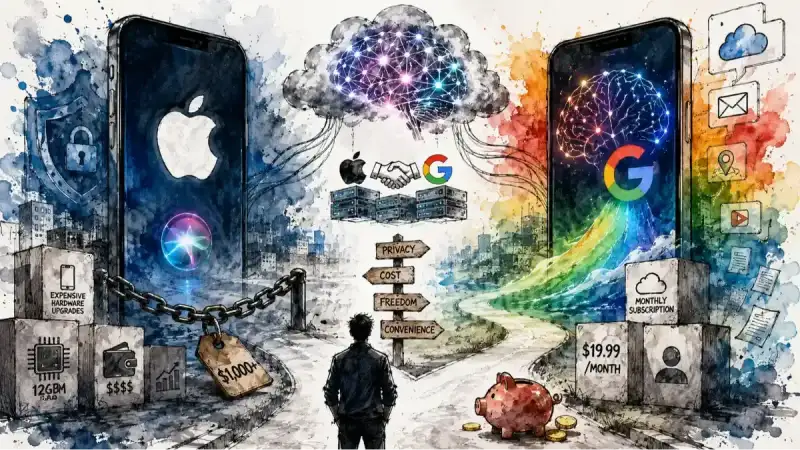
Apple spent years telling you its AI would run entirely on your device, keeping your data private and secure. Then at WWDC 2026, the tech giant quietly admitted that was no longer the reality. The new Siri AI, the centerpiece of Apple Intelligence, runs directly on Google's Gemini models, costing Apple an estimated $1 billion annually.
That is the headline capturing the tech industry's attention this quarter. But the real story is not the partnership itself; it is what this massive deal reveals about the hidden costs of choosing Apple over Google. Most buyers are looking at flashy interface features and completely ignoring the long-term structural tradeoffs.
That is a highly critical mistake for anyone buying a smartphone this year. You are no longer just choosing a hardware ecosystem or an operating system. You are signing up for a complex web of recurring financial commitments, forced device upgrade taxes, and quiet digital privacy compromises.

The $1 Billion Secret Behind Siri's New Brain
Apple's recent developer conference exposed a company scrambling to catch up in the aggressive generative AI race. Tim Cook, in his final major roadmap presentation as CEO, announced a complete overhaul of Siri, including contextual understanding and cross-app actions. The live demos looked smooth, but the core reasoning capability actually comes from Google's architecture.
The Apple Foundation Models infrastructure shows that lightweight tasks run locally on the device's chip. However, complex professional reasoning gets immediately routed to AFM Cloud Pro servers. This cloud tier runs on Google Cloud's NVIDIA GPUs, utilizing Google's Gemini models as the core foundation for deep semantic processing.
Apple insists your data stays encrypted and inaccessible to Google under their "Private Cloud Compute" framework. Yet, the psychological contract with the consumer has fundamentally shifted. Your iPhone now sends personal queries, email drafts, and photo metadata to a cloud infrastructure co-designed by its primary market competitor.
This matters because Apple built its entire trillion-dollar premium brand around strict, uncompromising user privacy. The company's historic marketing promised that what happens on your device stays on your device. That core foundational promise is no longer operationally true in the era of advanced cloud-based language models.
 Oracle’s AI Ambition Comes at a Human Cost: 7,000–10,000 Tech Jobs at Risk?
 NSE IPO Opens September 17: Share Price Set at ₹1,700–₹1,785 — Should Investors Apply?
 iOS 27 Update: What’s New, Which iPhones Are Supported, and Who Gets Siri AI?
 ₹156 Crore Technology Centre in Devanahalli: What It Could Mean for Small Businesses
 Terrier Cyber Quest 2026: Indian Army Opens a New Front in the Cybersecurity Battle
The financial reality of this infrastructure is incredibly staggering for the company's balance sheet. Apple is spending roughly $1 billion per year just to rent Google’s vast computing power. That massive operational expense will inevitably get passed down to the global consumer base through subtle channels.
The Regressive Hardware Upgrade Tax
Here is another hidden cost most global buyers completely miss: Apple Intelligence simply does not work on older hardware. Full AI features require a brand-new iPhone Air, iPhone 17 Pro, or iPhone 17 Pro Max. Your hardware must also be equipped with at least 12GB of RAM to process basic localized tokens.
Millions of loyal iPhone 15 and iPhone 16 users are now completely locked out of the premium Siri experience. Apple is intentionally using software intelligence to force a massive hardware upgrade cycle. Analysts call this a regressive hardware tax, requiring consumers to drop $1,000 USD just to access standard software updates.
If you refuse to pay this steep hardware tax, you are left with a severely degraded user experience. You get the same basic, rigid voice assistant that has frustrated consumers for over a decade. This strategy creates a sharp fragmentation within the iOS ecosystem, dividing customers into distinct technological classes.
Compare this exclusionary strategy directly to the operational deployment of Google Gemini. Gemini runs efficiently on almost any modern Android device, requiring only standard cloud connectivity. Google also offers the dedicated Gemini application directly on iOS, bypassing the need for premium internal device memory.
If you are using an older smartphone, Google delivers advanced generative AI capabilities without demanding an immediate upgrade. You do not need to purchase a brand-new thousand-dollar smartphone just to summarize a lengthy work document. This highlights a massive philosophical divide between the two silicon valley giants regarding accessibility.
The hardware paywall also severely impacts the long-term resale value of older iPhones. Devices lacking the necessary 12GB of RAM will depreciate significantly faster in the secondary market. Buyers will actively avoid purchasing used phones that cannot run the company's core intelligence suite.
The Diluted Data Privacy Model
Apple's localized processing stance was once its primary competitive advantage against the data-hungry advertising model of Android. The integration of external cloud models chips away at that distinction day by day. When you request a complex workflow automation, your data leaves the physical safety of your device.
Apple claims the transmitted data is cryptographically blinded and wiped immediately after processing. Independent security researchers can audit the Private Cloud Compute nodes, but that audit only covers Apple's proprietary code. The underlying physical Google Cloud layer introduces entirely new enterprise variables that complicate absolute safety.
Furthermore, severe geopolitical restrictions have created a massive global AI divide for consumers. Apple confirmed that its premium intelligence features will not launch in the European Union or China initially. Regulatory compliance issues regarding data sovereignty have completely halted the deployment in these major economic zones.
Meanwhile, Google Gemini operates with widespread availability across these exact restricted regions. Android users in Europe can leverage advanced cloud tools daily, while iPhone users in the same room cannot. This leaves global enterprise professionals using iOS at a severe, measurable productivity disadvantage.
For users who handle proprietary corporate data or sensitive legal documents, this architectural shift introduces serious compliance risks. Feeding enterprise information into an assistant powered by a competitor's cloud infrastructure requires intense legal scrutiny. The absolute local control that enterprise IT managers once trusted has officially dissolved.
The Tech Vaidya Analysis on Ecosystem Lock-In
The massive Gemini deal proves that Apple's true corporate goal is ecosystem lock-in rather than pure technological innovation. The company is completely comfortable admitting defeat in training foundational language models. Their primary objective is ensuring you never leave the iOS interface, regardless of who provides the underlying brain.
By integrating Gemini under its own sleek user interface, Apple retains absolute ownership of the customer relationship. You might be using Google's processing power, but you are still buying apps through the App Store. You are still paying monthly fees for iCloud storage and utilizing Apple Pay for daily transactions.
This works beautifully because Apple's revenue growth is driven heavily by its high-margin Services division, not raw AI features. Services revenue hit an unprecedented $31 billion USD recently, growing at a rapid 16 percent clip. The App Store and iCloud subscriptions generate the actual profit that Wall Street demands.
Artificial intelligence is merely a customer retention feature designed to build high digital walls around the user. Once you train an AI assistant on your daily routines, switching to a competing operating system becomes painful. The cognitive friction required to migrate your automated workflows acts as an invisible psychological barrier.
The hidden cost here is your long-term flexibility as a technology consumer. Apple is using borrowed AI processing to build digital moats that keep your wallet trapped inside their ecosystem. You are paying a premium hardware entry fee just to become dependent on a third-party cloud service.
Google Gemini executes a similar lock-in strategy but focuses entirely on cloud software dependency. Once your corporate emails, documents, and spreadsheets are deeply integrated with Gemini Advanced, canceling that subscription is impossible. You become locked into a perpetual twenty-dollar monthly rental fee just to maintain your business workflows.
The Real-World Financial Impact
Let us break down the true cost of ownership over a standard twenty-four month phone lifecycle in 2026. A consumer buying into the Apple ecosystem faces a massive upfront hardware cost minimum of $999 USD. If Apple introduces premium subscription tiers for advanced Siri features later this year, add another $240 USD annually.
A Google Gemini user can opt to keep their existing mid-range Android hardware, avoiding the upfront smartphone purchase completely. However, accessing the premium Gemini Advanced model requires the Google One AI Premium plan at $19.99 USD monthly. Over two years, that software rental fee totals just under $480 USD.
The financial choice is clear but highly compromised on both sides of the digital aisle. Apple demands a massive upfront hardware investment while offering a diluted privacy framework powered by its competitor. Google demands a continuous monthly software subscription while openly using your behavioral data to optimize its global advertising profiles.
Neither technological path is free, and the marketing campaigns actively hide these ongoing structural costs. You must view these advanced features as a long-term financial commitment rather than a cool software update. The era of buying a standalone device that operates at full capacity out of the box is gone.
Do not rush to purchase a new smartphone this year simply because marketing campaigns promise revolutionary AI capabilities. The current ecosystem deployment across both platforms is a calculated monetisation trap designed to increase recurring revenue streams.
If you value tight hardware integration and are already deeply invested in iOS, Apple Intelligence remains the default choice. Just understand the hidden reality: you are paying a steep hardware upgrade tax for a Siri assistant powered by Google. Your absolute data privacy is the primary casualty of this strategic corporate compromise.
If you prioritize raw processing flexibility and extensive cross-platform availability, Google Gemini is the superior operational tool. But you must be entirely comfortable trading your daily personal data to fuel Google's corporate enterprise engine. Weigh these hidden financial and privacy costs carefully before upgrading your device.
What is your take on the Apple-Google AI partnership? Does it change how you think about iPhone privacy? Drop a comment below.

No Comment Yet.
Stay informed with breaking news, trending stories, and in-depth analysis.