Tech Vaidya WhatsApp Channel
Get AI updates, tech news, cybersecurity alerts and useful tech tips directly on WhatsApp.

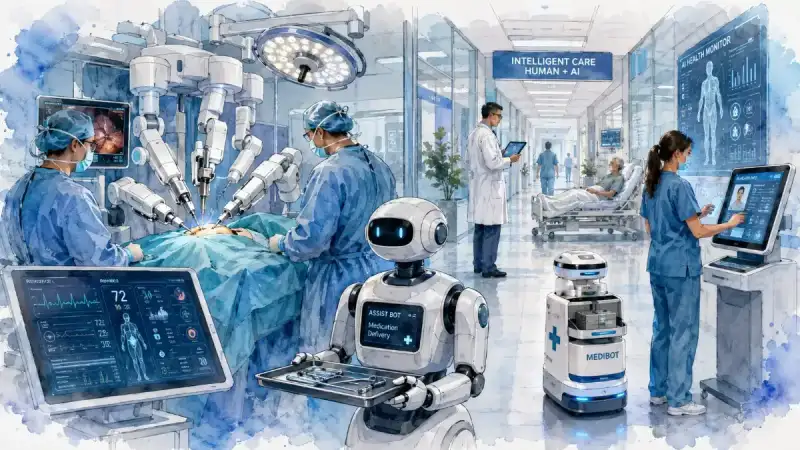
Imagine walking into a hospital where the first person—or rather, the first machine—you meet is an intelligent robot. It checks your appointment, verifies your medical records, and guides you to the correct department without any delay. Moments later, another robot delivers medication while an AI system alerts your doctor about changes in your vital signs. A decade ago, this would have sounded like science fiction. Today, it is becoming reality in hospitals across the world.
Healthcare has entered one of its biggest technological transformations since the invention of modern medical imaging. Artificial intelligence, robotics, automation, and smart data systems are reshaping how hospitals operate every single day. What once required dozens of healthcare workers can now be completed faster with the assistance of intelligent machines. Rather than replacing medical professionals, these technologies are helping them deliver better care. Experts believe this transformation is only in its early stages.
As hospitals become busier and populations continue to age, healthcare systems are facing enormous pressure. Doctors and nurses are treating more patients than ever before while dealing with increasing administrative workloads. Long waiting times, staff shortages, and rising healthcare costs have become common challenges in many countries. Robotics has emerged as one of the most promising solutions to improve efficiency without compromising patient care. That is why governments and healthcare providers are investing billions of dollars in medical robotics.
The biggest question many people ask is surprisingly simple. Will robots eventually replace doctors? The short answer is no. The long answer is far more interesting because robots are changing medicine in ways few people expected. Understanding that difference is the key to understanding the future of healthcare.
Robots Are Already Working Inside Modern Hospitals
When people hear the phrase "hospital robot," they usually picture a machine performing surgery. In reality, robotic systems are involved in many different tasks throughout a hospital. Autonomous robots transport medicines, laboratory samples, surgical instruments, and medical supplies between departments around the clock. This allows nurses and hospital staff to spend more time caring for patients instead of moving equipment. Even small improvements like these can dramatically increase hospital efficiency.
Some hospitals now use ultraviolet disinfection robots to reduce the spread of dangerous infections. These robots can disinfect patient rooms, operating theaters, and high-risk areas without exposing healthcare workers to unnecessary risks. During and after the COVID-19 pandemic, interest in automated disinfection technologies increased significantly. Hospitals learned that automation could strengthen infection control while reducing manual workload. Many experts expect this trend to continue over the next decade.
Artificial intelligence has also transformed patient monitoring. Smart robotic systems continuously analyze heart rate, blood pressure, oxygen levels, and other vital signs. If abnormal patterns appear, doctors receive immediate alerts that allow faster medical intervention. Early detection often makes a significant difference in patient outcomes. Instead of replacing human judgment, AI helps doctors recognize problems sooner.
 AI Won't Replace Doctors. But the Hospital You Visit Five Years From Now Could Look Completely Different
 Goodbye Chemo? Scientists Built a Smart DNA Sniper That Kills Only Cancer Cells — The 2026 Breakthrough Explained
 Apple’s New Mac mini and Mac Studio Aren’t Just Faster Macs — They’re Built for the AI Agent Era
 The Robot Beat Usain Bolt’s 100-Metre Time. What Happened After the Finish Is More Important
 What Did Starship Prove on Its 13th Test Flight? A Milestone, or Just Another Step Forward?
Some hospitals have even introduced robotic receptionists and patient assistants. These systems help visitors find departments, answer frequently asked questions, manage appointments, and improve navigation inside large medical facilities. Patients spend less time searching for information while hospital staff can focus on more complex responsibilities. Although these robots appear simple, they improve the overall patient experience in meaningful ways. Healthcare is becoming smarter at every level.
Robotic Surgery Is More Advanced Than Most People Realize
One of the biggest misconceptions about robotic surgery is that robots perform operations independently. In reality, every robotic procedure is controlled by highly trained surgeons. The robot does not make medical decisions or replace surgical expertise. Instead, it translates the surgeon's hand movements into extremely precise actions inside the patient's body. The technology functions as an advanced extension of the surgeon's skills.
Human hands naturally have limitations, especially during delicate procedures. Robotic surgical systems can filter out tiny hand tremors while allowing movements that are difficult or impossible using traditional techniques. This precision often enables smaller incisions, reduced blood loss, and shorter recovery times for suitable patients. Many complex procedures have become safer because surgeons have access to enhanced visualization and greater control. The goal is better outcomes, not replacing surgeons.
Artificial intelligence is making these systems even more powerful. AI can analyze medical images, compare previous scans, identify subtle abnormalities, and organize patient information within seconds. Doctors receive faster access to relevant clinical insights before making important decisions. However, every diagnosis and treatment plan still depends on experienced medical professionals. Technology supports clinical judgment—it does not replace it.
Hospitals are also exploring digital twins, predictive analytics, and AI-assisted planning before surgery begins. These technologies allow surgeons to simulate procedures, anticipate complications, and prepare more personalized treatment strategies. As computing power continues to improve, robotic surgery will likely become even more accurate and accessible. The operating room of the future will combine human expertise with intelligent technology in ways that were unimaginable only a few years ago.
The Global Race for Medical Robotics Has Already Begun
Medical robotics is no longer limited to a handful of world-class hospitals. Countries including the United States, Japan, South Korea, Germany, and Singapore are investing heavily in robotic healthcare infrastructure. Governments see robotics as a long-term solution to growing healthcare demands, aging populations, and shortages of skilled medical professionals. Hospitals are adopting automation not simply to showcase advanced technology but to improve patient safety and operational efficiency. The global healthcare industry is entering one of the fastest periods of technological transformation in its history.
The United States currently leads many areas of robotic surgery and AI-assisted healthcare. Major hospitals are expanding the use of robotic systems across specialties including cardiology, oncology, orthopedics, neurology, and urology. Healthcare providers are also integrating artificial intelligence into diagnostics, patient monitoring, and administrative workflows. This combination allows physicians to spend less time on paperwork and more time treating patients. Experts believe this shift could redefine healthcare delivery over the next decade.
Asian countries are moving just as aggressively. Japan has long been recognized as a global leader in robotics and is now applying decades of engineering expertise to healthcare. South Korea is developing AI-powered smart hospitals where automation supports everything from logistics to patient monitoring. Singapore continues investing in intelligent healthcare infrastructure designed to improve efficiency while maintaining high-quality patient care. These nations are proving that robotics is becoming an essential healthcare tool rather than an experimental technology.
Emerging economies are also joining the race. India, China, Brazil, and several Middle Eastern countries are rapidly expanding investments in healthcare technology. While adoption is currently concentrated in larger hospitals, costs are expected to decline as competition increases and manufacturing scales up. Just as advanced medical imaging eventually became more affordable, robotic healthcare systems are likely to become increasingly accessible over time. The future of healthcare is becoming more global than ever before.
Artificial Intelligence Is Making Hospital Robots Smarter Every Year
The real revolution is not robotics alone but robotics powered by artificial intelligence. Modern medical robots are becoming increasingly capable of processing vast amounts of clinical information within seconds. AI can compare medical scans, identify patterns, prioritize urgent cases, and provide physicians with decision-support recommendations. These capabilities significantly reduce the time needed to analyze complex medical information. Faster access to insights often leads to faster treatment decisions.
Machine learning systems continue improving as they process larger medical datasets. They can identify trends that may be difficult for humans to detect during busy clinical practice. Researchers are exploring AI models capable of predicting complications before symptoms become severe. Early warnings could help doctors intervene before a patient's condition worsens. Preventive healthcare may become one of AI's greatest contributions to medicine.
Natural language processing is another major breakthrough. AI systems can summarize lengthy medical records, organize physician notes, and retrieve relevant patient history almost instantly. This reduces administrative burden while minimizing documentation errors. Doctors spend more time interacting with patients instead of navigating digital paperwork. Healthcare professionals consistently identify this as one of AI's most valuable applications.
Researchers are also developing collaborative robots, often called "cobots," designed specifically to work safely alongside humans. Unlike industrial robots operating behind safety barriers, these systems interact directly with doctors, nurses, and technicians. They assist with lifting patients, preparing surgical instruments, transporting supplies, and supporting rehabilitation therapy. Collaboration—not replacement—defines the future of healthcare robotics. Human expertise remains at the center of every important medical decision.
Challenges That Could Slow the Robotics Revolution
Despite remarkable progress, robotic healthcare still faces significant obstacles. Advanced robotic surgical systems cost millions of dollars, making them inaccessible for many hospitals around the world. Beyond the initial investment, hospitals must also budget for maintenance, software upgrades, and specialized technical support. These ongoing expenses remain one of the industry's biggest barriers. Financial accessibility will determine how quickly robotics expands globally.
Training presents another challenge. Operating advanced robotic systems requires extensive education, practice, and certification. Surgeons, nurses, biomedical engineers, and technical support teams must all develop new skills to use these technologies effectively. Medical schools and training institutions are gradually updating their curricula to prepare future healthcare professionals. Continuous education will become increasingly important as technology evolves.
Cybersecurity has become a major concern in connected hospitals. Medical robots, AI systems, and cloud-based patient records all rely on secure digital infrastructure. Healthcare organizations must protect sensitive medical information from cyberattacks while ensuring critical systems remain operational. A cybersecurity failure in a hospital could have life-threatening consequences. Protecting digital healthcare infrastructure is now as important as protecting physical facilities.
Ethics also plays a central role in the discussion. Patients want transparency regarding how artificial intelligence contributes to medical decisions. Doctors remain legally and ethically responsible for diagnosis and treatment, regardless of technological assistance. Healthcare organizations must ensure that AI systems are fair, reliable, and free from harmful bias. Trust will ultimately determine how widely these technologies are accepted.
What Will Hospitals Look Like by 2035?
Imagine arriving at a hospital where nearly every routine process is automated. Registration happens instantly through biometric identification, while AI reviews your medical history before you even meet a physician. Autonomous robots deliver medications, laboratory samples, and equipment without interrupting clinical staff. Smart monitoring systems continuously analyze patient conditions throughout treatment. The hospital operates with greater speed, accuracy, and coordination than ever before.
Remote healthcare will become even more sophisticated. Patients recovering at home may wear intelligent medical devices that continuously transmit health information to hospitals. AI systems could detect subtle warning signs long before patients notice symptoms themselves. Doctors would receive alerts only when meaningful medical intervention becomes necessary. This proactive model could significantly reduce emergency hospital admissions.
Personalized medicine will also benefit from robotics and AI. Future healthcare systems may combine genetic information, lifestyle data, wearable devices, and medical imaging to create individualized treatment strategies. Surgical planning could become highly customized for every patient before entering the operating room. Advanced simulation technology may allow surgeons to rehearse complex procedures virtually. Precision medicine will become increasingly practical as technology advances.
Even with these extraordinary innovations, one fact remains unchanged. Patients trust compassion, empathy, communication, and clinical judgment—qualities that cannot be replicated by machines. Robots may assist with precision, speed, and repetitive tasks, but they cannot replace the human connection between doctors and patients. Healthcare will become more technological without becoming less human. That balance may ultimately define the future of medicine.
Every major technological revolution has raised fears that machines would replace human professionals. Computers transformed offices, smartphones reshaped communication, and artificial intelligence is now redefining knowledge work. Yet history consistently shows that technology is most valuable when it enhances human capability rather than replacing it. Hospital robotics appears to be following the same path. The future belongs not to doctors or robots alone, but to doctors empowered by intelligent robotic systems.
Healthcare is entering an era where precision, automation, and artificial intelligence work together to improve patient outcomes. Hospitals of the next decade will likely be smarter, faster, and more connected than ever before. Patients may never notice many of these technologies operating behind the scenes, but they will experience shorter waiting times, more accurate diagnoses, and better treatment outcomes. The robotics revolution has already begun. The only remaining question is how quickly it will transform every hospital around the world.

No Comment Yet.
Stay informed with breaking news, trending stories, and in-depth analysis.
