Tech Vaidya WhatsApp Channel
Get AI updates, tech news, cybersecurity alerts and useful tech tips directly on WhatsApp.

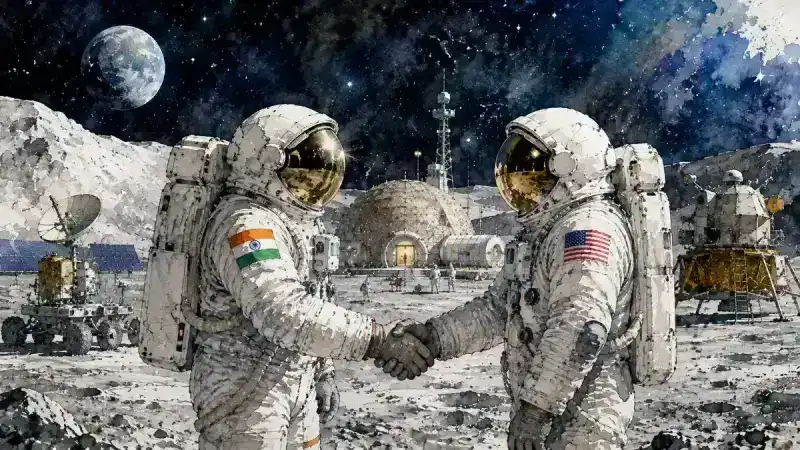
India’s space programme has reached a point where the conversation is no longer limited to launching satellites, reaching the Moon, or sending humans into space. The next question is much bigger: can India become part of the infrastructure that will support humanity’s long-term presence on the Moon? That question has gained fresh significance after the United States invited India to participate in its emerging lunar exploration framework, linked to the Artemis Accords and the broader ambition of building a sustained human presence around the Moon.
The development came into focus after the India-US Civil Space Joint Working Group meeting held in Bengaluru on August 5 and 6. The discussions covered deeper cooperation in civil space activities, with lunar exploration emerging as one of the most important areas of future collaboration. The invitation is significant not simply because India is being asked to participate in another international space programme, but because the nature of lunar exploration itself is changing. The Moon is increasingly being viewed not as a destination for short visits, but as a place where scientific infrastructure, communication systems, surface vehicles, power systems and eventually human habitats could operate for long periods.
For India, that changes the scale of the opportunity. India has already demonstrated that it can reach the Moon with comparatively modest missions and costs. Chandrayaan-3’s successful landing near the lunar south polar region showed that ISRO could accomplish a technically demanding soft landing in one of the most challenging areas of the lunar surface. The next stage is no longer just about proving that India can land on the Moon. It is about determining what role India can play when several countries begin building a permanent ecosystem of lunar exploration.
The Moon Base Is Bigger Than a Single Mission
The phrase “Moon Base” can easily create an image of a futuristic settlement with astronauts living permanently on the lunar surface. That is not necessarily what the immediate plans mean. A lunar base is more likely to emerge gradually, through a network of missions, robotic systems, scientific instruments, power infrastructure, communication links, transportation systems and temporary human habitats.
The Artemis programme led by NASA is designed around this broader vision. The objective is to return humans to the Moon, establish a sustained presence and use the lunar environment as a platform for scientific research and future exploration. The lunar south pole is particularly important because scientists believe some permanently shadowed regions there may contain water ice. Water on the Moon could eventually become much more than a scientific discovery. It could potentially be processed into drinking water, oxygen and even rocket propellant, making the region strategically important for future lunar operations.
This is where India’s participation could become interesting. ISRO has already developed expertise in lunar exploration, remote sensing, spacecraft operations and cost-efficient mission design. India’s Chandrayaan missions have also contributed valuable data about the Moon’s surface and composition. A deeper partnership could allow Indian technology and scientific expertise to become part of a much larger international lunar architecture rather than remaining confined to individual national missions.
There is also a larger geopolitical dimension. The Moon is becoming a new arena for international cooperation, but it is also becoming an arena of strategic competition. The United States and its partners are pursuing Artemis, while China is developing its own International Lunar Research Station plans with partner countries. Russia, Japan, European nations and other spacefaring countries are also pursuing different forms of lunar exploration. India’s position between these major space powers gives it an opportunity to play a role that extends beyond simply being another participant.
 Beyond the Hype: How 2,250 Tech News Articles Reveal the 4 Parallels Between the 2026 AI and Space Races
 Why Is Typing Kannada on Apple Laptops Still So Difficult? Which Kannada Keyboard Is Best for Apple Computers?
 Apple Finally Folded the iPhone! Why the iPhone Duo Could Change the Smartphone Industry
 TechVaidya: One Year. Over a Thousand Articles. And a long road still ahead...
 Toxic Review: Yash Owns the Screen, But Does the Film Own the Story?
Why India Matters to the Moon Race
India brings something particularly valuable to international space cooperation: the ability to achieve complex missions with comparatively efficient use of resources. Chandrayaan-3 demonstrated this in a way that attracted global attention. But the real value of that achievement may become clearer when lunar exploration moves from isolated missions to sustained operations.
A future lunar ecosystem will need much more than launch vehicles and landers. It will need navigation, communications, robotics, scientific instruments, autonomous systems, power generation, surface mobility and reliable data networks. It will also require technologies capable of surviving extreme temperature variations, radiation, dust and the harsh conditions of the lunar environment. India does not have to build every part of this infrastructure to become important to it. Contributing even a few critical technologies could give ISRO and Indian industry a meaningful place in the larger system.
The private sector could be equally important. A long-term lunar programme cannot be built entirely by government space agencies. Commercial companies are already becoming increasingly involved in launch services, spacecraft, lunar landers, communication systems and space-based infrastructure. If India’s participation expands, Indian startups and established technology companies could eventually find opportunities in areas that are still being defined.
That possibility could create an important shift in the Indian space industry. For decades, India’s space capabilities were largely associated with government-led missions. The liberalisation of the space sector has already begun changing that model. A future in which Indian companies build components, software, robotics, sensors or communication systems for international lunar missions could turn the Moon into a new market for Indian space technology.
Artemis Accords Are About Rules Too
There is another reason the invitation matters. The Artemis Accords are not simply a list of missions to the Moon. They also establish principles for responsible civil exploration and the use of space resources. They address issues such as transparency, interoperability, emergency assistance, preservation of scientific sites and the responsible use of lunar resources.
That becomes increasingly important as more countries begin operating on the Moon. The lunar surface is not an empty piece of land waiting to be divided among nations. The existing international space-law framework does not allow countries to simply claim the Moon as sovereign territory. At the same time, future missions will need practical arrangements for operating around valuable scientific sites and potential resource locations.
This is why India’s participation has significance beyond engineering. Being part of these discussions gives India a voice in shaping how future lunar activity is conducted. The rules established today could influence everything from how countries coordinate missions to how lunar resources are handled decades from now.
For India, this is also an opportunity to balance cooperation with strategic independence. Joining an international framework does not mean giving up an independent space programme. In fact, the opposite could be true. India can continue developing its own missions while using international partnerships to gain access to technologies, scientific cooperation, infrastructure and opportunities that would be difficult or expensive to develop alone.
The Real Prize May Not Be the Moon
The most interesting part of a lunar programme may ultimately be what it creates back on Earth. Technologies developed for extreme environments often find applications far beyond their original purpose. Advanced robotics, autonomous navigation, remote operations, lightweight materials, energy systems, communication technologies and artificial intelligence could all benefit from the demands of lunar exploration.
There is also a scientific opportunity. The Moon preserves a record of the early Solar System that Earth has largely lost because of geological activity. Studying lunar rocks, permanently shadowed regions and the effects of the space environment could help scientists understand how planets evolved and how Earth itself came to be what it is today.
But the economic implications could be even larger over time. If lunar infrastructure becomes reliable enough to support repeated missions, the Moon could evolve from a destination into a part of the wider space economy. Communication stations, navigation services, scientific facilities, resource-processing experiments and transportation systems could eventually become recurring activities rather than one-off missions.
India therefore has to think beyond the question of whether ISRO will send another spacecraft to the Moon. The more important question is whether India will help build the systems that make repeated lunar activity possible.
India Cannot Afford to Be Only a Passenger
There is a danger in international space partnerships that is easy to overlook. Participation by itself does not guarantee influence. A country can join a programme, contribute a limited component and still remain dependent on the technologies and decisions of others.
India’s opportunity will be much greater if it can bring capabilities that other partners genuinely need. That means investing not only in missions, but also in high-end propulsion, robotics, autonomous systems, lunar communication, power technologies, space-qualified electronics, advanced materials and human-spaceflight capabilities.
The same applies to Indian industry. If the next phase of lunar exploration becomes a global programme involving dozens of companies, India will benefit far more by becoming a supplier of critical technologies than by simply purchasing access to the ecosystem. The country’s large engineering talent base and growing private space sector could become significant advantages if they are connected to long-term lunar programmes.
There is also a strategic lesson here. Space exploration is increasingly moving from the era of flags and footprints to the era of infrastructure. The first Moon race was largely about proving who could reach the lunar surface. The next phase could be about who can build reliable systems that continue working there.
That is why an invitation to participate in a future Moon Base programme should not be viewed merely as another diplomatic announcement. It represents a possible entry point into a much larger technological and economic transformation.
The Moon Is No Longer Just a Destination
India’s journey to the Moon began with the question of whether an Indian spacecraft could travel there. Chandrayaan answered that question. Chandrayaan-2 exposed the difficulties of landing safely. Chandrayaan-3 demonstrated that India could overcome those difficulties. The next challenge is fundamentally different.
The question now is whether India can become one of the countries helping to shape what happens after humans return to the Moon.
That will require patience. A genuine lunar base will not appear overnight, and the path from individual missions to sustained human presence will involve technical failures, political changes, enormous costs and difficult engineering problems. But countries that begin building the necessary capabilities today will have a much stronger position when the lunar ecosystem becomes a reality.
For India, the opportunity is therefore larger than another Moon mission. It is an opportunity to move from being a successful participant in lunar exploration to becoming one of the countries helping define its next chapter.
The Moon may once again become a symbol of national achievement. But this time, the bigger story could be about infrastructure, cooperation, technology and influence.
And if India wants a meaningful place in that future, the goal should not simply be to reach the Moon.
The goal should be to help build what comes next.

No Comment Yet.
Stay informed with breaking news, trending stories, and in-depth analysis.