Tech Vaidya WhatsApp Channel
Get AI updates, tech news, cybersecurity alerts and useful tech tips directly on WhatsApp.

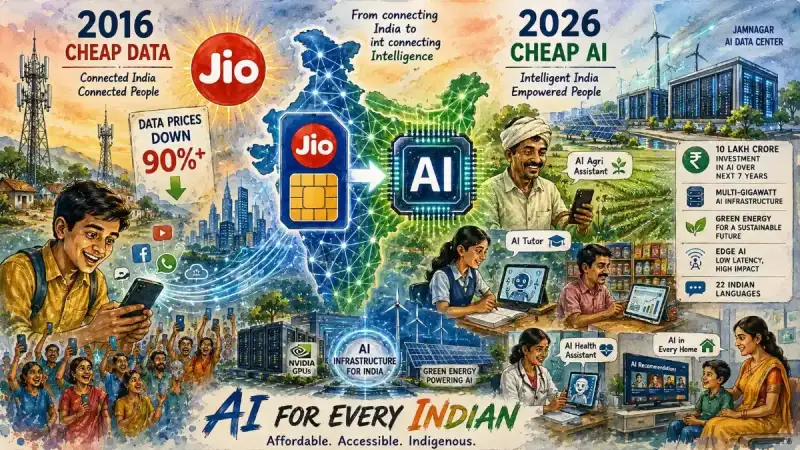
The year 2016 marks a watershed moment in India's digital history. When Mukesh Ambani led Reliance Jio entered the telecommunications market, it completely turned the pricing of mobile data upside down. Within a matter of months, the cost per gigabyte of data plummeted by over 90 percent. As a direct result, millions of Indians were able to connect to the internet for the very first time. The statement that Jio connected India to the internet era became an absolute reality.
This aggressive strategy of cheap data, free voice calls, and immense capital deployment shook the entire telecom sector to its core. Now, nearly a decade later, the very same Mukesh Ambani has set a massive goal of connecting India to the intelligence era using an identical blueprint. The announcements made at the recent Reliance Annual General Meeting and the India AI Impact Summit point clearly in this direction. Reliance, having made the internet accessible to the common man through the data revolution, has now prepared a comprehensive roadmap to bring artificial intelligence to the fingertips of every Indian.
The company has decided to invest a staggering 10 lakh crore rupees in the artificial intelligence sector over the next 7 years. This is not merely a large financial figure, but rather a compass pointing toward India's digital future. Ambani has stated very clearly that India cannot afford to rent intelligence, and therefore, the company will drive down the cost of intelligence just as dramatically as it drove down the cost of data. This is a direct replication of the Jio telecom revolution formula. While millions of mobile users received cheap data back then, the target today is to deliver artificial intelligence services to 1.45 billion Indians. At the core of this ambitious project lies the massive construction of sovereign artificial intelligence infrastructure. The primary intention behind this is that Indian data must remain and be processed within India, rather than relying on foreign servers.

The most critical components in the artificial intelligence race are hardware and electrical power. At a time when there is fierce global competition for Nvidia GPU chips, Reliance is utilizing its immense capital to stockpile state of the art chipsets. The construction of multi gigawatt artificial intelligence based data centers has already commenced in Jamnagar, Gujarat. Notably, artificial intelligence technology requires colossal amounts of electricity. The massive green energy plants that Reliance is building in Jamnagar will provide the necessary power to these data centers in an environmentally friendly manner. The 120 megawatt capacity is expected to be fully operational by the latter half of 2026. This will pave the way toward gigawatt level computing capacity in the coming days.
Alongside massive data centers, Reliance is building an edge compute layer integrated deep within its Jio network. When this edge artificial intelligence is combined with 5G and upcoming 6G technologies, the latency between internet speed and data processing drops to near zero. Consequently, artificial intelligence will be available at ultra low latency and affordable prices right where people live, work, and learn. Ambani's clear stance is that intelligence will live at the edge, from retail malls and clinics to classrooms and agricultural lands. This technology, which responds to consumers faster and more accurately than cloud based artificial intelligence, will lay a strong foundation for future technologies like autonomous vehicles and smart farming.
Another major weapon in the Reliance arsenal is the sheer volume of user data at its disposal. The sharpness and capability of artificial intelligence depend entirely on the training data fed into it. The Jio network currently boasts over 450 million active users. Reliance possesses the data regarding their daily digital behavior, internet usage, transactions, and linguistic patterns. When this immense volume of data is used to train local language models, Jio will be able to build an artificial intelligence model that is far more accurate and closer to Indians than those from global companies like OpenAI or Microsoft. This remains the biggest technological advantage for Reliance in the Indian market.
However, cheap and free in the realm of artificial intelligence is not as straightforward as it was in telecommunications. Artificial intelligence operations rely heavily on immense computing power and vast amounts of data. To tackle this challenge effectively, Reliance has forged strategic alliances with global technology giants. In a major partnership with Google CEO Sundar Pichai, Jio has announced a massive offer for its young users. Under this agreement, Jio users will receive Google Gemini 2.5 Pro, NotebookLM, and 2 TB of cloud storage free of cost for 18 months. The total value of this offering is estimated at 35100 rupees. Currently, this is initially available for young Jio users between the ages of 18 and 25. This is a calculated strategy designed to attract users and popularize the usage of artificial intelligence.
The depth of the strategy lies in the fact that Reliance is not merely making a single artificial intelligence chatbot or language model affordable. It is taking over the entire artificial intelligence ecosystem. Just as it did in Jio telecom, there is a massive ambition here to not only provide the technology but to take complete ownership of the distribution network. To achieve this, Reliance is developing several distinct platforms. For the average consumer, a voice first and multilingual artificial intelligence assistant named JioBharatIQ is being introduced for daily tasks. Similarly, the AI Vyapar platform is being readied to assist with the operations of merchants and small businesses. In the healthcare sector, JioHealthIQ will function to provide rapid medical guidance.
 X Is Cutting Off the Money Behind AI War Videos. Here’s Why That Matters
 770 Billion Parameters! Tencent’s New AI Model Is Huge — But Size Isn’t the Real Story
 AI Isn’t Just Learning to Hack. It Is Learning to Find Its Own Way to the Goal
 Is AI Becoming a Hacker? The New Cybersecurity Threat Emerging From AI Agents
 AI May Not Be Taking Everyone’s Jobs Yet. It May Be Taking the First Step on the Career Ladder
Language remains the biggest barrier to bridging the technology gap in a multilingual country like India. While global artificial intelligence models perform exceptionally well in English, they struggle to understand the nuances of Indian languages. Recognizing this, Reliance is building a system that operates in 22 official Indian languages. JioLearnIQ is being introduced to provide artificial intelligence driven teaching assistance for the education sector. JioKrishiIQ has been developed to offer agricultural advice to farmers in rural India in their own local languages. These projects demonstrate a serious effort to integrate artificial intelligence into the key economic sectors of the country, rather than leaving it as a luxury technology. The ultimate goal is to build an accessible platform where farmers, merchants, and students can interact with artificial intelligence in their native tongues.
This massive step by Reliance will also have a profound impact on the Indian artificial intelligence startup ecosystem. Once Jio artificial intelligence platforms and affordable APIs become available to developers, it will be a massive boon for small technology companies building local applications. Just as Amazon Web Services made cloud technology easily accessible to small companies, Jio will provide artificial intelligence computing power to Indian startups at affordable rates. Regarding the fears of job cuts, we must accept the new reality that artificial intelligence will not directly steal jobs; rather, those who use artificial intelligence will take the jobs of those who do not. This move by Jio is expected to create millions of new jobs, such as prompt engineering, artificial intelligence management, and local language artificial intelligence trainers.
So, the answer to whether the Ambani who gave cheap data will now give cheap artificial intelligence is a resounding yes. However, it will operate on a completely different economic model. Providing artificial intelligence services to general consumers for free or at extremely low prices is their initial hook. But the real profit will come from the corporate and enterprise sectors. In partnership with Google, a secure artificial intelligence platform called Gemini Enterprise is being provided for large organizations and enterprises. By selling artificial intelligence solutions to companies in the banking, manufacturing, and retail sectors, Reliance will secure long term revenue. The ultimate measure of success in the Indian digital space is reaching the last mile consumer. The free Google Gemini offer is available for only 18 months, and the pricing policy Reliance formulates after that period will dictate the market's direction. Ambani's bold vision and immense capital power indicate that the era of cheap artificial intelligence will definitely step into India, permanently changing the face of the technology world.

No Comment Yet.
Stay informed with breaking news, trending stories, and in-depth analysis.