Tech Vaidya WhatsApp Channel
Get AI updates, tech news, cybersecurity alerts and useful tech tips directly on WhatsApp.

| Hariharan
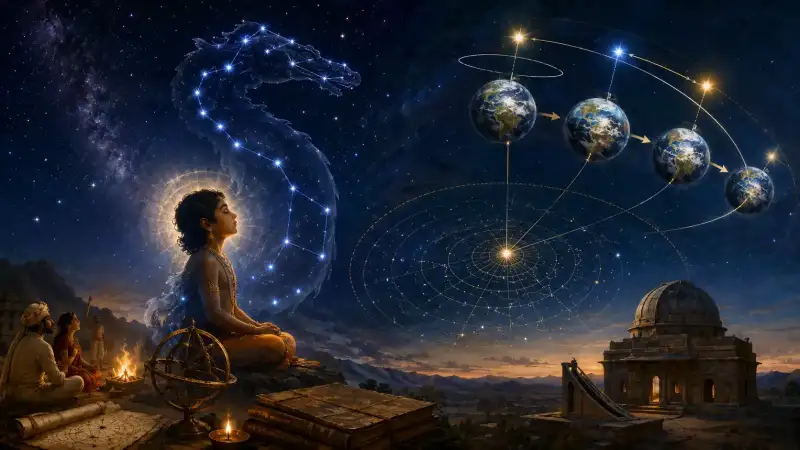
Anyone who has grown up absorbing Indian culture is intimately familiar with the story of Dhruva. It is the poignant tale of a five-year-old boy who, denied a place on his father King Uttanapada's lap due to a stepmother's jealousy, retreats to the forest to perform intense penance. Pleased by his unwavering devotion, the divine grants him a permanent, unmoving position in the night sky. To a casual listener, this appears to be nothing more than a beautiful moral story emphasizing faith and determination. However, when we examine this narrative through the precise lens of modern astronomy, a spectacular scientific truth begins to emerge. This is not merely a fable born of imagination, but a highly accurate, 5000-year-old astronomical record.
Modern science, primarily over the last two centuries, has unraveled complex truths about the cosmos that our ancestors had already documented with unparalleled clarity in their ancient texts. Ancient India had identified a specific pole star that guided their nights and anchored their celestial observations. Interestingly, the star they gazed upon was not Polaris, the current North Star we rely on today. Around 2800 BCE, the star occupying the true north celestial pole was entirely different. It was Thuban, also known scientifically as Alpha Draconis. Ancient Indian scriptures remembered this specific star with a blend of poetic brilliance and scientific exactitude. This is not a random coincidence, but the extraordinary scientific memory of a civilization.
Hidden Sky Maps in the Vedas and the Draco Constellation
To decipher the scientific mystery of Dhruva, we must look directly into the Vedas, specifically at the references to a Vedic constellation known as 'Shishumara'. For a long time, many scholars misinterpreted this term as a dolphin or a porpoise. However, when the structural descriptions found in the texts are mapped against the actual night sky, Shishumara flawlessly aligns with the northern constellation of Draco. The Taittiriya Aranyaka provides a meticulously detailed and observation-heavy description of this celestial formation. It states that the Shishumara constellation consists of fourteen stars arranged in a distinct curving or coiled shape across the dark sky.
The most fascinating aspect of this Vedic description is the name given to the very last star in this formation: 'Abhaya'. In Sanskrit, Abhaya translates to 'the fearless one' or 'the unmoving one'. The ancient texts explicitly identify this Abhaya as Dhruva, stating clearly that it resides at the very tip of the Shishumara's tail. This precise imagery is echoed in the Brahmanda Purana and the Vishnu Purana. Dhruva is described as the cosmic pivot, the central hinge around which all celestial bodies and constellations revolve. The Bhagavata Purana preserves this exact star catalog, listing deities like Agni, Indra, and Prajapati, culminating with Abhaya at the tail's end. These are not just poetic metaphors; they represent an unbroken, highly accurate scientific memory of the northern sky that has survived for millennia.
The Earth's Wobble and the Changing Pole Star
For a long time, several Western scholars dismissed the Vedic references to a pole star as pure mythological fantasy. Their argument was based on the fact that during the era the Vedas were composed, Polaris, our current North Star, was nowhere near the celestial pole. What they failed to account for was the dynamic nature of our planet's movement in space. The Earth does not spin perfectly upright on its axis; instead, it slowly wobbles like a spinning top losing its momentum. This physical phenomenon is known in astronomy as the 'precession of the equinoxes'. This slow, gradual wobble takes a staggering 26,000 years to complete a single cycle.
 Sanjaya Vision The Original Live Report of Mahabharata or Ancient Drone and Satellite Technology A Fascinating Analysis
 Lalita Sahasranama: The Ancient “Psychoacoustic Software” for the Human Mind
 Talos of Greek Mythology: Was This the World’s First Robot Concept?
 Pushpaka Vimana: The Link Between Ravana’s Flying Chariot and Modern Aviation
As a direct consequence of this wobbling, the point in the sky that the Earth's North Pole points to slowly shifts over thousands of years. Therefore, the identity of the pole star is never permanent. Today, Polaris holds the prestigious title of the North Star. If the Earth continues its precessional wobble, roughly 12,000 years from now, a brilliant star named Vega will take its place. Similarly, if we calculate backward in time, we find that around five thousand years ago, approximately in 2800 BCE, Thuban or Alpha Draconis was situated exactly at the celestial north pole. The ancient texts and their incredibly accurate descriptions of the Shishumara constellation completely dismantle the colonial dismissal of Vedic astronomy.
Reading the Heavens Through Ancient Texts
Professor R.N. Iyengar, a distinguished researcher from the Indian Institute of Science (IISc), analyzed this phenomenon extensively in his research paper titled "Dhruva the Ancient Indian Pole Star." By expertly combining the textual analysis of ancient Sanskrit scriptures with modern astronomical calculations, he arrived at a breathtaking conclusion. His calculations demonstrated that between 3200 BCE and 2400 BCE, the star Thuban was the closest luminous body to the north celestial pole. Around 2800 BCE, it aligned almost perfectly with the pole, appearing entirely motionless in the night sky to anyone observing from Earth.
This verifiable scientific reality perfectly matches the position of 'Abhaya' mentioned in the Yajurveda. The exact location of Thuban within the Draco constellation is identical to the position of Dhruva at the tip of the Shishumara's tail as described in the Vedas. Such precise and physically verifiable alignment cannot be dismissed by any rational scientist as a mere coincidence. Our ancestors observed the movements of the stars with the naked eye over decades and centuries, locking their accumulated data into their sacred texts. Their observational capacity and analytical brilliance were undoubtedly on par with the data generated by modern telescopes.
Rituals, Subtle Observations, and Cosmic Memory
The greatest strength of Indian civilization lies in its ability to transform complex knowledge into daily rituals, ensuring its survival across generations. In the Ekagni Kanda of the Krishna Yajurveda, there is a pivotal ritual during the Hindu marriage ceremony where the bride and groom are instructed to gaze at the Dhruva star together. As noted by the renowned Orientalist Hermann Jacobi, such a ritual, intended to symbolize an unbreakable and steadfast marital bond, must have originated during an era when a star genuinely appeared entirely 'unmoving' in the sky. That specific era was undeniably the age of Thuban. Astronomical knowledge that existed long before texts were formally written down flowed seamlessly through generations in the form of these sacred rituals.
Furthermore, the Puranas refer to Dhruva as 'Medhi', meaning the central pillar of the sky. Yet, these very same texts subtly note that Dhruva actually moves in a very tiny circular path day and night. On the surface, this looks like a contradiction. How can the unmoving star move? However, this reveals the hyper-acute observational skills of the ancient astronomers. By the time the Puranic texts were codified, the precession of the equinoxes had caused Thuban to drift slightly away from the exact, dead-center celestial pole. Therefore, while it still appeared as the central anchor of the heavens, careful observation revealed it tracing a minuscule circle rather than sweeping a large arc like other stars. The ancients were vigilant enough to notice and record even this subtle shift.
Ultimately, when we weave together the star maps of the Vedas, the cosmic worldview of the Puranas, ancient marriage rituals, and modern astronomical calculations, a crystal-clear picture emerges. The Indian tradition preserved the exact identity of the third-millennium BCE pole star, Thuban, with unbelievable precision. Dhruva is not just a character in a mythological story; he is the ultimate symbol of how a civilization encrypts its scientific knowledge to survive the ravages of time. It is a living testament to an ancient society that seamlessly blended poetry, ritual, patient observation, and supreme logic into an unbroken thread of cosmic memory. The legend of the unmoving star is real, and it stands as one of the most beautiful examples of India's long, uninterrupted continuity of scientific thought.
❤️ Also Read
❤️Beyond the Blade: How Gene Editing is Rewriting the "Death Sentence" of Cancer?
❤️Six Months in the Digital Wilderness: The Tragic Isolation of the Windows 10 "Holdouts."
❤️David Attenborough at 100: The Century-Old Voice That Brought Nature to Our Living Rooms
❤️The Illusion of Algorithms: Read This Before You Get Trapped!
❤️May 8 Mega Launch: HMD Vibe 2 Brings Flagship "Vibes" to the Masses via Flipkart
🟢 Follow our WhatsApp Channel JOIN ➤
🛒 ಆನ್ಲೈನ್ ಶಾಪಿಂಗ್ ಮಾಡುವಾಗ ಈ ಕೆಳಗಿನ ಲಿಂಕ್ ಬಳಸಿ

No Comment Yet.
Stay informed with breaking news, trending stories, and in-depth analysis.