Tech Vaidya WhatsApp Channel
Get AI updates, tech news, cybersecurity alerts and useful tech tips directly on WhatsApp.

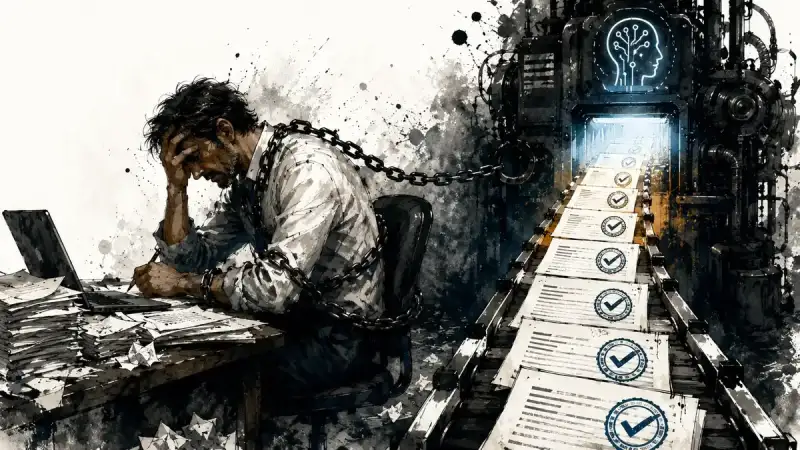
The global tech landscape has fundamentally changed the way enterprise professionals gather and present information in 2026. We have aggressively transitioned from generating original analytical ideas to simply hunting for automated citations.
The heavy marketing out of Silicon Valley convinced us that AI-powered search engines and automated research tools were absolute necessities. We were told that manually synthesizing information and forming independent perspectives was an outdated, inefficient use of corporate time.
This massive behavioral shift is deeply damaging to actual intellectual property creation across every major industry. By aggressively chasing machine-generated citations, modern professionals are actively outsourcing their core intellectual value to a remote server.
You are no longer functioning as an expert in your chosen professional field. You are slowly devolving into a highly paid editor whose only job is to verify whether a machine's external links are technically functional.

The Hidden Problem With Automated Search and Citations
The primary issue with relying on automated citations is the absolute death of original analytical thinking. When you immediately ask a language model to find sources on a topic, you bypass the critical human phase of structural synthesis.
You skip the messy, difficult cognitive process of forming your own unique perspective based on raw data. Instead, you immediately adopt the synthesized worldview of the underlying algorithm, relying on its predetermined hierarchy of what information is actually important.
This creates a dangerous professional dependency that is almost entirely invisible to the average corporate worker. You begin to believe that an argument is only valid if an artificial intelligence can quickly find a pre-existing internet link to support it.
 X Is Cutting Off the Money Behind AI War Videos. Here’s Why That Matters
 770 Billion Parameters! Tencent’s New AI Model Is Huge — But Size Isn’t the Real Story
 AI Isn’t Just Learning to Hack. It Is Learning to Find Its Own Way to the Goal
 Is AI Becoming a Hacker? The New Cybersecurity Threat Emerging From AI Agents
 AI May Not Be Taking Everyone’s Jobs Yet. It May Be Taking the First Step on the Career Ladder
This reliance severely restricts true innovation and limits your ability to forecast future industry trends. If you only write what can be heavily cited by existing web pages, you are mathematically restricted to only discussing the past.
Furthermore, these advanced systems are notoriously unreliable when tasked with retrieving highly specific, factual academic or legal sources. They frequently hallucinate entirely fake DOI numbers, fabricate non-existent author names, and generate convincing but completely fraudulent journal titles.
Professionals are wasting massive amounts of daily time chasing down source links that simply do not exist in reality. The cognitive load required to verify an automated citation is often significantly higher than simply doing the original reading yourself.
Tech Vaidya Analysis on the Synthetic Echo Chamber
We are rapidly entering an era characterized by a massive synthetic echo chamber across the global digital economy. Corporate content, industry reports, and strategic analyses are increasingly just AI models blindly citing other AI models.
When a professional copies an automated summary and pastes it into a corporate strategy document, they add exactly zero unique market value. They are simply moving commoditized information from one digital container to another without applying any genuine critical friction.
This behavioral pattern completely neutralizes the primary reason clients and employers hire expensive human talent. They do not hire you to act as a slow, biological search engine that simply retrieves and formats existing public data.
They hire you for your unique contextual understanding, your proprietary industry experience, and your ability to form unsupported, highly accurate professional judgments. When you hide behind a wall of machine-generated citations, you actively strip away the only asset that makes you difficult to replace.
Based on current market trends, organizations are beginning to heavily scrutinize employees who produce massive volumes of heavily cited, perfectly formatted, yet entirely soulless work. They are realizing that synthetic research lacks the necessary intuitive leaps required to outmaneuver physical market competitors.
True global authority in 2026 does not come from having the most external links at the bottom of your presentation. Authority comes from having the raw confidence to state a completely original operational reality and standing firmly behind your own unique strategic analysis.
The Real-World Financial Impact
The financial consequences of substituting original thought for automated citations are severe and highly immediate. The real-world opportunity cost of functioning purely as a human verification layer is destroying long-term career mobility.
Consider an independent enterprise consultant who charges a premium rate of $250 USD per billable hour for market strategy. If their entire deliverable is simply an aggregated summary of AI-generated citations, their actual market value instantly plummets to the $20 USD monthly cost of their software subscription.
Clients are becoming highly sophisticated at recognizing the bland, hyper-structured tone of machine-aggregated research. When a client realizes they paid thousands of dollars for a document they could have generated themselves in four seconds, that business relationship is permanently terminated.
There is also a massive, unchecked legal and compliance liability tied to utilizing automated citations in professional environments. Submitting a legal brief, medical analysis, or financial forecast based on hallucinated AI sources exposes the firm to catastrophic litigation risks.
A single fabricated citation in a corporate compliance document can trigger regulatory fines easily exceeding hundreds of thousands of dollars. Standard professional liability insurance policies do not cover extreme gross negligence caused by blindly trusting consumer-grade software tools.
You are placing your entire professional reputation and your company's financial security in the hands of a probabilistic word predictor. The financial risk far outweighs any temporary feeling of relief you get from skipping the hard work of original drafting.
Stop allowing artificial intelligence to dictate the boundaries of your professional expertise and your daily intellectual output. You must immediately break the habit of outsourcing your core analytical thinking to external digital platforms.
Use these advanced technological tools strictly to format raw text, check complex grammar, or organize your own existing original notes. Never use them to determine what your actual strategic argument should be, or to generate the foundational evidence for your claims.
If your work requires a citation, ensure it is a source you have personally evaluated, understood, and integrated into your own framework. True intellectual value in 2026 comes from deep, unprotected original thinking, not from hiding behind an automated bibliography. If you are just acting as a middleman for a machine's research, your job will not exist by the end of the decade.
Are you noticing a lack of original thought in your industry right now? Tell us how you protect your own ideas in the comments below.

No Comment Yet.
Stay informed with breaking news, trending stories, and in-depth analysis.