Tech Vaidya WhatsApp Channel
Get AI updates, tech news, cybersecurity alerts and useful tech tips directly on WhatsApp.

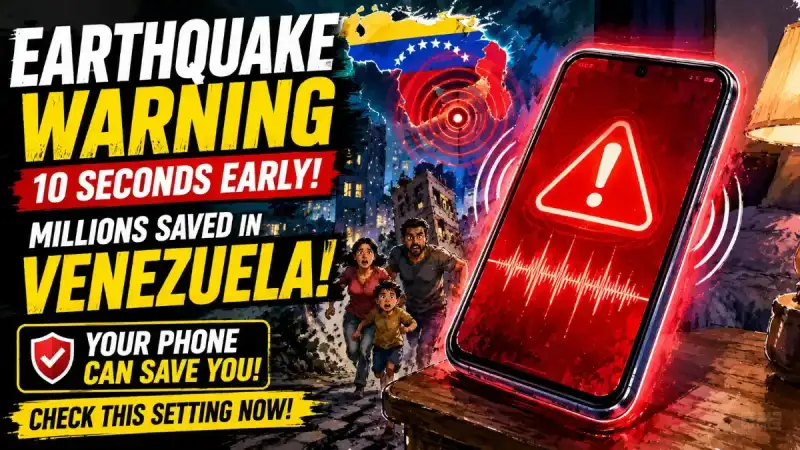
It was a quiet night in Venezuela. The entire city had slipped into a deep sleep, with only the streetlights flickering in the dark. Suddenly, shattering the midnight silence, a massive, piercing siren began blaring simultaneously inside thousands of homes. Panicked residents woke up to find their smartphones glowing with a bright red screen, making a terrifying noise. The message on the screen was clear: "Earthquake occurring, drop and cover immediately."
Still groggy from sleep, people barely understood what was happening. Yet, driven by the urgency of that glowing red warning, many scooped up their children and sprinted out of their homes. Exactly ten seconds after they reached the open streets, the ground began to shake violently. Right before their eyes, building walls cracked, and household items crashed to the floor.
Miraculously, not a single person suffered even a minor scratch. Why? Because ten seconds before the buildings started to crumble, the entire city's population was already standing safely on the road. This isn't a dramatic scene from a Hollywood disaster movie. It is a genuine, recent event. That night, millions of lives were saved not by magic, but by the smartphones sitting right in their pockets.
We often limit our technology to scrolling through reels or chatting with friends. However, this incident in Venezuela stands as the world's greatest testament to how technology can act as a massive protective shield. The 'Android Earthquake Alerts System' introduced by Google is quietly rewriting the history of global disaster management.
Not Magic, Just Science: How Your Phone Actually Works
We all know that governments spend millions of dollars installing massive seismometers (earthquake measuring machines) in remote forests and hilly terrains. But carrying these giant machines to every corner of the world is financially and physically impossible. Realizing this, Google did something brilliantly simple. It turned the smartphones in our hands into the world's largest network of mini-seismometers.
You might be wondering how this is even possible. Inside every modern smartphone is a tiny, highly sensitive sensor called an accelerometer. When you turn your phone sideways to watch a YouTube video, this is the sensor that automatically rotates your screen. This exact sensor is sensitive enough to detect the faintest vibrations deep within the earth.
When you leave your phone on a bedside table while you sleep, that sensor acts as a silent watchman, constantly waiting for any signs of a tremor. If it detects the specific frequencies of an earthquake, it wakes up instantly. This isn't just the story of one or two phones; millions of Android devices across a city do this work simultaneously.
 The Great Salary Divide: Massive Paychecks for AI Experts, Stagnation for the Rest
 Oracle’s AI Ambition Comes at a Human Cost: 7,000–10,000 Tech Jobs at Risk?
 NSE IPO Opens September 17: Share Price Set at ₹1,700–₹1,785 — Should Investors Apply?
 iOS 27 Update: What’s New, Which iPhones Are Supported, and Who Gets Siri AI?
 ₹156 Crore Technology Centre in Devanahalli: What It Could Mean for Small Businesses
The 10-Second Race Between Primary and Secondary Waves
When an earthquake strikes, two distinct types of waves travel from deep underground to the surface. The first to arrive are the Primary waves (P-waves). These travel incredibly fast but are harmless—they act as nature's messengers. Right behind them come the Secondary waves (S-waves). These travel much slower, but they are the destructive forces that rip through the earth and tear down buildings.
Google's technology operates precisely in the gap between these two waves. The moment the harmless P-waves hit the surface, thousands of phone sensors detect them. Instantly, these phones send a signal to Google's main servers at the speed of light. The servers crunch this massive amount of data in mere milliseconds to pinpoint the exact epicenter of the quake.
The next step is pure adrenaline. Before the destructive S-waves can reach the city, Google's servers blast a loud, overriding siren to millions of phones in the surrounding area. This entire process happens in the blink of an eye. Those ten to fifteen seconds of early warning are all a family needs to escape a collapsing roof, run down the stairs, and reach an open field.
The World's Largest Safety Net: A Google Masterpiece
When Google launched this project in 2021, it was merely an experiment. But in just two years, by 2023, it expanded to 98 countries, including India. Without installing a single new wire or physical machine, Google built the world's largest earthquake detection network entirely through software.
So far, this system has accurately detected over 18,000 earthquakes. During critical disasters, it has sent out official warnings over 2,000 times, saving countless innocent lives. Today, a staggering 2.5 billion Android users globally receive this protection completely free of charge.
You don't need to download any special third-party app, nor do you have to pay a single penny for a subscription. If you own an Android smartphone, this protective shield is built right into your operating system. Even when we are fast asleep, our phones stay awake, guarding us like loyal sentinels.
Why This Technology is Essential for India
For a densely populated country like India, this technology is an absolute blessing. Regions like the Himalayan foothills, Delhi, and the Northeast are highly sensitive seismic zones. Installing traditional machines in every village across these vast landscapes is economically draining. Often, if an earthquake strikes a remote village, the neighboring town only finds out after the disaster has already struck.
But today, almost every common farmer or daily wage worker has a basic smartphone in their pocket. That device has now transformed into an incredible life-saving tool. This takes a massive financial burden off the shoulders of government disaster management departments, while providing hyper-local, accurate data on where tremors are happening.
In the future, this technology will likely expand beyond earthquakes. By utilizing this same data and smartphone network, systems are being developed to provide early warnings for severe floods, extreme weather events, and cyclones. We are moving toward a future where your phone will alert you in your native language before the meteorological department even issues a bulletin.
Check Right Now: How to Enable This Setting on Your Phone
After reading these thrilling facts, it is natural to ask: "Does my phone have this feature? Is it turned on?" Don't just read and move on. Grab your phone, your parents' phones, and the devices of everyone in your house right now. Follow these quick steps to activate your safety shield today.
Step 1: Open the Settings app on your Android phone.
Step 2: Scroll down and find the Safety and Emergency section. (On some phones, you might find this under the Location settings).
Step 3: Tap on the option that says Earthquake Alerts.
Step 4: If the toggle button is off, turn it ON immediately.
Step 5: At the bottom of that same page, you will see a button that says See a demo. Tap it to experience exactly how loud the siren is and what the red screen looks like during a real earthquake.
Keep in mind: For this feature to work flawlessly, your phone's Location (GPS) and Internet connection (Wi-Fi or Mobile Data) must be turned on. Even if your phone is on silent mode or "Do Not Disturb," an earthquake alert will override those settings and blast the siren at full volume!
Do not limit your smartphone to passing the time. The exact same setting that saved the people of Venezuela could be the shield that protects your life tomorrow. Share this crucial information with your friends and family, and ensure this setting is enabled on every phone you care about. If you have any doubts, Tech Vaidya is always here to help!

No Comment Yet.
Stay informed with breaking news, trending stories, and in-depth analysis.
