Tech Vaidya WhatsApp Channel
Get AI updates, tech news, cybersecurity alerts and useful tech tips directly on WhatsApp.

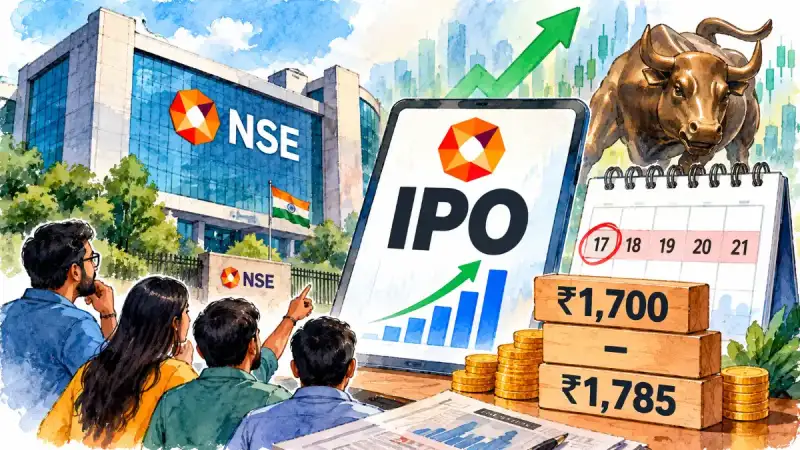
India’s stock market is preparing for one of its most closely watched public offerings. The National Stock Exchange of India, better known as NSE, is set to enter the public market with an Initial Public Offering that has already attracted significant investor attention. The IPO will open on September 17 and close on September 21, with the price band fixed between ₹1,700 and ₹1,785 per share.
For retail investors, the minimum lot consists of eight shares. At the lower end of the price band, one lot would require approximately ₹13,600, while the amount could rise to ₹14,280 at the upper end. Investors can apply for additional shares only in multiples of eight, subject to the applicable IPO rules.
The NSE IPO is important not simply because of its size, but because of the company behind it. NSE operates one of India’s most important financial market platforms. Its systems support equity trading, derivatives, clearing and settlement, market data, indices and several other financial services. The public issue therefore gives investors an opportunity to participate in the business infrastructure that supports India’s expanding capital market.
NSE IPO: Important Dates and Price Details
The anchor investor bidding process is scheduled for September 16. The IPO will open for other investors on September 17 and remain open until September 21. The face value of each share is ₹1, while the issue price has been fixed in the range of ₹1,700 to ₹1,785.
The minimum application size is eight shares. This means a retail investor applying at ₹1,700 per share would need around ₹13,600. At ₹1,785 per share, the minimum application amount would be approximately ₹14,280. The final amount will depend on the bid price selected by the investor and the allotment process.
The issue is structured as an Offer for Sale, or OFS. This means existing shareholders are selling their shares to the public. The company is not issuing a fresh set of shares to raise new capital through this offering. Instead, the shares being offered belong to existing investors and institutional shareholders.
Around 126.43 million shares are proposed to be offered through the IPO. The selling shareholders include financial institutions, investment organisations and other existing stakeholders. Since the issue is an Offer for Sale, investors should understand that the money raised through the share sale will primarily go to the selling shareholders rather than directly into NSE’s balance sheet.
 Oracle’s AI Ambition Comes at a Human Cost: 7,000–10,000 Tech Jobs at Risk?
 iOS 27 Update: What’s New, Which iPhones Are Supported, and Who Gets Siri AI?
 ₹156 Crore Technology Centre in Devanahalli: What It Could Mean for Small Businesses
 Terrier Cyber Quest 2026: Indian Army Opens a New Front in the Cybersecurity Battle
 Karnataka's Big AI Push: Data Centre Policy Nears Completion, AI University and Green Data Centres Gain Momentum
How Much Money Is Needed to Apply?
The minimum lot size is one of the most important details for retail investors. With eight shares in one lot, the minimum investment could range from ₹13,600 to ₹14,280, depending on the final bid price.
Investors who wish to apply for more shares must generally do so in multiples of eight. For example, applications may be placed for 8, 16, 24 or 32 shares, subject to the rules and limits applicable to the investor category.
However, a lower minimum application amount does not mean the IPO is risk-free. Even a company with a strong market position can see its share price fall after listing. The final listing price will depend on investor demand, market sentiment, the issue valuation and the overall condition of the stock market.
Investors should also avoid making decisions solely on the basis of unofficial grey market premiums or social media discussions. Such indications can change quickly and do not guarantee the actual listing performance of a stock.
Why NSE Is Important to India’s Financial System
The National Stock Exchange began operations in 1994 and played a major role in bringing electronic, screen-based trading to India. Over the years, it has developed into a broad financial market institution supporting equity trading, equity derivatives, currency derivatives, market indices, data services and clearing and settlement operations.
NSE is not merely a platform where investors buy and sell shares. It is part of the infrastructure that allows financial transactions to be processed, matched, cleared and settled. The reliability of this system is critical because millions of orders can enter the market within a very short period.
The exchange also plays a major role in derivatives trading. According to information shared by NSE, it has been one of the world’s largest derivatives exchanges by the number of contracts traded. It has also held a significant position globally in electronic order-book equity trading.
The size of NSE’s operations reflects the growth of India’s capital markets. As more individuals and institutions participate in equity and derivatives trading, the demand for faster, more reliable and more secure market infrastructure continues to increase.
Technology Is NSE’s Core Strength
Modern stock exchanges depend heavily on technology. Trading platforms must process a huge number of orders, messages and market updates within fractions of a second. Even a short technical interruption can affect thousands of investors and trading members.
NSE has stated that its systems process billions of messages on a regular basis. The exchange has also reported the ability to process very high volumes of orders across the cash market, equity derivatives and currency derivatives segments.
This level of performance requires powerful servers, low-latency networks, advanced risk management systems, strong cybersecurity and continuous monitoring. For an exchange, technology is not simply an internal support function. It is the foundation of the entire business.
The ability to maintain stability during periods of heavy trading is one of the most important factors that investors should consider while evaluating NSE. A strong technology platform can support growth, but technical failures, cyberattacks or prolonged service interruptions could damage market confidence.
Investor Participation Has Increased Sharply
The number of investors participating in India’s stock market has grown rapidly over the past few years. NSE has reported a significant rise in registered investors, supported by mobile trading applications, digital account opening, online verification and easier access to financial markets.
The exchange reported that the number of unique registered investors had grown from around 3.08 crore in March 2020 to more than 13 crore by June 2026. This expansion shows how stock market participation has moved beyond major cities and reached smaller towns and wider sections of the population.
NSE has also stated that investors are spread across more than 99% of India’s postal-code regions. This indicates that the country’s investment culture is becoming more widespread.
However, a rise in investor numbers also creates a need for better financial awareness. New investors must understand that stock market returns are not guaranteed. The ability to buy shares through a mobile application does not remove the risks associated with valuation, volatility and market cycles.
Where Does NSE Earn Its Revenue?
NSE’s revenue comes from several business segments. These include transaction charges from equity and derivatives trading, clearing and settlement services, index services, market data, analytics and other financial market activities.
NSE Clearing provides clearing and settlement services, while NSE Indices manages index-related activities. NSE Data and Analytics operates in the market data and information services segment. The group also has an international presence through its operations at Gujarat International Finance Tec-City.
This diversified business structure is important because NSE is not dependent on just one source of income. However, a large part of its business remains connected to trading activity and market participation. If trading volumes decline sharply, transaction-related revenue can also be affected.
NSE reported operating revenue of approximately ₹4,560 crore for the June 2026 quarter, compared with around ₹4,032 crore during the same period a year earlier. Its reported net profit for the quarter stood at approximately ₹3,121 crore, compared with ₹2,811 crore in the corresponding period of the previous year.
These numbers indicate strong financial performance, but investors should examine the complete financial statements and IPO documents before reaching a conclusion.
Where Will NSE Shares Be Listed?
The shares offered through the IPO are proposed to be listed on the Bombay Stock Exchange. This is a notable development because NSE itself is one of India’s leading stock exchanges, while its own shares are expected to be traded on BSE.
A strong listing is possible if investor demand remains high, but it should not be treated as a certainty. The listing price may be higher than the IPO price, lower than the IPO price or remain close to the issue price.
Market conditions, institutional demand, valuation, the performance of other financial stocks and the overall mood of investors will influence the stock after listing. The first day of trading may attract considerable attention, but long-term investors should focus on the company’s business performance rather than short-term price movements.
Risks Investors Should Consider
NSE has a strong position in India’s financial market, but that does not eliminate business risks. Its operations are affected by trading volumes, regulatory changes, technology performance, competition and investor participation.
Changes in market regulations could affect certain business segments. A prolonged decline in trading activity could reduce transaction-based income. Technical disruptions or cybersecurity incidents could damage the company’s reputation and affect confidence among trading members and investors.
Valuation is another important factor. A high-quality company can still become an unattractive investment if its shares are purchased at an excessive price. Investors should therefore evaluate both the strength of the company and the price at which the shares are being offered.
The IPO prospectus contains detailed information about the company’s business, financial position, risks, selling shareholders and the structure of the issue. Investors should read these documents carefully before applying.
Should You Apply for the NSE IPO?
The NSE IPO is a major event for India’s financial markets. The company operates critical market infrastructure, has a strong position in equity and derivatives trading, and has benefited from the rapid expansion of retail participation.
The price band of ₹1,700–₹1,785, the minimum lot size of eight shares and the September 17–21 application window are the key details retail investors should remember. The minimum application amount may be around ₹13,600 to ₹14,280, depending on the final bid price.
But investors should not assume that the IPO guarantees quick profits simply because NSE is a well-known institution. The Offer for Sale structure, valuation, regulatory environment, market conditions and post-listing demand must all be considered.
The NSE IPO offers investors exposure to one of the most important financial market institutions in India. Its technology infrastructure, market position, growing investor base and strong financial performance make it a closely watched public offering.
However, the right question is not simply, “Is NSE a big company?” The more important question is, “Is the IPO price suitable for my investment goals and risk capacity?”
NSE may be a strong business, but every investment decision must be based on valuation, risk and long-term objectives—not just the popularity of the company’s name.

No Comment Yet.
Stay informed with breaking news, trending stories, and in-depth analysis.