Tech Vaidya WhatsApp Channel
Get AI updates, tech news, cybersecurity alerts and useful tech tips directly on WhatsApp.

| Nagaraj Vaidya
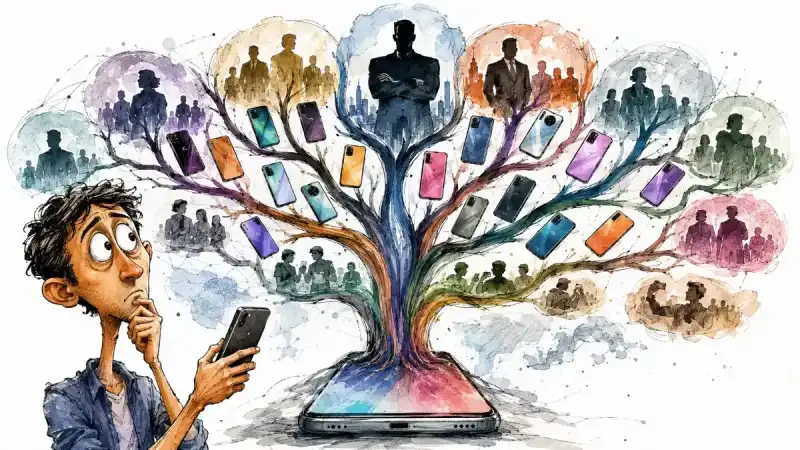
You probably know exactly which smartphone brand you carry. Apple, Samsung, Xiaomi, Redmi, POCO, OPPO, OnePlus, vivo, iQOO, TECNO, Infinix, Motorola, Nothing or perhaps one of the many other names fighting for space in the global smartphone market. But ask a deceptively simple question — “Who actually owns that brand?” — and the answer suddenly becomes much more complicated. Some names are independent companies, some are sub-brands, some belong to larger corporate groups, and some famous names are used under licensing arrangements. What looks like a crowded battlefield of dozens of smartphone companies is, in reality, a much more concentrated corporate ecosystem.
That distinction matters because a brand name and a company are not necessarily the same thing. A large technology company can create different brands to target different sections of the market: premium buyers, mainstream consumers, budget-conscious customers, gamers or younger users looking for performance. The products may have different designs, advertising campaigns and identities, while the companies behind them share corporate resources, technology, supply chains or strategic ownership. In other words, the smartphone shelf in a retail store can look far more competitive than the corporate structure behind it actually is.
Xiaomi’s Three-Face Strategy
Xiaomi offers one of the clearest examples of how this works. Xiaomi itself remains a major global smartphone company, while Redmi has developed into a major brand focused heavily on value-oriented devices. POCO, meanwhile, has built its identity around performance and aggressive specifications at competitive prices. The three names can appear to consumers as separate competitors, but they sit within the broader Xiaomi ecosystem. Xiaomi's own corporate information identifies the company as a major smartphone and consumer-electronics business, while its leadership structure continues to include responsibility for the Redmi brand.
This multi-brand strategy is commercially powerful because it allows one corporate group to address several customer segments without forcing every product to carry exactly the same identity. Someone looking for a premium Xiaomi device can stay within the Xiaomi family, while another buyer looking for value may choose Redmi and a performance-focused customer may gravitate towards POCO. The names change, the positioning changes and the marketing changes, but the broader corporate ecosystem remains connected.
That is one reason smartphone competition can be misleading at first glance. Two phones sitting next to each other may appear to be fighting for the same customer even when their brands belong to the same wider corporate family. Instead of one company trying to make one phone appeal to everybody, the multi-brand approach allows it to build several identities and compete across several price and performance segments simultaneously.
OPPO, OnePlus and the Corporate Puzzle
 World Smartphone Statistics 2025: The Numbers That Define Our Digital Life
 Apple Finally Folded the iPhone! Why the iPhone Duo Could Change the Smartphone Industry
 Why Is Typing Kannada on Apple Laptops Still So Difficult? Which Kannada Keyboard Is Best for Apple Computers?
 SSD vs. HDD vs. Cloud: Best Storage Solutions for Creatives
 TechVaidya: One Year. Over a Thousand Articles. And a long road still ahead...
The relationship between OPPO and OnePlus is another example of why smartphone ownership cannot always be understood simply by looking at logos. OPPO's own corporate history says that OnePlus was integrated into OPPO in 2021 and became a brand under OPPO. That means the two names can continue to have distinct identities in the marketplace while belonging to the same broader corporate structure.
This is an important distinction because OnePlus has built a strong identity of its own. Consumers may associate it with fast performance, clean design, enthusiast-focused products and a particular approach to Android smartphones. OPPO, meanwhile, has developed its own identity around camera technology, design, charging and premium smartphones. From a consumer's perspective, they can feel like separate brands with different personalities. From a corporate perspective, however, their relationship is much closer.
Realme adds another layer to the history of this smartphone ecosystem. Its corporate relationships and operating structure have evolved over time, which is precisely why old internet charts showing all of these brands under a single umbrella can become misleading. Smartphone ownership is not a permanent family tree. Corporate structures change, brands are reorganised and business relationships evolve. A chart that was accurate several years ago may no longer accurately describe the companies as they operate today.
vivo and iQOO: One Ecosystem, Different Personalities
vivo offers another interesting example through iQOO. iQOO was created with a strong emphasis on performance, speed and enthusiast-oriented experiences, while vivo has maintained a broader smartphone portfolio across multiple segments. vivo's own global material describes the iQOO series around performance and speed, and its current product ecosystem lists iQOO alongside vivo's smartphone ranges.
The strategy makes sense from a marketing perspective. A customer looking for a camera-focused or lifestyle-oriented smartphone can choose from vivo's mainstream portfolio, while a buyer prioritising gaming and high performance can be directed towards iQOO. Instead of forcing a single brand to appeal equally to every kind of customer, the ecosystem can give different groups a different identity.
This is where the word “sub-brand” becomes useful. A sub-brand is not necessarily a completely independent company operating in isolation. It can have its own design language, marketing strategy and product roadmap while still being closely connected to a larger corporate organisation. For consumers, that distinction is often invisible until they start looking into who actually makes, manages or controls the brand.
The Transsion Model: TECNO, Infinix and itel
If there is one corporate group that demonstrates the power of a multi-brand smartphone strategy particularly clearly in emerging markets, it is Transsion. The company officially identifies TECNO, Infinix and itel as its major mobile-phone brands. It describes TECNO as a premium innovative technology brand, Infinix as a technology brand aimed at younger consumers, and itel as a mass-market smart-life brand.
Walk into a smartphone market in many emerging economies and those three names can look like completely separate competitors. In reality, they are different faces of the same corporate group. That gives Transsion the ability to approach customers with different budgets and expectations without forcing every product into one brand identity.
The model is particularly interesting because it shows that multi-brand strategies are not just about having a premium brand and a cheap brand. Different brands can be designed around different consumer psychology. One can emphasise style, another performance, another affordability and another reliability. The company behind them can then build distribution, manufacturing and service infrastructure that supports the entire portfolio.
Transsion itself describes its business as a multi-brand smart-device strategy focused particularly on emerging markets. The company says its mobile-phone portfolio includes TECNO, itel and Infinix, alongside other businesses such as Carlcare, oraimo and Syinix.
Motorola Is Not an Independent Giant Anymore
Motorola is another name that can confuse consumers because its history is far older than its current corporate ownership. Motorola Mobility was acquired by Lenovo from Google in 2014, and Lenovo said at the time that Motorola would operate as a wholly owned subsidiary.
That means the Motorola name retained enormous consumer recognition even after its corporate ownership changed. This is one of the most powerful assets a technology company can acquire: not just hardware or patents, but a name that consumers already trust.
The same principle can be seen across the technology industry. A famous brand can survive a change in ownership because the value of the name itself is enormous. Consumers may continue to think of Motorola as Motorola, while behind the scenes the company operates within Lenovo's larger technology ecosystem.
Honor and the Huawei Confusion
Honor provides one of the clearest examples of why historical ownership and current ownership should never be mixed together. Honor was once part of Huawei, but Huawei announced in 2020 that it had agreed to sell the entire Honor business to Shenzhen Zhixin New Information Technology. Huawei's annual report records the transfer of its wholly owned interest in Honor Device Co. to Shenzhen Zhixin.
So while Honor's history is deeply connected with Huawei, it should not simply be described today as “Huawei's sub-brand.” The ownership changed. The brand name remained. That combination is exactly what creates confusion for consumers.
This is a recurring phenomenon in technology. A brand can carry its historical identity for years after the corporate structure behind it has changed. Customers remember the logo, the product name and the reputation far more easily than they remember acquisitions, shareholding structures and corporate transactions.
Nokia Shows Why “Brand Owner” and “Phone Maker” Are Different
Nokia's smartphone story is even more complicated because it demonstrates the difference between owning a brand and manufacturing products under that brand. Nokia Corporation has historically been one of the world's most important telecommunications technology companies, but Nokia-branded consumer phones have been produced through licensing arrangements.
Nokia's own corporate documentation describes brand partnerships and states that HMD Global had an exclusive global licence to create Nokia-branded mobile phones and tablets under the relevant agreement. Nokia also announced that HMD was moving towards a multi-brand strategy, including its own HMD-branded devices.
This means that seeing “Nokia” printed on a phone does not automatically mean the device was manufactured by Nokia Corporation itself. The brand can be licensed to another company for consumer devices. That is an important distinction in the modern technology business, where intellectual property and brand licensing can be just as important as physical manufacturing.
It also explains why some smartphone brand charts can be deceptive. A chart that simply places “Nokia” under “HMD” may be useful for understanding who made or marketed a particular device, but it does not necessarily mean HMD and Nokia are the same company. Ownership, licensing and manufacturing are three different concepts.
Google, Nothing and the Independent-BRAND Route
Google's Pixel strategy is comparatively straightforward. Pixel is Google's smartphone brand, tightly connected to Android and Google's broader software and AI ecosystem. Unlike some multi-brand groups, Google does not need a collection of smartphone names to target every possible price segment. Pixel itself is positioned as a premium smartphone experience built around Google's software, AI and hardware integration.
Nothing has taken a different route. The company has created a distinctive identity around industrial design and technology products, while CMF by Nothing has been used to address a more accessible, design-conscious segment. The result is another example of how a company can create different identities without necessarily creating completely independent corporations.
This approach is increasingly common in consumer technology. A company can maintain a strong flagship identity while creating another brand that experiments with price, materials, design or product categories. The benefit is flexibility: the parent company can explore a new market without forcing its flagship brand to change its entire identity.
ASUS, ROG and the Power of a Gaming Identity
ASUS and ROG illustrate the same principle from another angle. ASUS has a broad technology portfolio, while Republic of Gamers, or ROG, is positioned around gaming and high-performance hardware. The ROG identity has become powerful enough that many consumers immediately associate it with gaming technology rather than simply thinking of it as another ASUS product line. ASUS itself describes ROG as its gaming-focused brand.
That branding strategy works because gaming consumers often want something different from mainstream buyers. They care about performance, cooling, displays, refresh rates and specialised features. A dedicated gaming identity lets the company speak directly to that audience without changing the positioning of its mainstream products.
Sony follows a different premium strategy through Xperia, emphasising imaging, entertainment and creator-oriented experiences. Fairphone, meanwhile, has built its identity around repairability, longevity and sustainability. These examples show that smartphone segmentation is no longer just about price. A brand can be built around performance, photography, gaming, sustainability, software experience or even a particular philosophy of technology.
So, Who Are You Actually Buying From?
This is where the smartphone ownership map becomes genuinely useful. When you see a dozen smartphone brands in a store, you are not necessarily looking at a dozen completely independent companies. Some may belong to the same corporate group. Some may be subsidiaries. Some may be brands operating under licensing agreements. Others may genuinely be independent businesses.
That does not automatically make one phone better or worse than another. Corporate ownership is only one factor in deciding what smartphone to buy. Software support, security updates, repair availability, warranty service, data policies, hardware quality and long-term product support can matter far more to the actual owner of the device.
But knowing the ownership structure can help explain why the smartphone market looks the way it does. Why are there so many brands? Because companies have discovered that different names can target different consumers more effectively. Why do several brands sometimes release phones with remarkably similar specifications? Because they may operate within overlapping technology and supply-chain ecosystems. Why does a famous brand sometimes suddenly appear under a different corporate owner? Because the brand itself can be more valuable than the company that originally created it.
And this is why smartphone ownership charts should always be treated as snapshots rather than permanent maps. Corporate structures evolve. Brands are sold. Companies reorganise businesses. Licensing agreements expire or change. A brand that was once a subsidiary can become independent, while an independent brand can eventually become part of a larger group.
The deeper story behind the smartphone market, therefore, is not really about logos. It is about corporate strategy. Behind the name printed on the back of your phone sits a network of parent companies, subsidiaries, licensing agreements, manufacturing partners, software platforms, investors and supply chains. The consumer sees the brand; the industry sees the structure behind it.
So the next time someone says, “I use this brand because it is different from that one,” there is a surprisingly good question to ask: different how? Different logo? Different product strategy? Different software? Or genuinely different ownership? Once you start looking behind the branding, the global smartphone market begins to look less like a crowded battlefield of dozens of companies and more like a carefully organised family tree—with a few very large branches controlling far more of the forest than most consumers realise.

No Comment Yet.
Stay informed with breaking news, trending stories, and in-depth analysis.