Tech Vaidya WhatsApp Channel
Get AI updates, tech news, cybersecurity alerts and useful tech tips directly on WhatsApp.


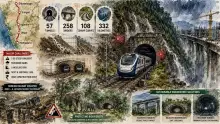
In yesterday's report, we vividly analyzed the terrifying technical challenges underlying this project. We laid out the harsh realities of constructing 57 massive tunnels, 258 bridges, navigating incredibly steep gradients, mitigating monsoon landslides, and remembering the tragic lessons of the Konkan Railway. However, the ultimate fate of this colossal project will not be decided merely on an engineer's blueprint. It will be determined by our legal loopholes, the fierce opposition from environmental scientists, and the historical precedents set by older railway projects currently stalled in the courts. This third investigative report sheds complete light on that dark legal warfare.
Part 3: Legal Loopholes and Lessons from History
| Nagaraj Vaidya
In India, no matter how magnificent a mega-infrastructure project looks on paper, or how many thousands of crores are allocated to its budget, it must inevitably pass through a grueling trial by fire in the courts of law and environmental justice before a single piece of earth is moved. The ₹3,300 crore Shivamogga-Sringeri-Mangaluru railway line, recently announced by the Union Government, will certainly not escape this rigorous ordeal.
In reality, long before heavy machinery arrives to drill through the mountains and clear the forests, all indications suggest that this project will be entangled in a complex legal labyrinth. The administrative system, which enthusiastically presents the public with a rosy picture of economic development, port connectivity, and tourism boosts, very cleverly conceals the harsh legal processes and the devastating environmental realities operating behind the scenes.
Laying 332 kilometers of iron tracks across the Western Ghats—one of the world's most sensitive biodiversity hotspots—is not merely an earth-moving exercise. It constitutes a severe and violent intervention into an entire ecosystem. To justify such a massive intervention within a legal framework, the system routinely exploits glaring loopholes embedded within our constitutional acts. Understanding how these legal blind spots are weaponized is a fundamental responsibility of every aware citizen today.

When introducing developmental projects, especially in forested regions, a severe lack of coordination among various government departments becomes glaringly obvious. While engineers draft technically feasible blueprints, the environmental department compiles a staggering list of ecological repercussions. In this bureaucratic tug-of-war, history shows us that legal obfuscation often emerges victorious.
The Ultimate Environmental Loophole: The Secret 'Green Card' for Railway Projects
 The Konkan Railway Legacy: Unforgettable and Tragic Lessons from the 2003 Landslide
 The Nightmare of Shiradi and Charmadi: Will the Coast Finally Get a Reliable Lifeline?
 Global Tech Leadership: How Indian Minds Are Steering Trillion-Dollar Tech Empires
 Are Aliens Real? The Pentagon's 160 Declassified Files Hold the Clues
 Agumbe’s Survival at a Crossroads: The Harsh Reality of Tunnels and Widening
The great war between the government and environmental scientists over ecological destruction almost always begins with a single, critical legal question. In our country, if the government wants to build a new national highway, construct a massive dam, or initiate a new mining operation, it must strictly adhere to the rules laid out in the Environment Protection Act of 1986.
Under these regulations, before any mega-project can commence, it is absolutely mandatory to conduct a comprehensive Environmental Impact Assessment through independent scientists. This rigorous study must publicly detail exactly how many trees will be destroyed, how much the groundwater table will deplete, and what level of distress will be inflicted upon local wildlife. Only after presenting these facts and addressing public grievances is a project given the green signal.
However, incredibly, a special provision tucked away in the antiquated Railway Act of 1989 completely overrides these stringent environmental regulations. According to this old act, there is absolutely no requirement to conduct such an independent, public Environmental Impact Assessment to construct new railway lines in India. The Railway Department enjoys total exemption from obtaining prior environmental clearances. By exploiting this massive loophole, governments find it incredibly easy to push projects forward without independent scrutiny.
But the story does not end there. While railway projects are exempt from standard environmental clearances, they are still bound by the Forest Conservation Act of 1980 and the Wildlife Protection Act of 1972. If a railway line must pass through protected forests, securing mandatory clearances from the Forest Department and the National Board for Wildlife is inescapable. It is at this exact juncture that environmental scientists launch their most potent legal battles, aiming to block entry into the forests based merely on superficial departmental reports.
The Hubballi-Ankola Legacy: 2.2 Lakh Felled Trees and a Supreme Court Reality Check
To accurately predict the future of the Shivamogga-Mangaluru railway project, one merely needs to revisit the dark history of the Hubballi-Ankola railway line, a project that has been rusting in legal limbo for decades. This proposed route spans a mere 168 kilometers, yet it is slated to pass through the exceptionally dense forests of the Kali Tiger Reserve buffer zone, the Malabar Hornbill conservation area, and the Bedthi river valley.
For this 168-kilometer stretch, estimated to cost between ₹2,500 and ₹3,000 crores, the Railway Department's own official reports admitted the horrific necessity of felling over 2.2 lakh massive, old-growth trees. Digesting this reality is incredibly difficult. If a relatively short 168-kilometer route demands the sacrifice of 2.2 lakh trees, what is the terrifying mathematical projection for the proposed 332-kilometer Shivamogga-Mangaluru route?
Slated to tear through the thickest forests of the Malnad region, this new project guarantees deforestation on an unprecedented scale. This is not merely about cutting timber; it is a fatal blow to countless millions of organisms, birds, and insects that rely on those specific trees for survival. The Hubballi-Ankola route was initially sold to the public using the exact same colorful dreams of massive economic profit and port connectivity. In 2020, yielding to heavy political pressure, the State Wildlife Board even hastily granted its approval.
However, environmentally conscious organizations immediately approached the High Court and secured a stay order. Eventually, a Central Empowered Committee appointed by the Supreme Court conducted a thorough ground study and delivered a report that sent shockwaves through the government. The committee explicitly stated that the ecological devastation caused by the project would be hundreds of times greater than any projected economic benefit. Thanks to decades of relentless legal intervention, that project remains entirely paralyzed today. It is an undeniable truth that the Shivamogga-Mangaluru project is heading toward the exact same legal paralysis.
Kudremukh and Someshwara: Severing Vital Wildlife Corridors in a UNESCO Heritage Site
If you closely examine the geographical blueprint of this new project, it is highly likely to pass through the 314 square kilometer Someshwara Wildlife Sanctuary, which was significantly expanded in 2011. Furthermore, it threatens to slice through the highly sensitive fringes of the Kudremukh National Park. A crucial point to note is that Kudremukh is not just an ordinary forest; it is an integral part of the Western Ghats, formally recognized as a UNESCO World Natural Heritage Site.
These incredibly dense jungles serve as the primary natural migration corridors for elephants, tigers, and leopards. Moving from one forest block to another in search of food, water, and breeding grounds is a natural process that animals have followed for centuries. Constructing a 332-kilometer barrier of iron tracks directly across this migration route will completely halt the free movement of these majestic creatures.
When freight trains weighing thousands of tons begin thundering through the forest all day, blasting deafening horns, the natural silence of the entire ecosystem will be shattered. Disoriented elephant herds and starving predators will inevitably be forced out of the forest fringes and into the neighboring Malnad villages, coffee plantations, and areca nut estates.
The districts of Hassan, Chikkamagaluru, and Shivamogga are already experiencing an uncontrollable spike in human-wildlife conflict. Farmers live in constant fear of elephant attacks every single day. If this railway line is constructed through the heart of the forest, the animals will permanently turn toward human settlements, exponentially escalating the conflict and making the lives of local farmers completely unbearable.
The Mathematics of Cumulative Impact: Predicting the Total Ecological Collapse of Malnad
There is a widespread misconception in our society that portrays environmental scientists and ecologists as inherent enemies of development. They are not opposing this project simply out of an emotional desire to save a few trees. Their genuine, scientifically grounded fear is not about the damage caused by just one single railway line. It is about the comprehensive calculation of the 'Cumulative Impact'—the totality of destruction that the Western Ghats have already suffered.
For decades, the Western Ghats have been under crushing pressure in the name of development. Massive hydroelectric projects like Sharavathi, Varahi, and Linganamakki have already submerged lakhs of hectares of prime forest land. Added to this, the relentless widening of national highways and the unchecked proliferation of resorts have severely compromised the geological stability of the mountain range. When you continuously encroach upon the forest for every new project, the ecosystem eventually loses its natural equilibrium. According to geologists, the Western Ghats have now reached that highly critical tipping point.
At such a fragile moment, blindly detonating dynamite to blast 57 massive tunnels without a comprehensive scientific study is an invitation to disaster. The intense seismic vibrations from these blasts pose a severe, long-term threat of permanently destroying the subterranean aquifers that feed the entire Malnad region. We cannot ignore the very real danger of natural water springs drying up forever.
The horrific landslides witnessed in recent years in Kodagu, Kerala's Wayanad, and Shiradi Ghat are the final, desperate warnings issued by nature. Environmental experts are merely placing this harsh reality before the government. Their stance is clear and logical: Yes, we absolutely need development, but it cannot come at the cost of annihilating the entire geographical and ecological foundation of the region.
Coming up tomorrow (Part 4): So, what is the ultimate solution to this fierce conflict between development and ecological conservation? Is true balanced development actually possible? What does a genuinely 'Green Solution' involving advanced tunnels, elevated viaducts, and eco-bridges look like? What are the five strict conditions for implementing true 'Sustainable Technology'? Do not miss the final, concluding part of this exclusive, in-depth campaign tomorrow.

No Comment Yet.
Stay informed with breaking news, trending stories, and in-depth analysis.