Tech Vaidya WhatsApp Channel
Get AI updates, tech news, cybersecurity alerts and useful tech tips directly on WhatsApp.

By Nagaraj Vaidya
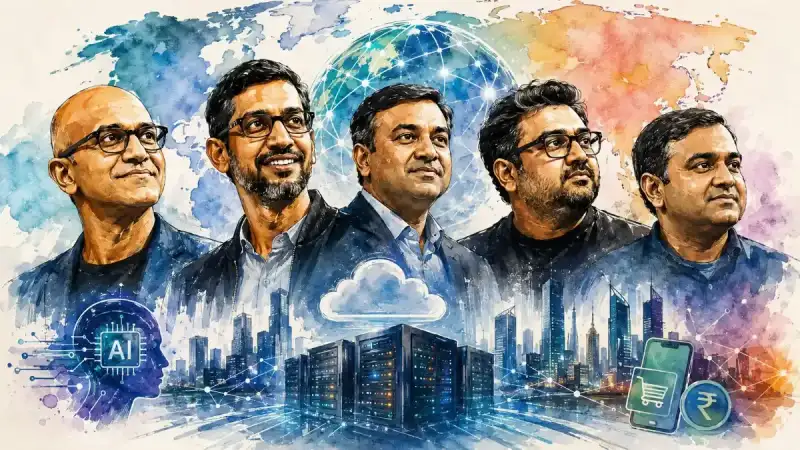
Imagine, for a moment, the most secretive and influential boardrooms in Silicon Valley, California. Every decision taken within those walls carries the power to alter the trajectory of the global economy. Today, technology behemoths like Microsoft, Google, IBM, Adobe, and YouTube have entrusted the keys to their future to leaders of Indian origin. This is one of the most intriguing developments unfolding in the global corporate world.
These positions were not secured on the basis of talent alone. When a company's market value crosses a trillion dollars, leading it requires more than just an engineer who writes the best code. Instead, it demands a diplomat who can manage pressures from a thousand different directions, negotiate with competitors, and steer millions of employees spread across the globe in a unified direction. Leaders possessing such characteristics are now earning the trust of the world's foremost technology companies.
How these leaders, who grew up on the streets of Hyderabad, Madurai, or Mumbai, are now steering American giants into a new era, is a remarkable study in itself. This leadership is not just a story of individual success; it is a reflection of the changing economic and technological realities of the global tech market. Here is an in-depth analysis of how Indian leaders are shaping the future of technology today.
Complex Markets and the Indian Mindset
The situation in Silicon Valley in the early 2000s was vastly different. Back then, companies were typically run by their founders, who were often aggressive and believed in monopolies. However, the current technology market has undergone a complete transformation. With the rise of cloud computing, artificial intelligence, and open-source technologies, no single company can survive in isolation. Sharing platforms, even with fierce rivals, has become a necessity of the times.
Growing up in a country as complex, resource-constrained, and perpetually uncertain as India has proven to be a boon for these leaders. Their very blood contains the strategy to not crumble when a plan fails, but to immediately seek alternative paths using available resources. Having been raised amidst multiple languages and cultures, they possess the patience and skill to integrate and draw work from diverse, global teams.
Furthermore, their unique combination of superior engineering skills and business management acumen has made them formidable leaders in the corporate arena. While possessing deep technical knowledge, they have also mastered the art of selling that technology to both the average consumer and large corporations.
 Why Is Typing Kannada on Apple Laptops Still So Difficult? Which Kannada Keyboard Is Best for Apple Computers?
 Apple Finally Folded the iPhone! Why the iPhone Duo Could Change the Smartphone Industry
 TechVaidya: One Year. Over a Thousand Articles. And a long road still ahead...
 NASA Invites ISRO to Join the Moon Base Mission: Why This Could Be a Turning Point for India
 Toxic Review: Yash Owns the Screen, But Does the Film Own the Story?
Satya Nadella and the Rebirth of Microsoft
When Satya Nadella took the helm at Microsoft in 2014, the company's situation was dire. It was trapped in a cycle of relying on Windows and Office software sales. In the smartphone era, Microsoft had been completely eclipsed by Apple and Google. At that time, a tough decision by Nadella changed the company's history. He unequivocally reduced Microsoft's decades-long dependence on the Windows operating system.
Instead, he shifted the entire company's focus onto Azure cloud services. His foresight that all future technology would operate through internet servers gave Microsoft a new lease on life. Another major decision he made was to wholeheartedly embrace open-source technology, a move that was not particularly popular in the American corporate world at the time. By acquiring the GitHub platform for 7.5 billion dollars, he successfully won over developers worldwide.
Today, the primary reason Microsoft has reached a market value of 3 trillion dollars is its focus on artificial intelligence. Recognizing the potential of OpenAI early on, Nadella invested a staggering 13 billion dollars in it. This masterstroke gave Microsoft a powerful lead in the AI race.
The lesson learned here is that leadership is not about predicting the future, but about pivoting the company towards it.
Sundar Pichai and Google's AI Battle
Sundar Pichai's success as CEO of Google began with the Chrome browser project, which now controls over 65 percent of the global browser market. Additionally, Android powers more than 3 billion devices. Pichai's calm and precise leadership has been instrumental in managing this massive user network. However, Pichai is currently facing the biggest and most dangerous challenge in Google's history.
With the advent of AI tools like ChatGPT, Google's primary revenue source, its Search engine, is facing a significant threat for the first time. People now want direct answers instead of searching through links. To confront this major crisis, Pichai rapidly developed and launched the Gemini AI model.
His current goal is not just to save the search engine. Instead, it is to transform every Google product, including Gmail, Docs, Maps, and YouTube, into an AI-centric ecosystem. This is an immense battle that could fundamentally alter Google's core nature.
The lesson learned here is that the biggest challenge is not external competition; it is the courage to change your own business model.
Kunal Shah at the Helm of WhatsApp: The New Super App
One of the most intriguing and recent developments in Indian leadership is Kunal Shah's entry into WhatsApp. Shah, who revolutionized India's digital economy through Freecharge and CRED, being chosen as the head of WhatsApp is not merely a leadership change. It is a major economic strategy for Meta.
India is WhatsApp's largest market. However, Meta earns negligible revenue from a free messaging app. Meta's goal is to leverage Kunal Shah's immense experience in India's digital payments and commerce sectors on a global scale. Shah is now tasked with transforming WhatsApp, which was once just a messaging app, into a global super app encompassing payment services, business messaging, and digital commerce.
If this attempt to make WhatsApp the central hub of everyone's economic and social lives, akin to China's WeChat model, succeeds, it could be the biggest milestone in the global tech sector. Many analysts view Kunal Shah's appointment as a crucial step in Meta's future growth strategy.
The lesson learned here is that those who understand user habits will lead the next wave of technology.
Neal Mohan and YouTube's New Direction
Neal Mohan's role in global technology is also highly critical. When Neal Mohan took over YouTube in 2023, the video market was undergoing a massive shift. YouTube was facing intense competition from short-form video platforms like TikTok. Mohan acted swiftly and aggressively promoted YouTube Shorts.
Today, Shorts garner a staggering 70 billion views per day. However, his real achievement lies not just in driving views but in creating a revenue stream for them. He expanded the advertising model, which was previously limited to long-form videos, to Shorts creators as well. By doing so, he retained creators who were leaving the platform and successfully strengthened the creator economy.
The lesson learned here is that a platform that helps content creators thrive is the one that will endure.
Arvind Krishna and IBM's Transformation
At IBM, Arvind Krishna's work is distinct from that of other CEOs. He faced the daunting challenge of transforming an old, massive, hardware-centric company into a modern software company. He made stringent decisions and divested low-profit businesses from the company.
He pivoted the entire company towards hybrid cloud and enterprise AI. Through the Watson X platform, IBM is now successfully providing AI services to the world's largest corporations. Arvind Krishna's leadership serves as an exemplary model for how large, established companies can adapt to new technologies without going bankrupt.
The lesson learned here is that even old institutions can be reborn in a new era.
The Biggest Question That Lies Ahead
While the fundamental technological inventions still originate in American labs, the skill of Indian CEOs in transforming them into profitable global businesses is now universally acknowledged. Amidst massive challenges like data privacy, AI regulations, and the global economic downturn, these leaders are consistently increasing their companies' revenues.
The fact that Indians today lead global technology companies is a matter of immense pride for all of us. This is a victory for their strategy, hard work, and foresight. The Western corporate world has acknowledged the power of the Indian intellect.
However, a different and more significant question looms before us. In the next decade, will India become a nation that builds its own trillion-dollar giants and makes its own fundamental inventions? Or will we remain merely exceptional managers, steering technology created by Western companies? The true test of Indian leadership lies not in growing others' companies, but in building our own global tech empires.

No Comment Yet.
Stay informed with breaking news, trending stories, and in-depth analysis.
