Tech Vaidya WhatsApp Channel
Get AI updates, tech news, cybersecurity alerts and useful tech tips directly on WhatsApp.

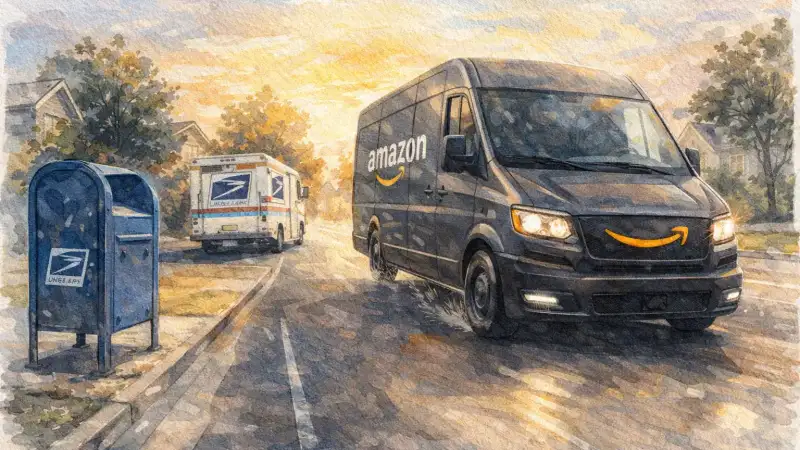
If you have looked out your front window recently expecting a familiar blue and white postal truck to drop off your latest online shopping haul, you might have noticed a distinct shift. More often than not, it is a sleek, dark gray van sporting that iconic smile logo pulling into your driveway. For years, the United States Postal Service was the undisputed backbone of Amazon’s last-mile delivery strategy, acting as the ultimate bridge between massive fulfillment centers and your front porch. But a seismic shift is happening right under our noses, and it is poised to change the American logistics landscape forever.
According to a recent bombshell report from Engadget, Amazon has officially forged a new operational reality that will see its package volume handed off to the USPS slashed by a staggering 20 percent. This is not just a minor corporate adjustment or a temporary routing glitch. This is a calculated, multi-billion-dollar maneuver by the e-commerce titan to take complete ownership of its supply chain. For the everyday consumer, it might just mean a different uniform walking up the driveway, but for the logistics industry, it is a Category 5 hurricane.
To truly grasp the magnitude of this 20 percent cut, we have to understand the symbiotic, yet fragile, relationship these two giants shared. The Postal Service, despite its financial struggles, had an unparalleled network capable of reaching every single address in the United States, six days a week. Amazon capitalized on this legacy infrastructure to build its Prime empire, essentially using the government agency as a heavily discounted courier service. But as Amazon grew from an online bookstore into the "everything store," relying on an aging federal institution became a bottleneck rather than a benefit.
The Backstory: From Unlikely Partners to Bitter Rivals
The turning point did not happen overnight. For the better part of the last decade, Amazon has been quietly, relentlessly building a shadow empire of logistics. They started leasing their own cargo planes, buying thousands of delivery vans, and creating the Delivery Service Partner program, which essentially franchised local delivery operations to independent contractors. While the USPS was busy fighting political battles and dealing with budget deficits, Amazon was pouring billions into becoming the most ruthless, efficient shipping company on the planet.
Why does this matter right now? Because we have finally crossed the tipping point. Amazon’s internal network has matured to the point where it no longer needs a safety net for its densest, most profitable routes. By severing 20 percent of the volume previously handled by the postal service, Amazon is sending a loud and clear message to Wall Street and its competitors: we are no longer just a retailer; we are a fully independent freight and logistics superpower.
This move is fundamentally about absolute control and profit margins. Every time Amazon hands a package over to a third-party carrier, they lose a fraction of their profit and, more importantly, they lose control over the customer experience. If a package is delayed by a snowstorm or a sorting error at a legacy post office facility, the customer blames Amazon, not the mail carrier. By cutting out the middleman, Amazon keeps the profits in-house and ensures that their strict, algorithmic standards for delivery speed are met without compromise.
The Brains of the Operation: How Artificial Intelligence Drives the Vans
 When Microsoft 365 Goes Down, the World Comes to a Standstill: Is Too Much of Our Digital Life in One Company's Hands?
 Oracle’s AI Ambition Comes at a Human Cost: 7,000–10,000 Tech Jobs at Risk?
 NSE IPO Opens September 17: Share Price Set at ₹1,700–₹1,785 — Should Investors Apply?
 iOS 27 Update: What’s New, Which iPhones Are Supported, and Who Gets Siri AI?
 ₹156 Crore Technology Centre in Devanahalli: What It Could Mean for Small Businesses
You cannot replace a national postal service without some seriously heavy technological firepower. The secret weapon allowing Amazon to confidently drop 20 percent of its USPS volume is its terrifyingly smart artificial intelligence and predictive routing algorithms. Long before you even click the checkout button, Amazon’s machine learning models are anticipating your purchase, moving inventory to a warehouse geographically closer to your zip code.
Once the package is boxed, the real magic begins. Amazon’s logistics software calculates millions of variables in real-time. It looks at traffic patterns, weather forecasts, the exact cubic volume of the delivery van, and even the walking distance from the curb to your front door. The system then dynamically decides if it is cheaper and faster to keep the package in the Amazon ecosystem or hand it off to a legacy carrier.
Increasingly, the math is pointing inward. The AI has realized that with enough density—meaning enough packages going to the same neighborhood—it is exponentially cheaper to send an Amazon-branded van than to pay the USPS parcel rate. This technology operates with a level of precision that a traditional postal service, burdened by decades-old sorting machines and unionized labor rules, simply cannot match. Amazon is playing a high-speed game of digital chess, while the legacy carriers are still playing checkers.
The Shockwave: Who Wins and Who Bleeds in the Current Market
The immediate financial impact of this deal is nothing short of devastating for the United States Postal Service. For years, Amazon’s massive package volume has been the lifeblood keeping the agency afloat as traditional first-class mail revenues plummeted. Losing a fifth of that business overnight leaves a gaping hole in the postal budget. The USPS is now staring down a catastrophic revenue loss, forcing them to figure out how to maintain a massive national infrastructure with significantly less income.
On the flip side, the everyday Prime subscriber is emerging as the immediate winner in this corporate divorce. With Amazon taking tighter control over the last mile, consumers will likely see an increase in the reliability of same-day and next-day deliveries. When Amazon controls the driver, the vehicle, and the route, the friction of transferring packages between different corporate entities disappears. Your dopamine hit of instant retail gratification is about to get even faster.
However, there is a hidden casualty in this transition: the small business owner. If the USPS loses a massive chunk of its revenue from Amazon, it has to make up that money somewhere else to survive. This inevitably leads to price hikes for postage and parcel services. Small Shopify merchants, independent creators, and local businesses who rely on affordable postal rates will be left holding the bag, paying higher shipping costs while Amazon enjoys the cost-saving benefits of its private fleet.
The Future of Your Front Porch: A Monopoly in Motion
Looking ahead, this 20 percent cut is clearly just the appetizer. As Amazon continues to scale up its electric Rivian van fleet, perfect its drone delivery technology, and build micro-fulfillment centers in urban neighborhoods, their reliance on outside carriers will only shrink further. It is not difficult to imagine a future where Amazon handles 99 percent of its own deliveries, completely freezing out traditional carriers from the e-commerce boom they helped build.
For the postal service, this represents an existential crisis that will require immediate government intervention or a radical restructuring of how mail is delivered in America. We may soon see a reality where the USPS goes back to delivering mostly paper bills and junk mail, while Amazon controls the physical distribution of actual goods.
Ultimately, this bold maneuver proves that in the modern tech economy, whoever controls the logistics controls the world. Amazon has successfully transformed its biggest operational expense into its most lethal competitive advantage. The next time you see that gray van pull up to your curb, realize you are not just getting a package; you are witnessing the aggressive, calculated takeover of the American delivery infrastructure.
❤️ Also Read
❤️Android 15 Under 10K? Lava Bold N2 Pro 4G India Launch at 12 PM Today
❤️The AI App Illusion: Why Free Artificial Intelligence is Bankrupting Silicon Valley?
❤️Death by Algorithm: How Claude AI is Redefining Battlefield Lethality?
❤️Tragedy on a Reel: How a Teen's Fatal Stunt in Hubballi Exposes the Dark Side of Digital Addiction
❤️Digital Betrayal: 1,530 Broken Rain Gauges Robbing Karnataka Farmers of Insurance!
❤️The Trillion Rupee Tech Gamble: Why India Is Spending 11 Billion Dollars On Microchips?
❤️Is ChatGPT Losing Its Sanity? The Dark Side of OpenAI's New 'Adult Mode' Plans
❤️The AI PC Era: Why Indian Enterprises are Switching to NPU-Powered Laptops
🟢 Follow our WhatsApp Channel JOIN ➤
🛒 ಆನ್ಲೈನ್ ಶಾಪಿಂಗ್ ಮಾಡುವಾಗ ಈ ಕೆಳಗಿನ ಲಿಂಕ್ ಬಳಸಿ

No Comment Yet.
Stay informed with breaking news, trending stories, and in-depth analysis.