Tech Vaidya WhatsApp Channel
Get AI updates, tech news, cybersecurity alerts and useful tech tips directly on WhatsApp.

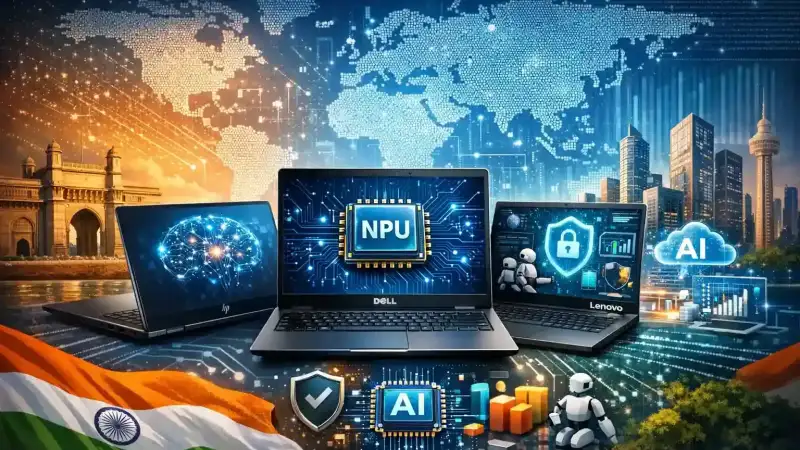
The Indian enterprise computing landscape is undergoing a seismic shift as AI-powered laptops transition from futuristic novelties to essential business tools. This transformation is driven by a collective push from global tech giants like Lenovo, HP, and Dell, who are aggressively launching AI-accelerated PCs tailored for the Indian corporate sector. As businesses across the country strive for greater efficiency and enhanced digital capabilities, these next-generation machines are becoming the cornerstone of modern workplace infrastructure.
The core of this hardware revolution lies in the integration of dedicated Neural Processing Units (NPUs). Unlike traditional laptops that rely solely on CPUs and GPUs, these AI PCs feature specialized silicon designed specifically to handle complex machine learning tasks. By offloading AI workloads to the NPU, the system achieves significantly higher efficiency, allowing for smoother multitasking and extended battery life. This architectural change represents the most significant leap in personal computing since the advent of multi-core processors.
On-device AI processing is the primary value proposition for Indian enterprises navigating a data-sensitive environment. Historically, most AI applications required a constant cloud connection, leading to latency issues and potential security vulnerabilities. With AI-powered laptops, productivity tools and automation features run locally on the device. This "Edge AI" approach ensures that sensitive corporate data never leaves the machine, providing a layer of privacy that is critical for sectors like finance, healthcare, and law.
Speed and reduced latency are immediate benefits of this shift toward local processing. In a fast-paced corporate setting, waiting for a cloud-based AI to generate a meeting summary or translate a document can hinder workflow. AI PCs eliminate this bottleneck by providing real-time responses. Whether it is enhancing video call quality through background noise cancellation or automating complex data analysis in Excel, the presence of an NPU ensures that these tasks are performed instantaneously without taxing the main processor.
Major device manufacturers are recognizing India as a high-growth market for this technology. Lenovo, HP, and Dell have not only introduced their flagship AI models here but are also focusing on localized support and enterprise-grade security features. Their strategy involves more than just selling hardware; it is about providing a comprehensive AI ecosystem that includes software optimizations and hardware-level threat detection. This competitive environment is accelerating the adoption of AI PCs across various business tiers in India.
Market analysts from IDC highlight that the surge in demand is closely linked to the rising adoption of generative AI software. As companies integrate AI into their daily operations, the need for hardware that can support these demanding applications becomes non-negotiable. India’s enterprise market is particularly receptive to this change, with IT hubs like Bengaluru, Hyderabad, and Pune leading the charge in upgrading their legacy systems to AI-ready infrastructure.
The impact of AI laptops extends far beyond the IT sector. In manufacturing, these devices are being used for real-time supply chain monitoring and predictive maintenance modeling. In education and creative industries, AI-accelerated PCs allow for faster rendering and intelligent content creation tools that were previously only possible on high-end workstations. This democratization of high-performance computing is empowering a wider range of professionals to leverage AI in their specific domains.
Future-proofing is a significant driver for corporate procurement teams. Investing in standard laptops today may result in technical debt within a year or two as AI-driven software becomes the industry standard. By opting for AI PCs now, Indian enterprises are ensuring that their hardware remains relevant and capable of handling future software updates that will increasingly rely on NPU capabilities. This forward-thinking approach is essential for maintaining a competitive edge in a globalized economy.
 Goodbye Chemo? Scientists Built a Smart DNA Sniper That Kills Only Cancer Cells — The 2026 Breakthrough Explained
 Apple’s New Mac mini and Mac Studio Aren’t Just Faster Macs — They’re Built for the AI Agent Era
 The Robot Beat Usain Bolt’s 100-Metre Time. What Happened After the Finish Is More Important
 What Did Starship Prove on Its 13th Test Flight? A Milestone, or Just Another Step Forward?
 AI Won't Replace Doctors. But the Hospital You Visit Five Years From Now Could Look Completely Different
The shift toward AI-powered devices also signals a change in how we perceive the role of a computer. No longer is it just a tool for input and output; the AI PC acts as a proactive collaborator. Features like intelligent power management, which learns a user’s habits to optimize performance, and advanced cybersecurity that detects anomalies in real-time, transform the laptop into a smart assistant. For the Indian workforce, this means less time spent on mundane administrative tasks and more time for strategic decision-making.
The Indian market's enthusiasm for AI PCs is also a reflection of the country's growing digital maturity. With a massive pool of developers and a rapidly digitizing economy, India is uniquely positioned to maximize the benefits of on-device AI. As more local startups develop AI-based solutions, the demand for hardware capable of running these local models will continue to skyrocket. This synergy between software innovation and hardware availability is creating a robust tech ecosystem.
As we move deeper into 2026, the distinction between a "laptop" and an "AI laptop" will likely disappear, as AI capabilities become a standard requirement for all enterprise-grade hardware. The initial wave of adoption we are seeing now in India is just the beginning of a broader transformation. Businesses that embrace this technology early are not just upgrading their machines; they are reimagining their entire operational workflow for an AI-first world.
Is your organization ready to lead the charge in the AI revolution? The transition to AI-powered laptops is more than a hardware upgrade—it is a strategic move toward a more secure, efficient, and intelligent future. Explore the latest range of AI PCs from Lenovo, HP, and Dell today to empower your workforce with the tools of tomorrow and stay ahead in the rapidly evolving Indian enterprise market.
❤️ Also Read
❤️Agumbe’s Survival at a Crossroads: The Harsh Reality of Tunnels and Widening
❤️Vanishing Springs: The Hidden ‘Thirst’ Behind the Agumbe Tunnel
❤️Intel Under the Lens: Lawmakers Target Chinese Supply Chain Links
❤️Inter-Agency Conflict Stalls AI Trade Progress: Why Chinese Tech Giants Are Hesitating to Order
❤️The Governance Gap: Why America Lacks a Unified AI Law
❤️Talos of Greek Mythology: Was This the World’s First Robot Concept?
❤️Google Pixel Watch March 2026 Feature Drop - Everything You Need to Know
🟢 Follow our WhatsApp Channel JOIN ➤
🛒 ಆನ್ಲೈನ್ ಶಾಪಿಂಗ್ ಮಾಡುವಾಗ ಈ ಕೆಳಗಿನ ಲಿಂಕ್ ಬಳಸಿ

No Comment Yet.
Stay informed with breaking news, trending stories, and in-depth analysis.