Tech Vaidya WhatsApp Channel
Get AI updates, tech news, cybersecurity alerts and useful tech tips directly on WhatsApp.

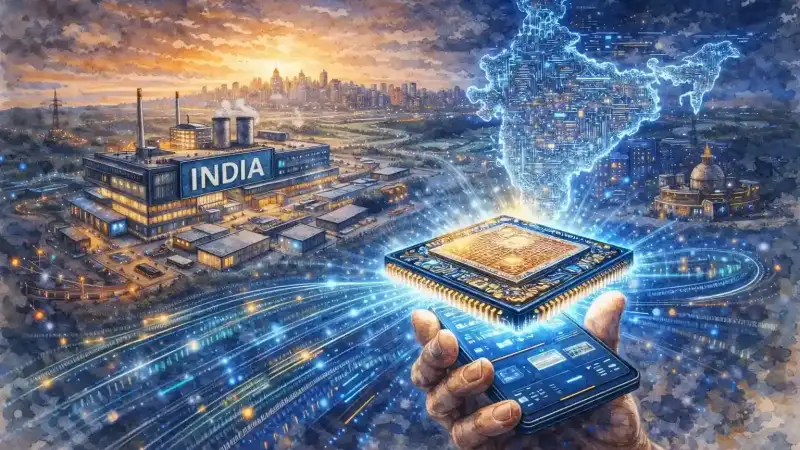
Imagine holding your smartphone, starting your car, or turning on a life-saving medical device. Now, imagine all of them suddenly stopping because a tiny piece of silicon the size of a fingernail is missing! This is not a science fiction scenario. It is the harsh reality of the modern global economy, where semiconductors are the new oil. Recognizing this extreme dependency, the Indian government is preparing a massive geopolitical and economic masterstroke.
A staggering Rs 1 lakh crore, which roughly translates to 11 billion dollars, is being mobilized to create a brand new semiconductor investment fund. This is not just a policy announcement! It is India declaring its absolute ambition to become a dominant force in the global technology race. But why is this happening right now, in 2026?
To understand the magnitude of this 11 billion dollar gamble, we must look at the historical background of global electronics. For decades, the world relied heavily on a handful of countries in East Asia to manufacture these critical components. When global supply chains choked during recent geopolitical tensions, assembly lines from Detroit to Chennai ground to a massive halt.
India quickly realized that importing nearly 100 percent of its semiconductor needs was not just an economic drain, but a massive national security vulnerability. The country needed to manufacture its own brains for the digital age, shifting from being merely a software superpower to a formidable hardware titan. How does a nation make such a massive pivot?
This new initiative does not emerge from a vacuum. It aggressively builds upon the foundation laid by the India Semiconductor Mission and previous incentive schemes that successfully attracted initial investments. However, the global landscape in 2026 demands a much larger war chest. Countries across the Americas and Europe are pouring billions into their own chip subsidies!
To stay competitive and entice global semiconductor manufacturing giants to set up fabrication plants on Indian soil, the government knew it had to drastically increase its financial commitment. The Rs 1 lakh crore fund is the exact financial magnet needed to attract these capital-intensive mega-projects. But what does building a semiconductor ecosystem actually entail?
Building a semiconductor fabrication plant, or a fab, is widely considered the most complex manufacturing process ever achieved by human beings. It requires billions of dollars in upfront capital, incredibly sophisticated machinery, and environments that are thousands of times cleaner than a hospital operating room. By providing direct financial subsidies, the Indian government dramatically reduces the immense risk for global technology firms.
This 11 billion dollar fund acts as a massive safety net, encouraging these titans to bring their most advanced manufacturing technologies to Indian shores. The technology itself is mind-boggling! We are talking about printing billions of microscopic transistors onto silicon wafers using extreme ultraviolet lithography. These transistors are so small that you could fit thousands of them across the width of a single human hair.
 Union Budget 2026 Will it Power Up India's Tech Sector Dreams of AI and Semiconductors
 Why Is Typing Kannada on Apple Laptops Still So Difficult? Which Kannada Keyboard Is Best for Apple Computers?
 Apple Finally Folded the iPhone! Why the iPhone Duo Could Change the Smartphone Industry
 TechVaidya: One Year. Over a Thousand Articles. And a long road still ahead...
 NASA Invites ISRO to Join the Moon Base Mission: Why This Could Be a Turning Point for India
The new policy ensures that India does not just import this technology, but masters it completely. By funding not only the massive fabs but also the crucial Assembly, Testing, Marking, and Packaging facilities, the government is ensuring the entire lifecycle of a microchip can happen domestically. Furthermore, this investment is strategically designed to plug the massive gaps in the local electronics supply chain.
For a long time, India has been assembling smartphones and televisions using imported parts. The true value addition happens when the core components inside these devices are made locally. This fund acts as the gravitational pull for a massive ancillary ecosystem. When a giant chip manufacturer sets up shop, hundreds of smaller suppliers providing specialized chemicals, ultra-pure gases, and precision tools will naturally follow.
The current impact of this aggressive policy push is already sending shockwaves through the global technology sector. Boardrooms in Silicon Valley and Taipei are taking India very seriously as a prime destination for their China Plus One strategy. Global firms are actively seeking alternative manufacturing hubs to diversify their supply chains and mitigate geopolitical risks. With an 11 billion dollar incentive on the table, India is suddenly transforming from a potential future market into an immediate and highly lucrative manufacturing partner!
The economic ripple effect of this Rs 1 lakh crore fund will be unprecedented. We are looking at the creation of hundreds of thousands of highly skilled jobs. Indian engineers who traditionally moved abroad to work in the semiconductor industry will now find cutting-edge opportunities in their own backyard. Beyond the researchers and scientists, these mega-factories will require legions of skilled technicians, machine operators, and logistics experts.
From a macroeconomic perspective, the reduction in import dependence will be an absolute game-changer. India currently spends tens of billions of dollars annually importing electronics and semiconductors. By manufacturing these chips locally, the country will save massive amounts of foreign exchange. Moreover, self-reliance in semiconductors directly translates to enhanced national security! Critical infrastructure like defense systems, telecommunications networks, and power grids will run on locally fabricated chips, eliminating the fear of foreign spyware or supply chain sabotage.
Looking ahead into the late 2020s and beyond, the future impact of the semiconductor fund will fundamentally alter India's global standing. Once the first wave of mega-fabs becomes fully operational, India will transition from being a consumer of technology to a net exporter of deep-tech hardware. The knowledge transfer facilitated by this 11 billion dollar fund will ignite local innovation, empowering Indian startups to design and manufacture custom chips for emerging fields like artificial intelligence, electric vehicles, and space exploration.
However, the path to becoming a global semiconductor hub is not without immense challenges. These fabrication plants require absolutely uninterrupted power and millions of liters of ultra-pure water daily. The government must ensure that this massive financial incentive is matched by flawless infrastructure execution at the state level. Will this massive financial gamble successfully dethrone the established global manufacturing giants? Share your thoughts on how this trillion-rupee investment will change the future of Indian technology in the comments below!
❤️ Also Read
❤️Vanishing Springs: The Hidden ‘Thirst’ Behind the Agumbe Tunnel
❤️Death by Algorithm: How Claude AI is Redefining Battlefield Lethality?
❤️THE DRAGON'S CODE: INSIDE CHINA'S TECH SUPERPOWER AMBITIONS
❤️The Silent Digital Heist: How Video Games Are Draining Parents Bank Accounts
❤️Agumbe’s Survival at a Crossroads: The Harsh Reality of Tunnels and Widening
❤️Google Pixel Watch March 2026 Feature Drop - Everything You Need to Know
❤️National Security Shift: Why the US is Protecting Crypto Networks?
❤️ByteDance and the Great Silicon Pivot: Why SeedChip Matters for Global AI
🟢 Follow our WhatsApp Channel JOIN ➤
🛒 ಆನ್ಲೈನ್ ಶಾಪಿಂಗ್ ಮಾಡುವಾಗ ಈ ಕೆಳಗಿನ ಲಿಂಕ್ ಬಳಸಿ

No Comment Yet.
Stay informed with breaking news, trending stories, and in-depth analysis.