Tech Vaidya WhatsApp Channel
Get AI updates, tech news, cybersecurity alerts and useful tech tips directly on WhatsApp.

| Nagaraj Vaidya
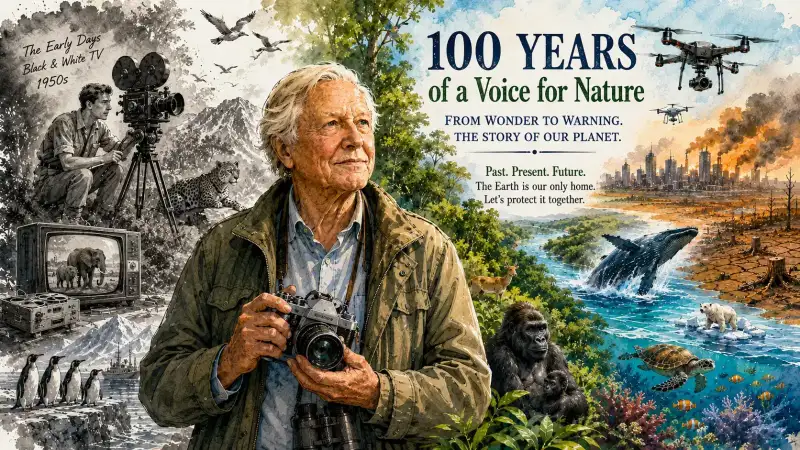
From the microscopic movements of insects on a damp forest floor to the haunting calls of blue whales echoing through the deep ocean, one voice has masterfully translated the profound mysteries of nature for the human ear. In May 2026, the world celebrates the remarkable 100th birthday of Sir David Attenborough. For decades, he has been far more than a mere presenter of wildlife documentaries. He has steadily evolved into the undisputed global conscience for the natural world, transforming how humanity perceives its relationship with the planet.
His century-long journey is not just the biographical account of a single man; it is the definitive chronicle of humanity's evolving understanding of the natural world. In an era when wildlife was mostly read about in encyclopedias or viewed as taxidermy in quiet museums, Attenborough brought the raw, unfiltered wild directly into drawing rooms. His true genius lies not merely in delivering scientific facts, but in elevating complex biology into an unparalleled art of storytelling. When he speaks in hushed tones while crouching a few feet away from a silverback gorilla, the viewer is instantly transported to the heart of the Rwandan jungle.
Over a career spanning more than seven decades, his footprints have graced every continent on Earth. From the freezing, desolate expanses of Antarctica to the searing heat of the African savanna, he has witnessed it all. The breathtaking imagery he helped capture and the narratives he wove did not just serve as entertainment. They forged an educational weapon that awakened the environmental consciousness of multiple generations. Through his enduring career, one can also trace the fascinating evolution of broadcasting technology itself.
From Black-and-White Screens to 4K Drones: The Evolution of Wildlife Storytelling
A closer look at Attenborough's early career reveals a timeline perfectly synchronized with the history of television technology. When he joined the BBC in the 1950s, television was still locked in a black-and-white era. The cameras of the time were massive, cumbersome pieces of machinery, and carrying them into untamed wilderness was nothing short of an extreme adventure. Audio recording was equally primitive. Yet, instead of narrating tales from the safety of a London studio, he pioneered the practice of taking the lenses directly into the natural habitats of wild animals.
His influence on British broadcasting history extends far beyond his on-screen presence. In 1965, during his tenure as the controller of BBC Two, he was responsible for introducing color television to the United Kingdom. He recognized early on that the true majesty of the natural world—the iridescent feathers of a bird of paradise or the vibrant hues of a coral reef—could never be fully appreciated in grayscale. This technological leap permanently altered the trajectory of wildlife documentaries, bringing an unprecedented level of intimacy and realism to the screen.
The release of the monumental 13-part series 'Life on Earth' in 1979 marked a watershed moment in television history. Viewed by an estimated 500 million people worldwide, the series unfolded the complex story of evolution with the gripping intensity of a blockbuster cinematic epic. Before this, documentaries were largely seen as dry, academic material. Traveling to remote corners of the globe, Attenborough and his dedicated crew utilized the best optical technology available at the time, setting a new gold standard for visual storytelling.
 Why Is Typing Kannada on Apple Laptops Still So Difficult? Which Kannada Keyboard Is Best for Apple Computers?
 Apple Finally Folded the iPhone! Why the iPhone Duo Could Change the Smartphone Industry
 TechVaidya: One Year. Over a Thousand Articles. And a long road still ahead...
 NASA Invites ISRO to Join the Moon Base Mission: Why This Could Be a Turning Point for India
 Toxic Review: Yash Owns the Screen, But Does the Film Own the Story?
The Changing Face of the Earth: A Stark Contrast Between 1926 and 2026
As the years rolled on, technology advanced at a blistering pace, and Attenborough seamlessly integrated these innovations into his craft. Cameras became lighter, and lenses became astonishingly powerful. The advent of slow-motion technology allowed viewers to witness the exact mechanics of a cheetah's sprint or a kingfisher's dive in granular detail. Micro-photography unveiled the hidden, alien-like landscapes of the insect world, while infrared cameras pierced the pitch-black night to reveal the secret lives of nocturnal predators.
In more recent masterworks like 'Planet Earth II' and 'Blue Planet II', drone technology and pristine 4K resolution created a visual spectacle that left audiences spellbound. Whether it was the sweeping aerial shots of massive animal migrations or a snow leopard hunting on a treacherous, snow-capped peak, technology pushed the boundaries of what could be captured. However, Attenborough never allowed the technology to overshadow the narrative. The camera remained a tool—a third eye designed to explore nature's depths, complementing the story rather than dominating it.
Visuals alone, however, do not complete the sensory experience. The rustle of dry leaves, the cracking of ancient glaciers, and the silent tension of a hunt were captured using state-of-the-art audio equipment. This flawless marriage of cutting-edge sight and sound is what kept millions glued to their screens, creating an immersive experience that fueled humanity's growing hunger to understand the world it inhabited.
From Pure Wonder to Urgent Warning: The Shift in Attenborough’s Global Message
In the earlier decades of his career, Attenborough's documentaries were driven predominantly by a sense of celebration. The tone was filled with pure wonder, curiosity, and an eagerness to introduce audiences to bizarre and beautiful creatures. During those days, the Earth was significantly greener, and the catastrophic scale of deforestation was not yet apparent. His voice reflected the sheer joy of discovery. But as time marched forward, the lenses that once captured pristine wilderness began to document a slow, devastating tragedy.
Driven by an insatiable thirst for industrial development, dense rainforests were replaced by expanding concrete jungles. Glaciers that had stood for millennia began to melt into the oceans. Thousands of unique species lost their habitats and vanished entirely. For a man who had intimately known these landscapes decades prior, returning to find them decimated was a heartbreaking reality. Consequently, the tone of his narration fundamentally shifted; the awe was increasingly replaced by a deep sense of anxiety and an urgent warning.
In his later works, this cautionary stance became unmistakable. He stopped framing climate change, ocean acidification, and biodiversity loss as distant scientific anomalies. Instead, he presented them as the most critical moral failures of modern humanity. In his twilight years, he became a fierce advocate for the planet, delivering the hard truth that the responsibility to save the Earth lies squarely on our shoulders, and that failing to act equates to engineering our own extinction.
The Man Behind the Lens: A Legacy of Humility and Hope for the Planet's Future
Measuring the span of Attenborough's life is essentially reading a critical chapter of the Earth's environmental history. When he was born in 1926, the global population hovered around a mere 2 billion. Carbon dioxide levels in the atmosphere were stable, and more than 60 percent of the Earth's surface was enveloped in wild, untouched nature. Today, as he turns 100 in 2026, the population has surged past 8 billion, wilderness areas have shrunk to less than 30 percent, and global carbon emissions have pushed the climate to a breaking point.
His poignant documentary 'A Life on Our Planet' serves as his ultimate witness statement. Armed with undeniable data and visual proof, he laid bare the stark contrast between the world he was born into and the world he is leaving behind. He exposed the grim reality of coral bleaching, the suffocating presence of ocean plastics, and the devastating impact of wildfires. Yet, his warnings have never been designed merely to instill fear; they are always accompanied by a resilient, positive vision that it is not too late to reverse the damage.
Despite the global fame, the knighthood, and the universal adoration, David Attenborough has remained fundamentally humble. Veterans of his filming crews fondly recall how he would insist on carrying heavy equipment alongside young camera operators. In an era dominated by smartphones and instant messaging, he preferred the personal touch of writing letters by hand, diligently responding to fans through the post. His authenticity on screen is merely a reflection of his genuine character off it.
The core of his century-long legacy is anchored in one powerful, simple truth: if humanity has the power to destabilize the entire planet, it also possesses the intelligence and capability to save it. His 100th birthday is far more than a milestone on a calendar. It is a moment for global reflection, a final reminder from the ultimate storyteller that the natural world is a fragile masterpiece. The greatest tribute we can offer to the voice that showed us the Earth is to ensure we pass it on to the next generation in a better state than we found it.
❤️ Also Read
❤️Our 'Photographic Memory' and AI's 'Digital Alzheimer's'!
❤️SpaceX IPO Trap or Opportunity? How Musk Commands 79% of Votes with Just 42% Equity
❤️An Invisible War on US Soil: Iranian Hackers Infiltrate American Infrastructure
❤️Why Apple EarPods Are Still My Favorite in the TWS Era?
❤️David Attenborough at 100: The Century-Old Voice That Brought Nature to Our Living Rooms
🟢 Follow our WhatsApp Channel JOIN ➤
🛒 ಆನ್ಲೈನ್ ಶಾಪಿಂಗ್ ಮಾಡುವಾಗ ಈ ಕೆಳಗಿನ ಲಿಂಕ್ ಬಳಸಿ

No Comment Yet.
Stay informed with breaking news, trending stories, and in-depth analysis.
