Tech Vaidya WhatsApp Channel
Get AI updates, tech news, cybersecurity alerts and useful tech tips directly on WhatsApp.

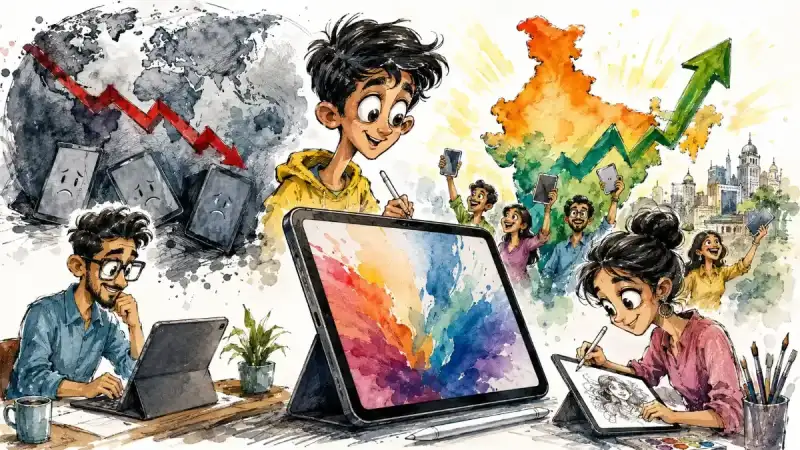
There was a time when buying a tablet was an easy decision to explain. Parents bought them for online classes, travelers used them for movies, and everyone else saw them as a bigger screen for YouTube and streaming. A tablet was essentially the device sitting between a smartphone and a laptop, without quite belonging to either category. In 2026, however, that definition is starting to look outdated.
The global market tells one story, while India is telling another. Worldwide tablet shipments fell to 33.6 million units in the second quarter of 2026, down 12.3% from the same period a year earlier. Rising memory costs and supply pressures have added to the industry's problems, but the bigger question is whether consumers still see tablets as essential devices. In India, the answer appears to be increasingly yes.
India's tablet market grew 2% in 2025, while shipments jumped 14% in the final quarter of the year. The momentum continued into the first quarter of 2026, when the market recorded another 5% year-over-year increase. That doesn't look like explosive growth at first glance, but it becomes more interesting when you look at what people are actually buying and, more importantly, what they are using these devices for.
The Indian tablet story isn't simply about more people buying tablets. It is about tablets becoming useful for more things. Education remains important, but work, online meetings, digital note-taking, design, content creation and multitasking are increasingly becoming part of the equation. That shift could give tablets a second life in a market where many had already written them off.
Tablets Are No Longer Just Oversized Phones
A large display was once the biggest selling point of a tablet. Today, that's no longer enough. Demand for tablets with displays larger than 12 inches has been rising in India, suggesting that consumers increasingly want screen real estate for actual work, not just entertainment. A bigger display makes it easier to read documents, manage spreadsheets, work across multiple apps and handle presentations.
That is also making the line between tablets and laptops increasingly blurry. A few years ago, the distinction was simple: laptops were for work, tablets were for entertainment. Today's tablets can be paired with keyboards, used with styluses, run multiple applications and pack increasingly powerful processors. At the same time, laptops are becoming thinner, lighter and more touch-friendly.
For consumers, the calculation is surprisingly simple. Not every task requires a laptop, but plenty of tasks are uncomfortable on a smartphone. Reading PDFs, checking documents, attending online classes, responding to email, reviewing presentations or joining video meetings can all be handled comfortably on a tablet. Instead of replacing the laptop outright, tablets are becoming alternatives for the situations where carrying a laptop feels unnecessary.
 Why Is Typing Kannada on Apple Laptops Still So Difficult? Which Kannada Keyboard Is Best for Apple Computers?
 Apple Finally Folded the iPhone! Why the iPhone Duo Could Change the Smartphone Industry
 TechVaidya: One Year. Over a Thousand Articles. And a long road still ahead...
 NASA Invites ISRO to Join the Moon Base Mission: Why This Could Be a Turning Point for India
 Toxic Review: Yash Owns the Screen, But Does the Film Own the Story?
The shift is also visible in pricing. In 2025, shipments in India's $350-$470 tablet segment increased dramatically, with the category growing roughly sevenfold. That suggests consumers aren't simply searching for the cheapest possible tablet anymore. They are increasingly willing to spend more on better displays, faster processors, more storage and a device they can rely on for several years.
5G Is Changing What a Tablet Can Be
Connectivity is another major part of the story. Traditionally, a tablet was something you used at home or in the office, connected to Wi-Fi. If you took it outside, you often had to rely on your phone's hotspot. Cellular tablets, particularly 5G models, are gradually removing that limitation.
In 2025, cellular tablets accounted for a larger share of India's market than Wi-Fi-only models. Within the cellular segment, 5G accounted for 43% of shipments. That may sound like just another specification, but it points to a broader change: tablets are increasingly being treated as standalone connected devices rather than secondary screens.
For a student, that can mean attending a class without searching for Wi-Fi. For a traveling professional, it can mean reviewing documents or joining a meeting without carrying a laptop. For someone working outside the office, having a large display and cellular connectivity in the same device can be a genuinely useful combination.
But 5G alone isn't driving the market. It is part of a larger package that includes bigger displays, better processors, longer battery life, keyboards and styluses. Put together, those features are moving tablets away from their old identity as oversized smartphones and toward something closer to lightweight computing devices.
From Students to Designers, the User Base Is Changing
Education remains one of the strongest reasons people buy tablets. Digital textbooks, handwritten notes, recorded lectures, exam preparation and educational apps all work naturally on a large touchscreen. A tablet is easier to carry than a laptop while offering considerably more screen space than a phone.
But students are no longer the only important audience. Digital artists, designers, photographers, content creators and professionals who regularly work with presentations and documents are also finding practical uses for tablets. A high-quality display combined with a stylus can make sketching, annotating documents or taking handwritten notes feel much more natural than doing the same thing on a phone.
That is changing the question consumers ask before buying one. Instead of asking, "Is this good for watching YouTube?" the question increasingly becomes, "How much of my daily work can I actually do on this?" That's a much more powerful question for the tablet industry because people tend to spend more on devices that contribute directly to work and productivity.
This is also helping premium tablets gain traction. If a tablet is going to be used for several hours every day, spending more on a better screen, faster processor and larger storage starts to make sense. The tablet is no longer being treated as an occasional entertainment gadget. For some buyers, it is becoming part of their everyday computing setup.
India's Market Is Growing, But the Numbers Need Context
Looking at 2025 alone, India's tablet market grew by only 2%. That is hardly a spectacular number. But the 14% growth recorded in the final quarter is more revealing, particularly because the momentum carried into the first quarter of 2026 with another 5% increase.
There is another important distinction. India's overall tablet shipment numbers have been affected by fluctuations in commercial and government orders. The consumer segment has been considerably stronger. In other words, consumer interest in tablets hasn't disappeared even when the broader market has faced pressure from institutional purchasing cycles.
The manufacturing side is changing, too. India's domestic tablet production increased by more than 61% year over year in the first quarter of 2026. Tablet exports from the country also crossed 200,000 units during the period. That means India's tablet story is no longer simply about people buying devices; it is increasingly about India becoming part of the manufacturing and export chain as well.
That could become increasingly important for manufacturers. Producing more devices locally gives companies an opportunity to serve India's growing consumer market while also using the country as an export base. As global technology companies continue looking to diversify their supply chains, India's growing electronics manufacturing capacity could become an additional advantage for the tablet industry.
Samsung, Apple, Lenovo and Xiaomi Are Fighting a Different Battle
The competitive landscape is changing along with consumer expectations. Samsung remained India's leading tablet brand in 2025, followed by Apple and Lenovo. Xiaomi was among the fastest-growing major brands, with its tablet shipments in India increasing 74% during the year.
Samsung has a broad portfolio ranging from mainstream Galaxy Tab models to premium devices. Apple continues to dominate the premium end of the market with the iPad. Lenovo has been pushing larger displays and productivity-focused devices, while Xiaomi has been competing aggressively on pricing and accessories.
That means the battle is no longer simply about who can offer the most RAM at the lowest price. Display quality, processor performance, stylus support, keyboard accessories, battery life, software and the ability to connect seamlessly with phones and computers are becoming increasingly important. The next phase of the tablet war could be less about specifications on a box and more about the overall ecosystem.
Why India Is Different While the Global Market Struggles
Part of India's advantage comes down to price and production. Rising memory costs have put pressure on tablet manufacturers globally, and higher component costs can make consumers think twice before upgrading. Some major brands have already raised prices on selected devices in 2026.
India is not completely insulated from those pressures. But increasing local production and aggressive competition among brands can help soften some of the impact. At the same time, demand for 5G connectivity, larger screens and higher-end configurations is creating new reasons for consumers to upgrade.
That doesn't mean India's tablet market is guaranteed to grow indefinitely. Higher prices could eventually hurt entry-level buyers. Smartphones are becoming more powerful and larger, foldable phones are slowly expanding into the mainstream, and affordable laptops continue to compete for the same customers.
The tablet therefore has to keep proving why it deserves a place in a consumer's bag. Simply being bigger than a phone is no longer enough.
Could AI Become the Tablet's Next Big Opportunity?
Artificial intelligence could give tablets another reason to exist. Some newer devices already offer on-device AI processing, writing assistance, image tools, smart note-taking and AI-powered search. As processors become more capable, more AI functions could run directly on the device instead of relying entirely on the cloud.
This is where tablets have an interesting advantage. They combine a larger display with touch input, stylus support and portability. Imagine taking handwritten meeting notes and having them converted into organized text, summarizing a long document directly on the device, editing an image with a few gestures or using AI to turn rough sketches into polished concepts.
But simply putting an AI label on a tablet won't make it successful. Consumers need features that solve real problems. "This tablet has AI" is a weak selling point. "This tablet can save me 30 minutes every day" is a much stronger one. The companies that can turn AI into genuinely useful everyday features may have an advantage in the next phase of the market.
Smaller Cities Could Become the Next Growth Engine
India's technology adoption is no longer limited to the biggest metropolitan areas. Online education, digital services, e-commerce and remote work have expanded the need for larger-screen computing devices across a much broader part of the country. Tablets fit that demand particularly well because they offer more screen space than a phone without the size and weight of a traditional laptop.
It would be premature, however, to claim that smaller cities are definitively responsible for the majority of India's tablet growth. Available market data does not provide enough detail to make such a sweeping conclusion. What is clear is that India's next wave of technology adoption is not dependent only on the largest cities.
As education, digital services and remote work continue expanding, tablets have more opportunities to find new users. That could become increasingly important as the premium smartphone market becomes more expensive and consumers look for a second device that can handle work and entertainment without costing as much as a full laptop setup.
Will Tablets Actually Replace Laptops?
Not completely. At least not anytime soon.
Laptops still have a major advantage when it comes to demanding professional software, complex video editing, coding, heavy multitasking and long hours of keyboard-driven work. A tablet doesn't necessarily need to beat a laptop at all of those tasks. Its real advantage is doing a surprisingly wide range of everyday tasks while remaining lighter and easier to carry.
That means tablets and laptops may continue to coexist rather than one completely replacing the other. One person may need both. Another may find that a tablet with a keyboard is enough. Someone else may use a tablet primarily for creative work while keeping a laptop for heavier workloads.
The tablet is therefore competing with more than just laptops. Smartphones, foldables, compact PCs and cloud-based computing are all fighting for the same consumer attention. To survive that competition, tablets need to offer something distinctive rather than simply being larger versions of devices people already own.
India's Tablet Story Is Just Getting Interesting
The global tablet market is under pressure. That's real. But assuming India will simply follow the same path would miss what is happening on the ground.
India's market gained momentum toward the end of 2025 and continued growing in early 2026. Demand is shifting toward larger displays, 5G connectivity and better hardware. Domestic manufacturing is expanding, brands are competing more aggressively and consumers are increasingly using tablets for work rather than treating them purely as entertainment devices.
Most importantly, the definition of a tablet is changing. It can be a student's digital notebook, a professional's lightweight workstation, a designer's sketchpad, a creator's editing screen or a traveler's portable computer.
That may explain why tablets still have room to grow in India while other markets struggle. Around the world, the question may increasingly be, "Why do I need a tablet?" In India, the question is starting to become, "What else can I do with one?"
And that difference could be more important than any shipment number.
The future of tablets won't be decided by screen size, RAM or 5G alone. It will be decided by how useful these devices become in people's everyday lives. In India, that space is getting bigger — and the tablet's second act may turn out to be far more interesting than its first.

No Comment Yet.
Stay informed with breaking news, trending stories, and in-depth analysis.