Tech Vaidya WhatsApp Channel
Get AI updates, tech news, cybersecurity alerts and useful tech tips directly on WhatsApp.

| EnVee
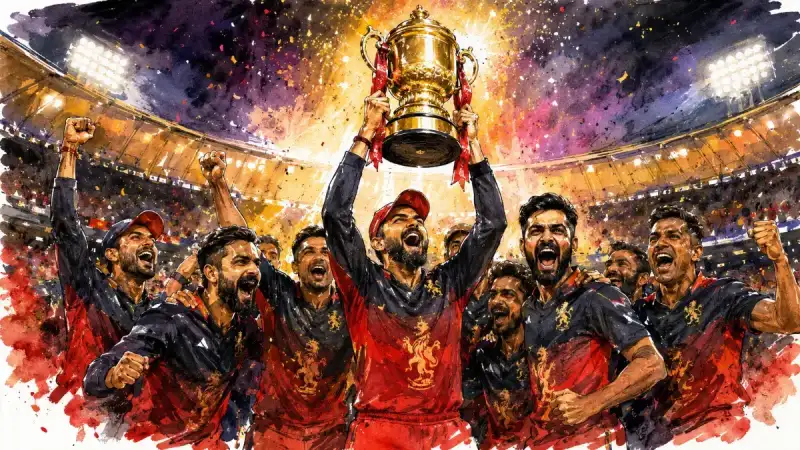
Last night, the internet witnessed an undeclared digital funeral. Not of a person, but of a massive meme that had fed social media algorithms and sustained millions of troll pages for 15 years. That meme was the global mockery that the Royal Challengers Bengaluru would never win a cup. By defeating the Gujarat Titans by 5 wickets in the IPL 2026 final, RCB secured their second consecutive title and made history. In doing so, they completely erased the old 'chokers' tag and transformed into a true trophy machine.
This is not a standard sports report. It is the psychological transformation of a brand. In sports history, when a team consistently loses, a negative ecosystem forms around it. The entire internet, including X and Instagram, turns that failure into a business. However, by winning back to back IPL titles, RCB has altered the very coding of this ecosystem. Joining the ranks of Chennai and Mumbai, Bengaluru is no longer just an emotion; it has upgraded into an unbeatable operating system.
Digital algorithms always push negativity the hardest. Once, an RCB loss was enough to send the engagement metrics of global troll pages skyrocketing. But with this consecutive trophy win, the franchise has delivered a direct 404 Error to the trolls' database. The 'chokers' default setting, created by continuous defeats, has now been completely formatted. Meme creators are now forced to decode RCB's secret code of success rather than mocking them. This is a massive technical shift that has changed the internet's navigational direction.
Technically speaking, the old RCB squad was an overloaded server resting on the shoulders of just two or three superstars. Whenever traffic spiked during crucial matches, that server was bound to crash. However, the current RCB operates on a distributed network model. Every player functions like an independent micro-service, ensuring that even if one department fails, the system does not collapse, providing instant backup. This perfect hardware and software balance has turned the team into an invincible machine.
The psychology of the fans has also undergone a massive shift. 'Ee Sala Cup Namde' was once just an emotional loop—a blind hope with no guarantee. Today, that emotional loop has been upgraded into a programmed logic. The faces of the fans entering the stadium no longer show old anxieties; instead, they carry the precise confidence of defeating their opponents. This psychological migration from hope to assurance is a rare case study in sports psychology. Moving forward, fans will no longer just dream of winning the cup; they will assert their right to retain it.
From a corporate and business perspective, this transformation has increased RCB's brand value tenfold. A franchise that attracted the highest number of sponsors even while losing has now elevated its return on investment to a global scale by winning consecutive trophies. Brands that previously invested merely on entertainment value are now pouring money into domination value. Every single social media post from RCB has now grown into an economic powerhouse, generating million-dollar engagements.
Ultimately, RCB has rewritten its own historical source code. Ten years from now, the new generation of tech-savvy youth watching the IPL will have no knowledge of the history where RCB was considered a losing team. To them, it will only be known as a dynasty or a trophy machine designed specifically to win cups. These spectacular victories in 2025 and 2026 have installed a permanent security patch over the bitter memories of the past. Brand transformation is not just about changing a logo or a jersey; it is about radically changing the human mindset, and this is living proof.
 Why Is Typing Kannada on Apple Laptops Still So Difficult? Which Kannada Keyboard Is Best for Apple Computers?
 Apple Finally Folded the iPhone! Why the iPhone Duo Could Change the Smartphone Industry
 TechVaidya: One Year. Over a Thousand Articles. And a long road still ahead...
 NASA Invites ISRO to Join the Moon Base Mission: Why This Could Be a Turning Point for India
 Toxic Review: Yash Owns the Screen, But Does the Film Own the Story?
'Mr. IPL' Rewires the Stadium's Psychology
Chasing the modest target of 156 runs set by the Gujarat Titans was not merely a battle between bat and ball. It was a massive mind game of controlling the psychology of over a hundred thousand spectators. When the match began at the Narendra Modi Stadium in Ahmedabad, the atmosphere heavily favored Gujarat. But as RCB began their chase, Virat Kohli hijacked the entire stadium's navigation system with his bat. The whole nation watched in awe as Ahmedabad slowly transformed into Bengaluru's Chinnaswamy Stadium.
Smashing an unbeaten 75 off just 42 deliveries, Virat Kohli recorded one of the fastest final half-centuries of his career. For the critics who once analyzed his strike rate with data, this innings was the perfect reply. Internet users immediately set aside the King Kohli tag and initiated new trends like Mr. IPL and Finisher King. With the most runs, the most centuries in IPL history, and now another consecutive final match-winning knock, this is not just sports; it is a masterclass execution.
King vs Prince: Flipped Social Media Narratives
Before the final, the biggest discussion in the online world was 'King vs Prince'. A massive build-up suggested a generational handover between Virat Kohli and Shubman Gill. Algorithms were pushing the narrative that the young captain Gill would become the new ruler of this era. But in the final stage, human experience proved far more powerful than machine learning. Gill faded, and Virat reigned supreme. Using pictures of a defeated Gill, netizens began trolling him as 'Prince Gill'. The internet is ruthless; it does not think for a second before throwing someone it elevated yesterday into the abyss today.
The Moment That Hijacked the Internet's Dopamine
Sports and the release of dopamine in the human brain share a direct connection. The moment the winning runs were hit, Virat Kohli looked toward the gallery and blew a flying kiss to his wife, Anushka Sharma. Anushka responded with the same affection. This brief visual instantly became the biggest viral content of the night. More than cricket analysis, this romantic moment began ruling the internet. Fans, calling Anushka RCB's lucky charm and trophy queen, blended sports with family values to create a phenomenal digital emotion.
During the qualifier match, a mysterious ring worn by Anushka had generated dozens of theories on social media. Seeing the same ring on her hand as she held the trophy today, digital detectives are weaving new narratives that the ring is the secret code behind RCB's success. All these events have elevated the RCB brand from a mere cricket team to a global pop-culture phenomenon.
Celebrities and politicians across the country took to their X accounts to express their joy over RCB's triumph. Cricket legend Sachin Tendulkar wrote, "Success changes the questions you have to face. RCB handled that challenge brilliantly." Deputy Chief Minister D.K. Shivakumar tweeted, "From the first match to the final, the RCB team has shown hard work, discipline, and excellent teamwork. This is another honor for our Bengaluru." Above all, former player AB de Villiers' post, "This time... 2x Namdu #RCB," felt like a true victory for an entire generation of players who had left the field in tears without a cup.
On the other hand, the creativity of trollers knew no bounds. Netizens dug up an old video of a man who had challenged to shave his head completely if RCB won, making him the internet's new victim by declaring that the time for him to go bald had finally arrived. Videos of Gujarat Titans fans crying throughout the tournament became the comedy merchandise of the digital world.
Winning the Cup, But Skipping the Parade
When does a team truly feel mature? Not in the uproar it creates when it wins, but in the restraint it shows during the moment of victory. When RCB won their first cup last year, 11 innocent fans lost their lives in a stampede during the victory celebrations in Bengaluru. RCB has not forgotten that dark history. Despite winning a consecutive IPL title this time, they did not opt for a loud public parade. Instead, they offered a heartfelt tribute to those 11 fans and sent a clear message to their supporters: "Celebrate at home."
This was not just a franchise decision; it was the ultimate move of a responsible corporate brand. The RCB management proved that no trophy is bigger than the fans who lost their lives for their team. This single gesture has established RCB not just as a trophy-winning team, but as one of the most morally outstanding sports franchises in the world.
The slogan "Ee Sala Cup Namde," which was once trolled across the entire cricket world, has today turned into the most influential documentary of sports history. What was just a dream two years ago is now an unbreakable record. Virat Kohli's bat, Anushka Sharma's smile, the memory of lost fans, and RCB's consecutive IPL trophy—this is not just a scoreboard statistic. It is a historical masterpiece where sports, digital culture, and human emotions intersect at a single point.

No Comment Yet.
Stay informed with breaking news, trending stories, and in-depth analysis.