Tech Vaidya WhatsApp Channel
Get AI updates, tech news, cybersecurity alerts and useful tech tips directly on WhatsApp.

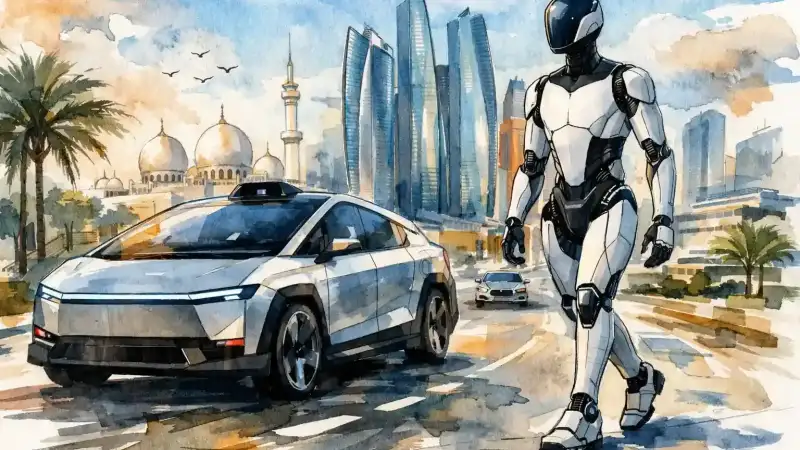
The global mobility landscape is undergoing a massive transformation, and Tesla continues to position itself right at the epicenter of this seismic shift. Moving far beyond its original identity as a pure electric vehicle manufacturer, the company is rapidly evolving into a dominant force in artificial intelligence and robotics. The most recent developments highlight a highly aggressive global expansion strategy, beginning with the highly anticipated introduction of its Full Self-Driving technology to completely new and diverse markets.
In a significant milestone for the company, Tesla has officially commenced Full Self-Driving pilot tests in Abu Dhabi. This move marks the automakers very first foray into testing its advanced autonomous driving capabilities within the Middle East. Abu Dhabi, known for its rapid modernization, pristine road infrastructure, and strong governmental push towards smart city technologies, provides an ideal testing ground for Teslas vision-based autonomous systems.
The data gathered from the complex, high-temperature, and unique driving environments of the United Arab Emirates will be absolutely crucial. Tesla relies heavily on real-world data to train its neural networks, and exposing the system to Middle Eastern driving patterns will exponentially improve the softwares robustness. This expansion indicates that Tesla is confident enough in its core technology to step outside its primary North American testing zones and adapt to entirely new regulatory and cultural driving norms.
Simultaneously, the company is not resting on its laurels regarding the European market. Plans are currently underway to expand Full Self-Driving capabilities across Europe, with countries like the Netherlands being prime initial targets. The European expansion presents a distinctly different set of challenges compared to the Middle East, primarily due to the stringent regulatory frameworks dictated by the European Union regarding autonomous vehicle safety and data privacy.
However, penetrating the European market is a critical step for Tesla to maintain its global leadership in mobility tech. European cities have complex layouts, older infrastructure, and high pedestrian traffic, which will rigorously test the limits of the Full Self-Driving software. Successfully navigating these European streets will serve as a massive validation of Teslas pure-vision approach, proving that expensive lidar and radar arrays might indeed be unnecessary for achieving full autonomy.
Beyond the software inside the consumer cars, Tesla is aggressively pushing the physical hardware boundaries with the development of its Cybercab. The Cybercab represents a fundamental pivot in Teslas business model, shifting from merely selling vehicles to individuals to becoming a massive fleet operator in the ride-hailing sector. This dedicated robotaxi is being designed from the ground up for maximum durability and minimal maintenance, aiming to revolutionize urban public transportation.
The economic implications of a fully functional Cybercab network are staggering. By removing the cost of the human driver, Tesla aims to drive the per-mile cost of transportation down to levels that could challenge not just Uber and Lyft, but even heavily subsidized public transit systems. This shift could redefine urban planning, reducing the need for sprawling parking lots and altering how city dwellers commute on a daily basis.
Parallel to the autonomous driving revolution, Tesla is investing massive resources into its Optimus humanoid robot program. Initially viewed by some critics as a mere distraction, Optimus has rapidly evolved into a highly capable machine. The synergy between Teslas cars and its robots is profound, as both rely on the exact same underlying artificial intelligence architecture to navigate and interact with the physical physical world.
The real-world AI training data harvested from millions of Tesla vehicles globally is being directly leveraged to make Optimus smarter. Tesla envisions these humanoid robots eventually taking over repetitive, dangerous, or purely mundane tasks. The initial deployment of these robots is expected within Teslas own manufacturing facilities, serving as a proving ground before they are eventually commercialized for use in other industries or even domestic households.
Supporting this massive wave of innovation requires unparalleled manufacturing capabilities, bringing the focus to Teslas Berlin Gigafactory. As the primary production hub for the European market, the Berlin facility is currently undergoing significant strategic adjustments. The company is preparing for critical union votes while simultaneously managing complex production shifts to optimize output and efficiency.
These operational changes in Germany are entirely necessary to support the upcoming influx of new technologies. Whether it is retooling lines for updated vehicle architectures that support the latest Full Self-Driving hardware, or preparing the logistical groundwork for future Cybercab deployments in Europe, the Berlin Gigafactory must remain incredibly agile. Navigating the European labor landscape while maintaining high production velocity is a delicate balancing act for Teslas management.
Every single one of these initiatives points towards Elon Musks grander vision. Tesla is no longer competing solely with traditional legacy automakers. Instead, it is positioning itself against tech giants in the AI space and pioneering a completely new sector of automated labor and mobility.
The success of this multifaceted strategy hinges entirely on overcoming massive regulatory hurdles and proving to a skeptical public that autonomous AI can be trusted with human lives. Governments worldwide are watching closely, and any major failure could set the entire industry back by years. However, if Tesla can successfully weave these disparate threads together, it will establish an almost insurmountable technological moat.
The transition from the current state of transportation to a fully autonomous, robot-assisted future will not happen overnight, but the foundational pieces are clearly being set in motion right now. From the sun-baked highways of Abu Dhabi to the manufacturing lines in Berlin, the architecture of tomorrows mobility is being built today.
The era of human-driven cars and manual labor might be slowly coming to an end, giving rise to an ecosystem powered entirely by silicon and neural networks. What are your thoughts on this rapid shift towards a fully autonomous world, and would you feel safe riding in a Cybercab with no steering wheel? Let us know your opinions in the comments below.
Also Read
❤️ Union Budget 2026 Will it Power Up India's Tech Sector Dreams of and Semiconductors
❤️ Hell Freezes Over: Apple Partners with Google to Bring Gemini to the iPhone
❤️ SpaceX’s 1 Million Satellite Plan: Elon Musk Wants to Build an ' Data Center' in Orbit
❤️ The Boss-less Office: Who Truly Rules Bengaluru’s 2 Lakh Delivery Partners?
❤️ It’s Not Just a Tablet, It’s a Mini Home Theater! – Lenovo Tab Plus
🟢 Follow our WhatsApp Channel for continuous updates JOIN ➤
 Artificial Intelligence Has Changed Everything. Are We Ready?
 X Is Cutting Off the Money Behind AI War Videos. Here’s Why That Matters
 770 Billion Parameters! Tencent’s New AI Model Is Huge — But Size Isn’t the Real Story
 AI Isn’t Just Learning to Hack. It Is Learning to Find Its Own Way to the Goal
 Is AI Becoming a Hacker? The New Cybersecurity Threat Emerging From AI Agents

No Comment Yet.
Stay informed with breaking news, trending stories, and in-depth analysis.