Tech Vaidya WhatsApp Channel
Get AI updates, tech news, cybersecurity alerts and useful tech tips directly on WhatsApp.

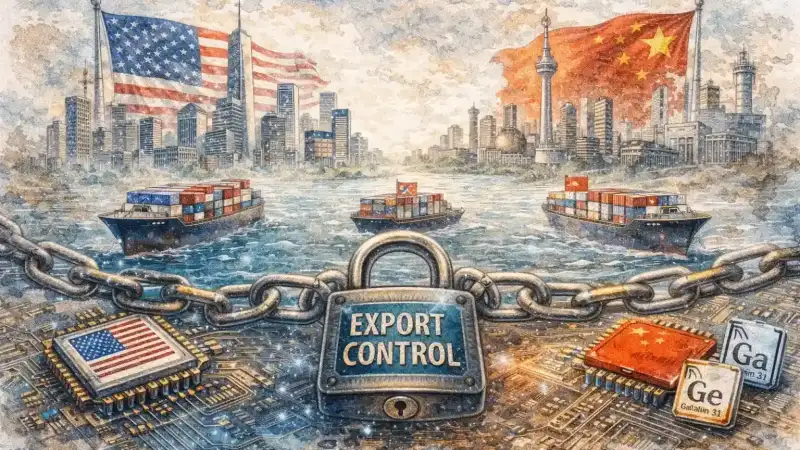
The technology rivalry between the United States and China has evolved from a simmering trade dispute into the defining geopolitical and economic reality of our era. For American business leaders, policymakers, and innovators, this competition is no longer just a distant diplomatic issue but a daily operational challenge. It dictates where products can be sold, where components can be sourced, and how intellectual property must be shielded. As both nations vie for supremacy in the foundational technologies of the twenty first century, the global tech landscape is undergoing a massive, irreversible structural transformation.
At the heart of this competition lies an aggressive regime of export controls initiated by Washington to safeguard national security. These controls are specifically designed to restrict China access to critical American technologies, most notably advanced semiconductors, artificial intelligence computing chips, and semiconductor manufacturing equipment. The strategic rationale is clear, to prevent the flow of dual use technologies that could fuel military modernization or surveillance capabilities abroad. However, for American tech giants, these regulations mean navigating a complex web of compliance while simultaneously losing access to one of the most lucrative consumer markets on the planet.
To counterbalance the restrictive nature of export controls, the United States has also embraced industrial policy on a scale not seen in decades. Legislation like the CHIPS and Science Act represents a monumental effort to repatriate critical supply chains and heavily subsidize domestic manufacturing. By injecting billions of dollars into the American semiconductor industry, the government aims to reduce reliance on vulnerable overseas nodes, particularly in East Asia. This dual approach of aggressively defending intellectual property while subsidizing domestic growth is fundamentally reshaping the investment strategies of Silicon Valley and major industrial hubs across the country.
Meanwhile, Beijing is not sitting idle and has implemented its own set of retaliatory measures and strategic pivots. In response to American export controls, China has accelerated its drive for technological self sufficiency, pouring immense state capital into its domestic semiconductor foundries and AI research initiatives. Furthermore, China has leveraged its dominance in the critical minerals supply chain, placing export restrictions on essential elements like gallium and germanium, which are vital for Western electronics and green tech manufacturing. This tit for tat escalation creates a highly volatile environment for any multinational corporation caught in the crossfire.
The immediate impact on the American technology sector is profound and multifaceted. Semiconductor companies, which rely heavily on massive global sales to fund their astronomical research and development budgets, are feeling the pinch of restricted revenue streams. There is a growing concern among industry leaders that if export controls become too broad, they might inadvertently starve American firms of the capital needed to stay ahead in the innovation race. Balancing national security imperatives with the commercial viability of the domestic tech ecosystem remains one of the most delicate tasks for current and future administrations.
This geopolitical friction has violently exposed the fragility of global supply chains that have been optimized for cost efficiency over the past forty years. The era of frictionless globalization is effectively over, replaced by a mandate for supply chain resilience and redundancy. American manufacturers are currently engaged in the costly and complex process of decoupling or de-risking their operations from China. This is not a simple switch that can be flipped, it involves redesigning products, validating new suppliers, and rebuilding logistics networks entirely from scratch.
As a direct consequence of this de-risking strategy, the concept of friend shoring has rapidly moved from a theoretical buzzword to a primary corporate directive. American companies are aggressively shifting production capacities to allied or non aligned nations such as India, Vietnam, Mexico, and Malaysia. While this geographic diversification mitigates the risk of sudden export control shocks or geopolitical conflicts, it also introduces new challenges related to infrastructure readiness, labor skill gaps, and local regulatory compliance in these emerging manufacturing hubs.
The United States cannot navigate this technological cold war in isolation, making international cooperation and alignment with allies absolutely critical. Washington has expended significant diplomatic capital to persuade key partners, particularly those in Europe and Japan, to implement parallel export controls. The coordination with nations like the Netherlands, home to the world leading lithography equipment manufacturer ASML, demonstrates the necessity of a unified front. However, aligning European economic interests with American security priorities requires constant negotiation, as European capitals often favor a more nuanced approach to their economic relationship with Beijing.
The frontier of this competition is rapidly expanding beyond traditional hardware and into the realms of artificial intelligence, quantum computing, and biotechnology. These emerging sectors hold the potential to revolutionize everything from healthcare to cryptography, making supremacy in these fields an existential priority. The regulatory frameworks governing the export and collaborative development of these nascent technologies are still being drafted, creating a highly uncertain environment for startups and venture capitalists who must place long term bets without knowing where the legislative boundaries will ultimately be drawn.
An often debated, unintended consequence of strict American export controls is the potential to accelerate China indigenous innovation capabilities. By cutting off access to the best American chips and software, Washington is essentially forcing Beijing to build an entirely independent technological ecosystem out of sheer necessity. Some industry analysts warn that while controls may buy the United States a temporary lead, they risk creating a parallel, highly competitive Chinese tech infrastructure that will eventually rival American standards and fragment the global market permanently.
This division also casts a long, chilling shadow over the future of global scientific cooperation. The free flow of academic talent and joint research initiatives, which have historically been the bedrock of scientific breakthroughs, are increasingly falling victim to suspicion and visa restrictions. American universities and research institutions are finding it harder to attract top tier international talent, while researchers are forced to navigate bureaucratic minefields to collaborate across borders. The fragmentation of the global scientific community threatens to slow the pace of human advancement on universal challenges like climate change and pandemic preparedness.
Moving forward, American enterprise leaders must accept that geopolitical volatility is now a permanent fixture on the corporate balance sheet. Agility, extreme compliance, and a deep understanding of international policy are no longer just legal requirements but core competencies for survival. Companies must build dedicated risk assessment teams that monitor not just market trends, but the shifting legislative winds in Washington and allied capitals to anticipate the next wave of export controls before they disrupt operations.
The stakes in the US China tech competition could not be higher, and the policies enacted today will determine the global economic hierarchy for the next century. As the dividing lines of the technological world become sharper, American businesses must actively engage with policymakers to ensure that the quest for national security does not extinguish the very innovation it seeks to protect. Successfully navigating this landscape requires a delicate fusion of aggressive domestic investment, strategic global partnerships, and an unwavering commitment to maintaining technological excellence.
How has your organization adapted its supply chain or research strategies in response to these expanding export controls, and what steps are you taking to ensure long term resilience?
Also Read
❤️ Microsoft's Major Leadership Overhaul: Sharpening Focus on and Cloud Supremacy for Its Next 50 Years
❤️ THE DRAGON'S CODE: INSIDE CHINA'S TECH SUPERPOWER AMBITIONS
❤️ eSIM Explained: Why You Should Ditch Physical SIMs for International Travel in 2026
🟢 Follow our WhatsApp Channel for continuous updates JOIN ➤
 Goodbye Chemo? Scientists Built a Smart DNA Sniper That Kills Only Cancer Cells — The 2026 Breakthrough Explained
 Apple’s New Mac mini and Mac Studio Aren’t Just Faster Macs — They’re Built for the AI Agent Era
 The Robot Beat Usain Bolt’s 100-Metre Time. What Happened After the Finish Is More Important
 What Did Starship Prove on Its 13th Test Flight? A Milestone, or Just Another Step Forward?
 AI Won't Replace Doctors. But the Hospital You Visit Five Years From Now Could Look Completely Different
🛒 Shop Online

No Comment Yet.
Stay informed with breaking news, trending stories, and in-depth analysis.