Tech Vaidya WhatsApp Channel
Get AI updates, tech news, cybersecurity alerts and useful tech tips directly on WhatsApp.
| Nagaraj Vaidya, Editor, Tech Vaidya Global
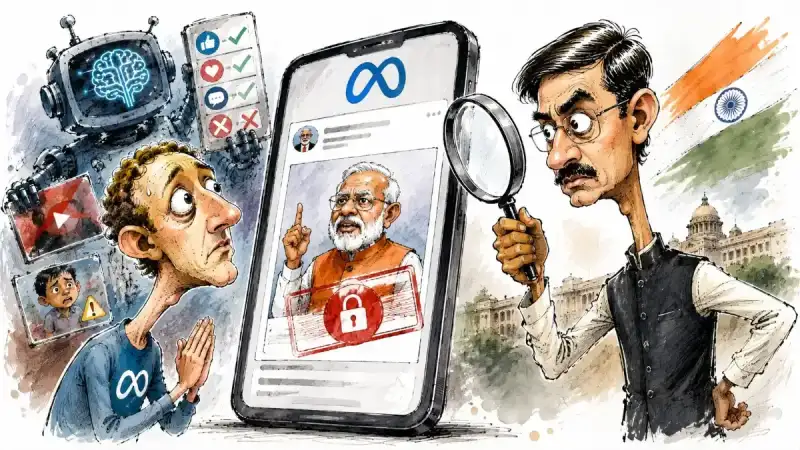
A social media post disappeared for a while. For most users, that would barely qualify as news. But this was a Facebook post by Prime Minister Narendra Modi, and the company behind the platform eventually had to apologize to the Indian government for restricting it by mistake. What looked like a routine technical failure suddenly raised a much bigger question: who decides what billions of people are allowed to see online when artificial intelligence is making those decisions at enormous scale?
The incident dates back to July, when a video posted by Modi about student protests and the alleged question-paper leak issue was temporarily restricted on Facebook. Meta later said the action was the result of an operational error and not a deliberate attempt to suppress the post. Under normal circumstances, that explanation might have ended the matter. But this was happening at a time when the Indian government was already pressing Meta over deepfakes, child safety and harmful content appearing on its platforms. That combination has made the incident far more significant than a single post being wrongly blocked.
Meta’s global affairs chief Joel Kaplan apologized to Information Technology Minister Ashwini Vaishnaw over the incident. Around the same period, Meta CEO Mark Zuckerberg also reportedly apologized to the Indian government over other operational and content-related problems involving the company’s platforms. The important point here is not simply that a global technology company said sorry. It is that Facebook, Instagram and other major platforms have become part of the machinery of public communication itself. Politics, news, business, advertising, public campaigns and even government communication now depend heavily on these platforms.
That creates a problem technology companies have been trying to solve for years: how do you moderate billions of pieces of content every day without putting a human being in front of every screen? Meta relies heavily on artificial intelligence, machine learning, image recognition, language systems, user reports and a combination of automated and human review. These systems can identify potentially harmful material in seconds. But speed is not the same thing as accuracy, and that difference becomes critical when the content involves politics, public debate, journalism or a major public figure.
A machine can identify a suspicious image or a phrase that appears to violate a policy. What it cannot always understand is the context around that material. A political statement may contain satire. A protest video may include language that looks threatening when taken out of context. A regional expression may mean something completely different from what a global moderation system expects. Once these limitations are taken into account, Modi’s blocked post starts looking less like an isolated technical glitch and more like a warning about the limits of automated decision-making.
When an Algorithm Gets It Wrong, Who Takes Responsibility?
Content moderation sounds simple until you look at what actually happens behind the screen. A platform does not merely ask whether a post contains a particular word or image. Systems can examine the text, the visuals, the audio, the account’s history, reports from other users and the platform’s own policy framework. Different layers may make different assessments before a final action is taken. Sometimes the decision is automated; sometimes the material is sent to a human reviewer.
 Why Is Typing Kannada on Apple Laptops Still So Difficult? Which Kannada Keyboard Is Best for Apple Computers?
 Apple Finally Folded the iPhone! Why the iPhone Duo Could Change the Smartphone Industry
 TechVaidya: One Year. Over a Thousand Articles. And a long road still ahead...
 NASA Invites ISRO to Join the Moon Base Mission: Why This Could Be a Turning Point for India
 Toxic Review: Yash Owns the Screen, But Does the Film Own the Story?
The biggest difficulty is context. Consider a political speech in which a politician quotes a statement they strongly disagree with. A system that looks only at the words may interpret the quoted material as the politician’s own statement. The same problem can arise with satire, memes, edited videos and regional language. India is particularly complicated because of its enormous linguistic and cultural diversity. A word, phrase or joke that is perfectly ordinary in one part of the country may have a very different meaning somewhere else.
There are also two very different ways an automated moderation system can fail. It can flag harmless material as harmful, or it can allow harmful material to remain online. The second failure can be devastating when the content involves child exploitation, violent threats or organized abuse. But the first failure is hardly harmless when it affects political speech, journalism or legitimate public debate. The challenge is therefore not to build a system that removes as much content as possible. The real challenge is to build one that makes the right decision for the right reason.
That is why the Modi incident deserves more attention than a simple “technical error” headline. The important questions are what triggered the restriction, how the mistake was detected, how quickly the post was restored and what was changed afterwards. A major platform cannot simply say that an algorithm made a mistake and move on. When its systems affect public communication at massive scale, the company has to explain how such failures are handled and how users can challenge them.
There is also an uncomfortable imbalance here. When a prime minister’s post is wrongly restricted, the incident can quickly reach government officials and senior executives at the company. A regular user does not have that advantage. If an ordinary person’s video or post is wrongly removed, they may have to rely on an appeal button, wait for a review and hope the system eventually recognizes the mistake. That gap between the powerful and the ordinary user is one of the biggest unanswered questions in the future of automated moderation.
Deepfakes Have Changed the Game
The problem becomes even more complicated with deepfakes. A few years ago, creating convincing fake audio or video required considerable technical skill. Today, increasingly sophisticated AI tools can alter faces, clone voices and generate videos that can look remarkably authentic. Someone can be made to appear as if they said something they never said. A person can be shown doing something that never happened. For an ordinary viewer scrolling through a phone, spotting the difference is becoming increasingly difficult.
That matters enormously in politics. Imagine a fake video of a major political leader making a controversial statement spreading across social media during an election campaign. By the time fact-checkers establish that the video is fake, millions of people may already have seen it. It may have been downloaded, reposted, shared through messaging groups and uploaded to other platforms. Correcting the original claim does not necessarily erase the impression created by the first video.
This is where the fight between generative AI and detection technology becomes important. Platforms are developing systems designed to identify manipulated images, synthetic audio and AI-generated video. At the same time, the tools used to create those fakes are becoming more sophisticated. A detection system that performs well against one generation of AI-generated content may struggle against the next. There is no single piece of software that will permanently solve the deepfake problem.
India has responded by tightening its framework around synthetically generated content. The broader direction of the new rules is clear: AI-generated or manipulated audio, video and images should not be allowed to pass themselves off as authentic material without appropriate safeguards. The goal is not to ban every piece of content created with AI. AI-generated illustrations, entertainment, advertising, education and creative work are not automatically misinformation. The real concern is deceptive use—content designed to make people believe that something happened when it did not.
Child safety presents an even more difficult challenge. Platforms are under enormous pressure to identify and remove material involving child sexual exploitation as quickly as possible. But people trying to distribute such material also adapt, changing accounts, language, images and distribution methods. Automated systems have to keep learning while human investigators and law-enforcement agencies deal with the most serious cases. In that environment, AI is an essential tool, but it cannot be the entire solution.
India Is Becoming a Tougher Market for Big Tech
India’s situation is particularly important because social media is no longer simply a place where people share photographs or talk to friends. Facebook, Instagram, YouTube and other platforms have become major channels for political communication, news distribution, advertising, business promotion and public campaigns. A post can travel across the country within minutes. A video created in one city can influence a political conversation thousands of kilometres away. That makes the decisions taken by these platforms part of the wider public information system.
This is one reason the Indian government has been pushing technology companies to take greater responsibility for what happens on their platforms. Illegal content needs to be acted upon quickly. Child safety requires stronger safeguards. Deepfakes and other synthetic media need clearer treatment. Platforms are also expected to comply with legally valid directions issued by authorities and courts. The regulatory environment in India is therefore moving away from the old idea that a platform is simply a neutral piece of technology sitting between users.
But there is another side to this debate, and it cannot be ignored. Stronger regulation can help protect users, but excessive control can create a different problem. Content that is illegal is not automatically the same as content that a government dislikes. A controversial opinion is not necessarily misinformation. Criticism is not the same as a threat. Satire is not the same as a factual claim. If automated systems are asked to make these distinctions without adequate human oversight and transparency, legitimate speech can easily become collateral damage.
That is why Meta’s real challenge in India is not simply to apologize when something goes wrong. It has to demonstrate that its systems can be trusted after they fail. That means understanding why a post was restricted, improving the process that caused the error, providing meaningful appeals and ensuring that mistakes can be corrected quickly. “The algorithm made a mistake” is an explanation, but it is not accountability.
There is also a much larger global implication. When a country as large as India demands stronger safeguards from a company such as Meta, the effects are unlikely to remain within Indian borders. Large platforms rarely build completely separate systems for every market. Regulatory changes in one major market can influence how products, moderation systems and safety policies are designed globally. India is therefore not just another market that Big Tech has to comply with. It is increasingly becoming a market capable of influencing how Big Tech operates.
Tomorrow, It Could Be Your Post
For ordinary users, the most important lesson from the Modi incident is perhaps the simplest one: the same system that wrongly restricted a prime minister’s post can make a mistake with anyone’s post. Your video could be flagged. Your photograph could be removed. A comment could be misunderstood. An innocent joke could be interpreted as a policy violation. When that happens, “the algorithm got it wrong” will not feel like much of an answer to the person whose content has disappeared.
Users will also have to become more careful about what they believe online. A video is no longer proof that an event happened. A familiar voice is no longer proof that the person actually spoke those words. A photograph is no longer enough to establish that an event took place. AI has made it dramatically easier to create convincing material, which means the ability to question, verify and cross-check what we see will become a basic digital skill rather than something reserved for journalists and fact-checkers.
But the responsibility cannot be pushed entirely onto users. The companies that control the distribution of information at enormous scale also carry enormous responsibility. If their systems remove legitimate content, there must be a meaningful way to challenge the decision. If dangerous deepfakes are spreading, platforms need the tools and people to respond. If children are being targeted, safety cannot be treated as another item on a product roadmap.
The deeper story behind Meta’s apology is therefore not really about one Facebook post. It is about the next phase of the internet, where AI is increasingly deciding what gets seen, what gets limited and what gets removed. At the same time, AI is also generating more of the content that platforms are expected to police. The same technology is becoming both the creator and the gatekeeper of digital information.
That leaves us with a much more important question than whether Meta made a mistake. How much power should an algorithm have over what people are allowed to see and say—and what happens when that algorithm gets it wrong? Today, the mistake involved a post by India’s prime minister. Tomorrow, it could involve a journalist, a small business owner, a student or an ordinary citizen. The future of AI moderation will not ultimately be judged by how intelligent these systems become, but by whether the people behind them are willing to remain accountable when the machines fail.

No Comment Yet.
Stay informed with breaking news, trending stories, and in-depth analysis.