Tech Vaidya WhatsApp Channel
Get AI updates, tech news, cybersecurity alerts and useful tech tips directly on WhatsApp.

| Nagaraj Vaidya Editor, Tech Vaidya Global
Education is not merely the turning of textbook pages; it is a journey of understanding life itself. It is the guiding light that opens a child's eyes to the world, the magical touch that sparks questions in their mind, and the seed that plants empathy in their heart. Yet today, our education system has cast aside this sacred mission, tearing children away from their own world, from the realities of society, from their cultural roots, and reducing them to barren machines chasing nothing but marks and rankings. The latest proof of this cruel transformation is the new directive issued by the Karnataka government's Department of School Education.
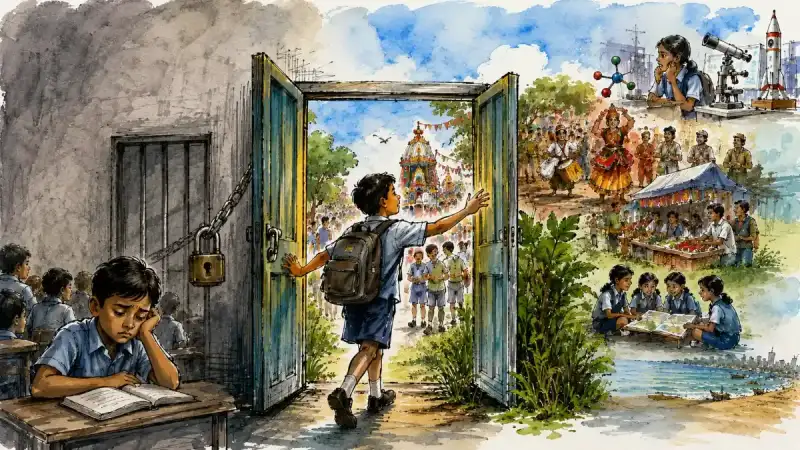
"This order that children studying in government schools shall not be sent as audiences to any programme conducted outside the school premises" is not merely an administrative circular. It is a direct assault on childhood, a crackdown on curiosity, and a betrayal of the very purpose of education. Confining children within four walls, snatching away the colourful spectacles of a vibrant world unfolding before their tiny eyes, silencing the sounds of society's happenings reaching their ears, and imposing dull, pre-packaged answers on the questions arising in their minds – this is the cumulative effect of this dark order.

When a child watches a street play or a science exhibition happening by the roadside, thousands of questions erupt in their mind. Why did this happen? How is that possible? What could happen next? Such questions are the fuel for their intellectual growth. When a child participates in a village fair or a Dasara festival, they learn about economic transactions, observe people from different castes and religions coming together, experience the beauty of diverse art forms, and directly savour the rich cultural heritage of their land. Far greater lessons unfold during those festive occasions than what is written in history books. The largest classroom of social science is not between textbook pages, but on the living grounds of that fair. The profound principles of economics are not revealed through mathematical formulas on a blackboard, but through the daily transactions of vendors shouting, buying, and selling. But the Education Department, wearing the two hypocritical masks of safety and discipline, stops children right at the threshold of this magnificent experiential university and commands, "You shall not go out."
Being a spectator is not mere entertainment; it is an exceptionally powerful process of observation and perception. When a child sees with their own eyes, thousands of neurons in their brain become active. Every dialogue they hear enhances their linguistic ability. Every event they observe sharpens their critical thinking. No artificial teaching method can compensate for such nuanced and multifaceted learning. Education experts have proven this truth through countless experiments. But our bureaucratic officials, sitting in their chairs, under artificial light, in air-conditioned rooms, preoccupied with shuffling document files, have neither discovered this fundamental principle nor do they show any interest in discovering it.
Let our officials once cast their neglectful eyes towards the countries with the finest education systems in the world. In Finland, which boasts the highest educational standards globally, education is an expansive system that transcends the rigid walls of the classroom. There, "outdoor learning" is the most important and integral part of the curriculum. For several days each week, teachers take children to forests, parks, museums, public spaces, and seashores. There, they witness biodiversity with their own eyes, study the flow of water, touch and smell various plants, stand before historical ruins and engage in dialogue with the past. The children there have the freedom to discover the real world, interact with it, ask questions, and find their own answers. Rather than teaching, teachers there focus on fuelling curiosity. They don't tell children "what to think," but instead impart the importance of "how to think."
Consider the example of Japan, where a child's education does not revolve solely around examination scores. In every town of Japan, local cultural programmes and festivals called "Matsuri" take place throughout the year. Parents and schools actively encourage children to participate in these festivals. There, a child learns to be part of their community, understands the importance of respecting heritage, realises collective responsibility, and gains deep experiences of cooperation, mutual respect, and cultural pride. Interacting with society, building relationships, facing real-life challenges – these are the key dimensions of Japanese education. According to them, a child isolated from society can never become a complete individual, and the goal of education is precisely the creation of such holistic personalities.
Now, if we examine our own country's National Education Policy, it too has "experiential learning" as its foundational principle. NEP 2020 clearly states that the most effective way for children to learn is to directly see, experience, touch, smell, taste, hear, and thereby understand the world around them. The policy handbooks provide clear guidance to bring children out of the four walls of the classroom, to open their learning to the real world, and to make society itself a part of their curriculum alongside textbooks. Kerala's education system has placed special emphasis on taking children to community programmes. Delhi's government schools have made field trips an integral part of students' learning. While all this is happening, Karnataka's Education Department alone is paradoxically moving in the reverse direction, and this is truly alarming. They are strangulating the living concept of "experience" and making the dull instrument of the "textbook" the sole standard.
 Why Is Typing Kannada on Apple Laptops Still So Difficult? Which Kannada Keyboard Is Best for Apple Computers?
 Apple Finally Folded the iPhone! Why the iPhone Duo Could Change the Smartphone Industry
 TechVaidya: One Year. Over a Thousand Articles. And a long road still ahead...
 NASA Invites ISRO to Join the Moon Base Mission: Why This Could Be a Turning Point for India
 Toxic Review: Yash Owns the Screen, But Does the Film Own the Story?
When we analyse the rationale behind this order, officials cite the pretext of safety and discipline. If children are taken outside, accidents might happen, managing them is difficult, and they might show indiscipline in their behaviour – this is their argument. But this is such a cowardly and irresponsible line of thinking that it is akin to chopping off one's head to cure a headache. They believe it is easier to avoid the problem than to solve it. But the very purpose of education is to prepare children to face the world in a safe manner. Along with providing them a shield of security, we must also teach them to face challenges, identify dangers, and find their own way through difficulties. For this, the department's duty is to provide proper guidelines to teachers, deploy volunteers and parents where necessary, and take children to programmes in a well-organised manner. Trying to evade this responsibility is equivalent to admitting their own failure.
Another cruel consequence of this order is that it further widens inequality. Poor children of government schools, especially those in rural areas, generally have no opportunity to see or experience many facets of society with their own eyes. For them, it is the school's sole responsibility to provide opportunities to witness town exhibitions, city science conventions, taluk-level sports meets, or district-level cultural competitions. To even deny that is to leave them to remain in the darkness of their ignorance. This is a form of systematic cultural oppression. Those who have resources, those whose families are wealthy and well-connected, can take their children out into the world. But for these children, the department is saying, "The school is your world." What kind of justice is this?
Studies have clearly shown how crucial outside experiences are in children's psychological development. When a child is exposed to different environments, their brain's neural connections grow rapidly. When they face different situations, their problem-solving ability increases. When they meet new people, their socio-emotional intelligence evolves. Denying such opportunities is equivalent to trying to fit a child into a fixed mould. This homogenisation is precisely what will turn the next generation into mechanical humans devoid of creativity, incapable of understanding diversity, and unresponsive to society's problems.
This order also places a lethargic burden on teachers. Inspired, creative teachers used to take their children to programmes, incorporate those experiences into classroom discussions, and make learning exhilarating. Tying the hands of such teachers and hindering their innovations is to kill the very soul of education. If teachers lose connection with the outside world, they too become mere rote-teaching machines, and this is a huge loss for everyone.
If we desire the creation of a healthy society, we must build bridges between schools and communities, not walls between them. A school should be a microcosm of society, where children have the freedom to see, understand, and question the world. Every school excursion is a new page in a child's life textbook. Participating in every cultural programme is another step in a child's intellectual expansion. Every scientific exhibition is a new dimension to a child's understanding of science.
The government and the Education Minister must come to their senses now, at least at this point. This order of theirs is not as simple as they imagine; it has numerous complex consequences. This is not just a matter of a signature on paper; this is the question of the future of millions of children. It is a question that determines the mental, social, cultural, and emotional development of an entire new generation. It is a question that determines the quality of Karnataka's education system. It is a question of what kind of citizens we want to create.
Our children, as they grow, should not become like broiler chickens that merely pile up marks on exam sheets, living only within their textbooks throughout their lives, deaf and blind to society's realities. Instead, they should grow strong like native chickens – seeing, experiencing in their hearts, and forming their own analyses of the land's art, culture, heritage, struggles, and festivals. Their childhood should have colours, their eyes should sparkle with curiosity, their ears should be filled with the melody of new sounds, and their hearts should overflow with a flood of questions.
The government must immediately withdraw this thoughtless order. They must frame another clear, appropriate, and scientific guideline – one that prioritises children's safety while also opening up opportunities for them to gain experiences of the outside world. Schools must not remain dark confinement cells; they must become grand gateways opening towards the world. Tomorrow itself, today itself, right at this moment, the government must clarify its stand and admit its mistake. Otherwise, it is time for a conscious society, education experts, parents, and students to raise their collective voice. Because if we remain silent today, tomorrow our children will be forced into silence. Education is meant to build human beings, to liberate them, and to connect them with the world – isn't that so? Let it be so, or not?

No Comment Yet.
Stay informed with breaking news, trending stories, and in-depth analysis.
