Tech Vaidya WhatsApp Channel
Get AI updates, tech news, cybersecurity alerts and useful tech tips directly on WhatsApp.

| Nagaraj Vaidya, Editor, Tech Vaidya Global
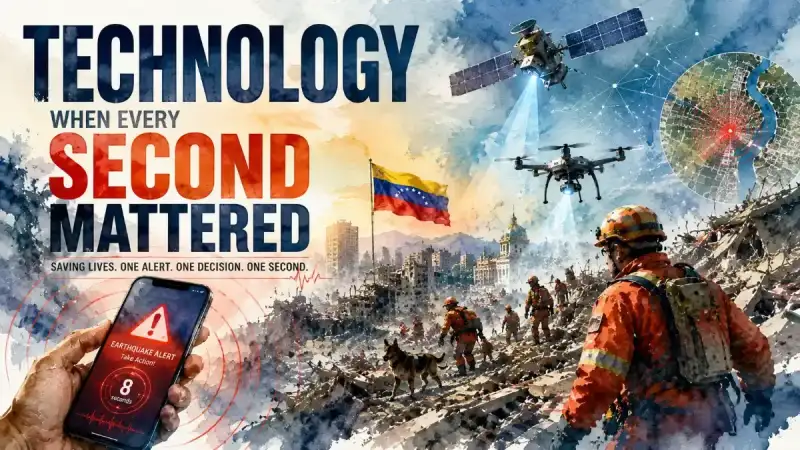
When the earth trembles, the first to rush in is neither the fire department, nor the medical team, nor the military. In recent years, the first responder during an earthquake has been technology. Within seconds, millions of smartphones blare out alerts. Thousands of seismic sensors measure the ground's vibrations. Satellites beam down damage images from space. Artificial intelligence estimates which areas might have the most people trapped. Drones fly over debris to search for survivors. Even though technology cannot defeat nature, its role in reducing death tolls is growing day by day – and the 2026 Venezuela earthquake stands as yet another powerful example.
On June 24, 2026, two powerful earthquakes – magnitude 7.2 and 7.5 – struck Venezuela just 39 seconds apart, shaking the nation to its core. Buildings collapsed in several cities, including the capital Caracas, and rescue operations are still ongoing. According to initial reports, the death count continues to rise, many have been injured, and search efforts are underway for thousands of people. Seismologists from the United States have warned that based on the earthquake's intensity and population density, the death toll could climb even higher.
This tragedy has once again raised a question: it is true that earthquakes cannot be prevented. But to what extent can technology help reduce their impact? The answer is – today, more than ever before in human history.
What many people do not know is that even an ordinary Android phone in our hands is a kind of earthquake sensor. Every Android phone contains a motion-sensing chip called an accelerometer. This is the same sensor that rotates our mobile screen, counts our steps, and detects the phone's movement. But this same sensor can also detect the initial tremors of an earthquake. When hundreds or thousands of Android phones in an area record the same vibration at the same time, Google's system analyzes it and confirms within moments whether it is a real earthquake. Then, alerts are sent instantly to people in areas where the stronger shaking has not yet arrived.
To some, five or ten seconds may not seem like much time. But in an earthquake, those five seconds can be the difference between life and death. Children in schools can take cover under desks. Surgeons in hospitals can pause delicate procedures for a moment. Drivers can avoid entering bridges or tunnels. Dangerous machinery in factories can be shut down immediately. Gas pipelines can be automatically closed. For this very reason, earthquake early warning systems are considered among the most critical safety infrastructures in many countries around the world.
The United States is one of the global leaders in this field. The **ShakeAlert** system, which operates along the West Coast covering California, Oregon, and Washington, continuously monitors thousands of seismometers. Within moments of an earthquake's onset, alerts are sent to schools, hospitals, rail systems, government agencies, and the public. Some trains automatically reduce speed. Fire station doors open on their own. Some industries transfer production units to safe states. All of this happens through computer systems acting before any human reaction.
The US Geological Survey (USGS) plays another crucial role. Within minutes of an earthquake, its PAGER system analyzes multiple factors – population density, building quality, earthquake depth, and intensity – and provides an estimate of possible casualties and damage. This information is used by governments, humanitarian aid organizations, and rescue teams worldwide. After the Venezuela earthquake too, this same system provided rapid alerts about the likely scale of damage, accelerating international relief operations.
 Why Is Typing Kannada on Apple Laptops Still So Difficult? Which Kannada Keyboard Is Best for Apple Computers?
 Apple Finally Folded the iPhone! Why the iPhone Duo Could Change the Smartphone Industry
 TechVaidya: One Year. Over a Thousand Articles. And a long road still ahead...
 NASA Invites ISRO to Join the Moon Base Mission: Why This Could Be a Turning Point for India
 Toxic Review: Yash Owns the Screen, But Does the Film Own the Story?
When it comes to earthquake technology, it is impossible not to mention Japan. Japan has built the world's most effective earthquake early warning system. Thousands of ultra-sensitive sensors continuously measure ground movement. The moment an earthquake begins, alerts spread across the country through television, radio, mobile phones, public address systems, and digital billboards. The famous Shinkansen bullet trains automatically apply brakes. Many factories shut down hazardous processes. In schools, children conduct earthquake drills multiple times a year, so that when an alert comes, their response is automatic. What Japan has demonstrated is one simple truth – technology alone is not enough; public preparedness is equally vital.
Mexico is another country that has learned crucial lessons from painful experience. After the 1985 earthquake, in which thousands lost their lives, a public earthquake warning system was built there. Even today, sirens blare before the tremors reach the city. People get a chance to evacuate buildings or move to safe locations. During the 2017 earthquake as well, this system provided warnings to thousands of people. Though earthquakes cannot be stopped, Mexico has shown the world that their impact can be mitigated.
The devastating earthquake that struck the Turkey-Syria border region in 2023 brought about another technological shift. In that tragedy, where thousands of buildings collapsed, drones, thermal cameras, satellite images, and artificial intelligence were widely deployed. AI-based image analysis helped identify areas where survivors might be trapped beneath the rubble. Drones flew into hard-to-reach zones and sent back real-time visuals. Many countries today are adopting similar models in their disaster management systems.
After the 2015 Nepal earthquake, another critical issue captured the world's attention: even with good technology, if buildings are weak, the death toll will not decrease. Following that tragedy, Nepal tightened its building codes. The use of earthquake-resistant designs increased. The understanding that engineering safety is also an integral part of earthquake technology grew stronger.
Chile's experience in this regard is also noteworthy. Located in the Pacific Ring of Fire, Chile experiences frequent strong earthquakes. Yet, due to its strict building codes, base isolation technology, shock absorber systems, and rigorous construction standards, many cities have withstood earthquakes far better than other nations. Chile has proven that investment in engineering can save thousands of lives.
Today, another force that works at incredible speed after an earthquake is satellite technology. Several Earth observation satellites, including Europe's Copernicus program, capture images of affected areas within hours. By comparing before-and-after images, it is possible to identify which bridges have collapsed, which roads are blocked, and which areas have suffered the most damage. This allows rescue teams to direct their resources to the most critical locations first.
Drones are no longer just photography tools. In today's disaster management, they are among the most vital assets. Equipped with high-resolution cameras, thermal sensors, LiDAR systems, and sometimes even the ability to carry small medical supplies, drones can gather information within minutes from areas that rescue workers cannot safely access on foot. Some countries are also researching snake-like robots that can burrow into debris.
Although much is being discussed about artificial intelligence, one thing must be clearly understood: AI still cannot accurately predict earthquakes in advance. The complex geological processes inside the Earth remain a challenge for science to fully comprehend. However, AI is proving immensely valuable in post-earthquake operations – analyzing millions of satellite images in moments, identifying damaged structures, recommending priority areas for aid, and verifying information circulating on social media. AI is already being used in all these tasks.
Future technology is even more interesting. IoT-based sensors are being installed in bridges, hospitals, dams, and high-rise buildings. After an earthquake, they instantly transmit data on whether the structure remains safe. 5G and satellite communication systems help maintain emergency connectivity even when regular mobile networks fail. Digital twin technology is enabling scientists to build virtual models of cities and analyze earthquake impacts in advance.
The Venezuela tragedy has sent a clear message to all earthquake-prone nations, including the United States: even with cutting-edge technology, if old buildings, weak infrastructure, and lack of public preparedness persist, losses cannot be fully avoided. At the same time, when early warning systems, good engineering, scientific planning, and rapid communication work together, thousands of lives can be saved.
Earthquakes will continue to happen. Humankind has not yet invented technology that can stop them. But we have already built technology that can transform the first few seconds of an earthquake into a chance to save lives. The events in Venezuela have reminded the world of this very lesson. Humanity may still be small before nature's power. But when science, engineering, and technology come together, that small human's chances of survival today are far greater than ever before.

No Comment Yet.
Stay informed with breaking news, trending stories, and in-depth analysis.
