Tech Vaidya WhatsApp Channel
Get AI updates, tech news, cybersecurity alerts and useful tech tips directly on WhatsApp.

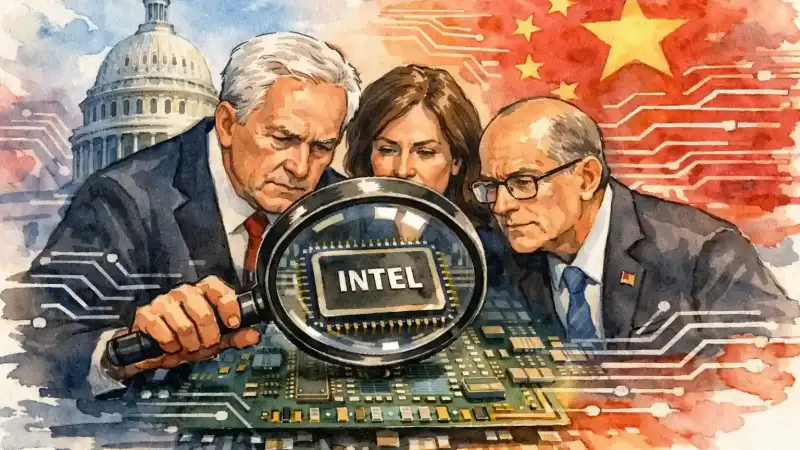
The global semiconductor landscape is witnessing a significant escalation in tensions as U.S. lawmakers turn their attention toward Intel Corporation. Recent inquiries from the House Select Committee on the Chinese Communist Party have raised serious questions regarding Intel’s procurement of testing equipment from suppliers with strong links to China. This move signals a new phase in the ongoing technological rivalry between Washington and Beijing, where even secondary tools in the manufacturing process are now being treated as potential vectors for espionage or intellectual property theft.
At the heart of the controversy is the fear that testing tools—essential for ensuring the quality and functionality of chips—could serve as a "backdoor" for sensitive data. Lawmakers argue that these instruments, though not directly part of the lithography process, interact deeply with the chip's architecture. If these tools are developed or serviced by Chinese-linked entities, there is a perceived risk that proprietary designs or manufacturing methodologies could be exfiltrated, giving Chinese competitors an unfair advantage in the race for semiconductor supremacy.
Intel has responded by emphasizing its commitment to national security and regulatory compliance. The company stated that the equipment in question is utilized primarily in early-stage testing environments rather than in high-volume production lines. According to Intel, these tools are subject to rigorous internal security protocols and do not violate existing U.S. export controls or trade sanctions. However, for a government that is investing billions into domestic manufacturing, "compliance" is no longer the only metric for success; "total independence" is becoming the new standard.
The timing of this scrutiny is particularly sensitive for Intel. As the primary beneficiary of the U.S. CHIPS and Science Act, Intel is positioned as the vanguard of America’s effort to re-shore semiconductor manufacturing. With billions in federal subsidies on the line, any perception that the company remains reliant on Chinese infrastructure creates a political liability. Lawmakers are increasingly of the view that if taxpayers are footing the bill for domestic "fabs," the entire ecosystem—from raw materials to final testing—must be scrubbed of adversarial influence.
This investigation also sheds light on the sheer complexity of modern supply chains. For decades, the semiconductor industry has thrived on a globalized model where components move across borders multiple times before a final product is realized. China has successfully positioned itself as a key provider of mid-tier manufacturing and testing equipment due to cost efficiencies and rapid scaling. For a giant like Intel, pivoting away from these established suppliers is not a matter of clicking a button; it involves massive capital reinvestment and potential delays in product timelines.
Moreover, the focus on testing tools represents a narrowing of the "de-risking" strategy. Previously, the U.S. focused largely on high-end lithography machines, such as those produced by ASML. By moving the goalposts to include testing and metrology equipment, the U.S. government is effectively signaling that no part of the semiconductor lifecycle is beneath notice. This "small yard, high fence" approach is expanding, and companies are finding that the "yard" is becoming increasingly crowded with restricted technologies.
There is also a broader strategic concern regarding "latent vulnerabilities." Even if a tool does not actively steal data today, the possibility of remote updates or hidden firmware could allow for future disruption. In a geopolitical crisis, the ability of a foreign power to remotely disable or degrade testing capabilities could paralyze a nation's ability to produce essential hardware. This long-term threat is what drives the current legislative push for more transparent and "clean" supply chains.
The reaction from the industry at large has been one of cautious observation. Other chipmakers, such as AMD and NVIDIA, are likely auditing their own supply chains in anticipation of similar inquiries. The message from Washington is clear: the era of prioritizing cost over security is over. Companies are now expected to perform "extreme due diligence" on every vendor, ensuring that there are no hidden ties to state-affiliated entities in restricted regions.
 Inter-Agency Conflict Stalls AI Trade Progress: Why Chinese Tech Giants Are Hesitating to Order
 iOS 27 Update: What’s New, Which iPhones Are Supported, and Who Gets Siri AI?
 Karnataka's Big AI Push: Data Centre Policy Nears Completion, AI University and Green Data Centres Gain Momentum
 Apple Intelligence vs Google Gemini 2026: The Hidden Costs Most Buyers Ignore
 Elon Musk Just Recruited a Robotics Genius to xAI and It Changes Everything
China, meanwhile, views these actions as a form of "technology containment." Beijing has frequently criticized the U.S. for using national security as a pretext to maintain its global hegemony. As the U.S. tightens its grip, China is likely to accelerate its own efforts to achieve self-reliance in semiconductor tools. This creates a feedback loop where both nations are racing to build entirely parallel tech ecosystems, a move that could permanently fragment the global electronics market.
For Intel, the challenge is maintaining its competitive edge while navigating this political minefield. The company must prove to lawmakers that it can lead the world in innovation without relying on the very country the U.S. is trying to outpace. This requires a delicate balancing act—maintaining global market access while strictly adhering to a "national-first" manufacturing philosophy. The outcome of this inquiry will likely set a precedent for how all future CHIPS Act recipients are audited.
The scrutiny also underscores the role of "economic statecraft" in modern diplomacy. Technology is no longer just a commodity; it is a tool of national power. By questioning Intel’s supply chain, the U.S. government is exercising its power to reshape global trade patterns. This shift forces corporate leaders to think like geostrategists, weighing the geopolitical risks of their procurement decisions as heavily as the technical specifications of the tools they buy.
In conclusion, the investigation into Intel’s use of Chinese-linked tools is a harbinger of a more controlled and siloed future for the tech industry. As the lines between commercial interests and national security continue to blur, the semiconductor industry will remain at the epicenter of global friction. The resolution of this issue will not only define Intel’s path forward but will also signal to the world how far the U.S. is willing to go to protect its digital borders.
Do you have any thoughts on how this supply chain tension might affect the launch timelines of next-generation processors? Share your views and stay tuned for more deep dives into the world of global technology.
Disclaimer: This article has been written by collecting information from various reliable news and industrial sources to provide a comprehensive analysis of the current situation.
❤️ Also Read
❤️Wings of 6G for India's Digital Ambitions
❤️Vanishing Springs: The Hidden ‘Thirst’ Behind the Agumbe Tunnel
❤️The Battle for Global Supremacy The American AI Stack Meets International Pushback
❤️The Governance Gap: Why America Lacks a Unified AI Law
❤️The Dawn of SIM-binding: India Redefines Digital Messaging Security
❤️Talos of Greek Mythology: Was This the World’s First Robot Concept?
❤️The $450 Billion AI Bet: Why Tech Giants Are Spending Like Never Before
🟢 Follow our WhatsApp Channel JOIN ➤
🛒 ಆನ್ಲೈನ್ ಶಾಪಿಂಗ್ ಮಾಡುವಾಗ ಈ ಕೆಳಗಿನ ಲಿಂಕ್ ಬಳಸಿ

No Comment Yet.
Stay informed with breaking news, trending stories, and in-depth analysis.