Tech Vaidya WhatsApp Channel
Get AI updates, tech news, cybersecurity alerts and useful tech tips directly on WhatsApp.

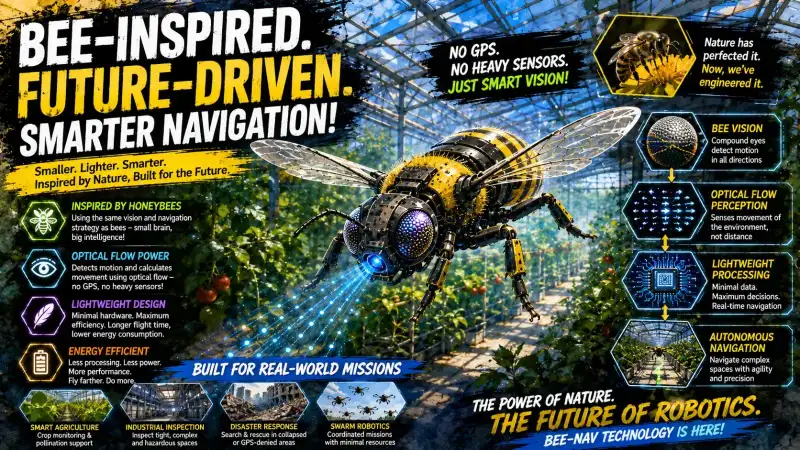
Drones are central to modern technology, handling tasks from package delivery to inspecting vast agricultural lands. However, the biggest technical hurdle these machines face today is their navigation system. To fly safely and understand their surroundings, current drones require massive amounts of computing power and memory.
To achieve this complex navigation, manufacturers equip drones with heavy spatial sensors, high-resolution cameras, and satellite receivers. When combined, these components significantly increase the weight of the drone and drain the battery at a rapid pace. Processing constant streams of high-density environmental data makes long-term flight nearly impossible and drives up manufacturing costs.
Seeking a sustainable solution to this hardware problem, a joint team of roboticists and biologists from Delft University of Technology, Wageningen University, and Carl von Ossietzky University turned to nature. They closely studied how honeybees find their way and successfully translated this biological process into a robotic algorithm. Their findings, recently published in the journal Nature, highlight a new navigation strategy called Bee-Nav.
Ditching Heavy Sensors: The Biological Secret Behind Optical Flow Navigation
Despite their tiny size and a brain no larger than a sesame seed, honeybees possess an extraordinary capacity for navigation. They fly through highly complex, cluttered environments, locate distant flowers, and return precisely to their hives. Honeybees do not have access to satellite signals, nor do they possess massive memory banks to store three-dimensional maps of their environment.
Instead, during flight, these insects rely entirely on a natural visual mechanism known as optical flow. This means they perceive how fast objects in their field of vision appear to move backward as they fly forward. By analyzing this simple visual metric, bees can seamlessly regulate their flight speed, maintain a safe distance from obstacles, and judge the distance they have traveled.
This biological approach requires an incredibly low amount of cognitive processing compared to spatial mapping. The scientific team successfully replicated this natural efficiency, shifting the focus away from heavy spatial mapping algorithms. By adopting the honeybee visual processing model, researchers found a way to let machines navigate with minimal energy consumption.
The Mechanics of Bee-Nav: Slashing Computing Power and Battery Consumption
 Goodbye Chemo? Scientists Built a Smart DNA Sniper That Kills Only Cancer Cells — The 2026 Breakthrough Explained
 Apple’s New Mac mini and Mac Studio Aren’t Just Faster Macs — They’re Built for the AI Agent Era
 The Robot Beat Usain Bolt’s 100-Metre Time. What Happened After the Finish Is More Important
 What Did Starship Prove on Its 13th Test Flight? A Milestone, or Just Another Step Forward?
 AI Won't Replace Doctors. But the Hospital You Visit Five Years From Now Could Look Completely Different
The Bee-Nav system fundamentally alters how a drone perceives its environment. Instead of utilizing heavy depth cameras that capture high-resolution images, this technology employs lightweight visual sensors that mimic the compound eyes of insects. These sensors do not record detailed pictures; they strictly track the movement of pixels across the lens.
Because the drone no longer needs to construct and constantly update a real-time structural map of the world, the computing power required drops drastically. This reduction in data processing allows engineers to use much smaller, lighter processors. A smaller processor naturally demands far less electricity, meaning the drone can operate on a significantly smaller battery.
This creates a highly beneficial domino effect in hardware design. The overall weight of the drone decreases sharply, which directly translates to improved flight efficiency and extended operational time. It proves that machines do not always need brute-force computing power to navigate complex environments if they use the right observational strategies.
Navigating Without External Signals: A Practical Solution for Industrial Sites
A major limitation of current drone technology is its heavy reliance on continuous satellite signals. In environments like dense agricultural greenhouses, underground mines, or the interiors of collapsed buildings, external signals fail to penetrate. When a standard drone loses this connection, it becomes highly susceptible to drifting and crashing.
The Bee-Nav system completely bypasses this external dependency. Because it relies entirely on its internal optical flow sensors to judge speed and distance, it can operate autonomously in areas completely cut off from the outside world. This makes it a highly reliable tool for indoor industrial inspections where standard navigation systems fail.
In the agricultural sector, for instance, there is a growing need for micro-drones to inspect crops like tomatoes inside large greenhouses. Heavy drones generate strong downdrafts that can damage fragile plants, while lightweight drones historically lacked the hardware to navigate autonomously. The honeybee-inspired design bridges this gap, allowing featherweight drones to perform long-duration inspections safely.
The Future of Micro-Drones and Swarm Robotics Inspired by Insect Anatomy
This development paves the way for the mass production of insect-sized autonomous drones. Until now, creating a fully self-flying micro-drone was largely impossible because the required navigation hardware was too heavy for a tiny frame to lift. Bee-Nav eliminates that barrier, bringing the concept of practical, autonomous micro-robotics closer to reality.
In the near future, the concept of swarm robotics will become much more feasible. Hundreds of tiny, inexpensive drones could work together to perform tasks like artificial pollination in agriculture or search-and-rescue operations in disaster zones. Just as a hive of bees coordinates its actions naturally, these lightweight machines will be able to navigate and operate collectively.
The collaboration between biologists and engineers has highlighted a crucial lesson for hardware development. Rather than forcing more processing power into machines, looking at millions of years of natural evolution offers highly optimized solutions. By simply observing a honeybee, modern robotics has found a way to make its devices lighter, cheaper, and remarkably efficient.
❤️ Also Read
❤️The Looming Shadow of Waste over Manki Marine Sanctuary: A Paradise Under Threat
❤️The Ultimate Leak: What Happens When Your Ancestry Report Ends Up on the Dark Web?
❤️Are Aliens Real? The Pentagon's 160 Declassified Files Hold the Clues
❤️Silicon Hubris vs. Regulatory Reality: Why Being a Tech Giant Didn’t Save Paytm from the RBI’s Axe
❤️The Illusion of Algorithms: Read This Before You Get Trapped!
❤️The "Independent" Illusion: Who Actually Controls Your News Feed?
❤️Let This 'Remake' Fever in Politics End; May the Soil of Karnataka Never Succumb to Glamour!
❤️May 8 Mega Launch: HMD Vibe 2 Brings Flagship "Vibes" to the Masses via Flipkart
🟢 Follow our WhatsApp Channel JOIN ➤
🛒 ಆನ್ಲೈನ್ ಶಾಪಿಂಗ್ ಮಾಡುವಾಗ ಈ ಕೆಳಗಿನ ಲಿಂಕ್ ಬಳಸಿ

No Comment Yet.
Stay informed with breaking news, trending stories, and in-depth analysis.