Tech Vaidya WhatsApp Channel
Get AI updates, tech news, cybersecurity alerts and useful tech tips directly on WhatsApp.

| Nagaraj Vaidya
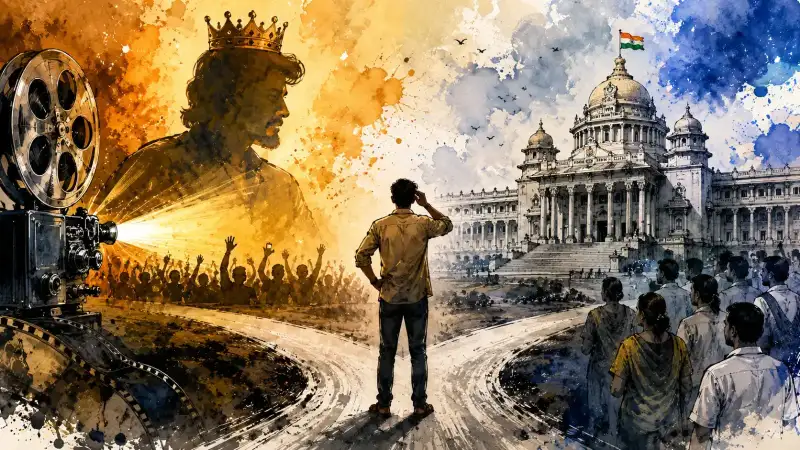
In the world of cinema, when original stories run dry, remaking successful films from other languages becomes an easy escape route. But this 'remake' mindset now creeping into the political thought of our state is a truly alarming phenomenon. The moment news trickles in from neighbouring Tamil Nadu that actor Vijay has sparked a new revolution by becoming Chief Minister, some here rush to prepare a stage for a similar experiment. Just because Vijay won there, imagining Darshan, Sudeep, or Upendra on the Chief Minister's chair here is not merely intellectual bankruptcy; it is the degradation of democracy itself. Politics is not a game that unfolds according to a pre-written script; it is a relentless struggle intertwined with the very lives of the people. We must not forget the vast difference between a fan who whistles in the darkness of a cinema hall and a voter who stands under the scorching sun demanding their rights.
Those attempting to blindly apply the Tamil Nadu political model to Karnataka must first understand the depth of that state's history. There, the relationship between cinema and politics has been deeply intertwined for over seven decades. From C.N. Annadurai, M.G. Ramachandran, and J. Jayalalithaa to today's Vijay, the public psyche there has a historical predisposition to accept a screen hero as their ruling leader. However, this model has never taken root in the soil of Karnataka. If we leaf through the history of our land, the people here have consistently placed greater moral trust in litterateurs, thinkers, and social activists, rather than burdening screen actors with political power. Therefore, the very attempt to 'remake' Tamil Nadu's 'original script' here is inherently incongruous.
This is not just a question about the political system; it is also a compass pointing to our societal priorities. The criteria by which a society chooses its leader is a direct indicator of its maturity. Just because a person can deliver a punchy dialogue on screen does not automatically grant them the qualification to steer the ship of state administration. What a politician must confront are not the artificial problems of a film set, but the tears of farmers on barren lands, the despair of unemployed youth, and the future of illiterate children. Can we really script a solution for such complex problems, adjust the camera angle, and find a resolution in a single take? In politics, there is no director to call 'Cut'; there is only continuous 'Action'.
It is at this crucial juncture that we recall the jewel of Kannada culture, Dr. Rajkumar. During the historic 'Gokak Movement', the entirety of Karnataka stood behind Annavru like a mountain. Had he so wished, he could have adorned the Chief Minister's chair with a single call. Political parties lined up at his doorstep in droves. The ground reality is that the public support Dr. Rajkumar commanded is a fraction of which no actor today possesses. Yet, Annavru never fell prey to the lure of power. The model he set by declaring, "I am an artist; the people's love is my greatest asset. I will not get mired in the mud of politics," must serve as a lesson for today's actors. Shining as a hero on the silver screen is easy, but Dr. Rajkumar knew the truth that in the real arena of life, finding solutions to people's problems is no easy feat.
We must, in today's context, scrutinise the profound reason behind Dr. Rajkumar's decision with even greater seriousness. His refusal to enter politics was not merely a personal choice; it was the fruit of his clear understanding of the sanctity of art and its social responsibility. It is not wrong for every artist to enter politics, but he understood that the power to shape people's minds while remaining an artist far exceeds the power of political office. The way Annavru propagated Kannada identity, social values, and devotion through cinema brought about a cultural transformation so massive that no single politician could achieve it in one term. Is this possible only from the chair of power? Certainly not. Real influence and respect come not from position, but from principled resolve.
Coming to the Sandalwood stars under discussion today—Upendra, Sudeep, or Darshan—no matter how great their achievements are in their own field, as far as politics is concerned, they are still toddlers taking baby steps. Upendra's 'Prajakeeya' (People's Governance) rhetoric, while attractive to the ears, seems like a pipedream on a practical level. Furthermore, a nation cannot be uplifted by the mentality that one can serve the people during breaks from film shoots. Politics is a full-time penance. Societal problems do not get resolved the moment a powerful dialogue is delivered on screen. It requires an understanding of the Constitution, command over administration, and the patience to truly empathise with people's pain. Unfortunately, current discussions revolve only around glamour and personality cults, rather than ideology or development.
We must understand the psychology behind dragging actors into politics. This is a symptom of the deep-seated desire for an 'instant solution' and the weakness of seeking a 'messiah' that exist in all our minds. We yearn for a magical leader who can solve complex problems with a magic wand. Cinema has taught us precisely this: a single hero defeats all the villains and resolves every problem within three hours. But democracy is not like that. Here, the hero is not an individual, but the collective; the process is slow, deliberative, and conducted through institutions. The struggle here is not as easy as clapping your hands while watching a fight on screen. It is ironic that when repairing systemic flaws demands long-term thinking, we chase after fleeting popularity.
 Why Is Typing Kannada on Apple Laptops Still So Difficult? Which Kannada Keyboard Is Best for Apple Computers?
 Apple Finally Folded the iPhone! Why the iPhone Duo Could Change the Smartphone Industry
 TechVaidya: One Year. Over a Thousand Articles. And a long road still ahead...
 NASA Invites ISRO to Join the Moon Base Mission: Why This Could Be a Turning Point for India
 Toxic Review: Yash Owns the Screen, But Does the Film Own the Story?
The current breed of politicians is the primary reason why actors' names are echoing in politics in this manner. Today's politicians are becoming acolytes of wealth rather than beloved of the people. Those who should be responding to public grievances are drowning in corruption and the lust for power. Instead of turning their offices into commercial transaction hubs, politicians must transform them into service centres that respond to the suffering of the people. Only when our rulers embody efficiency and honesty will the public stop running after glamour in this fashion. If politicians behave more responsibly and earn the trust of the people, there will be no need whatsoever for film heroes to enter politics.
In such a paradoxical time, the role of our media is equally critical. Instead of functioning as a responsible 'Fourth Estate', they are morphing into 'publicity platforms' that cheerlead this glamour politics. Just a hint that an actor might contest an election is enough to push real issues like drinking water scarcity, unemployment, dilapidated roads, and farmer suicides to the inner pages of newspapers, while the front pages are splashed with the star's portraits. It is no exaggeration to say that media houses swayed by 'star power' instead of objective analysis, ideological comparisons, and scrutiny of administrative competence are betraying the fundamental ideals of democracy. The media are becoming complicit in manufacturing a lightweight 'entertainment politics', feeding the public 'views' instead of 'news'.
Another heartbreaking aspect is the detrimental effect this star culture is having on the political consciousness of the youth. The younger generation, rather than debating political ideologies, constitutional values, and economic policies, is increasingly active in the 'fan armies' of their favourite actors. The venomous 'troll squads' on Facebook and Twitter are grotesque exhibitions of this insane fandom. Elections have been reduced to cricket matches played with the fervour of a film release, under the banner of 'Let's make him win'. This young army has little to no idea about the administrative agenda of what that leader must deliver post-victory. This is an extremely dangerous trend because, through this, there is a real risk that the culture of constructive criticism, dissent, and accountability will be completely eroded.
We must also look at another reality: the performance record of actors who have already entered politics. Some, after facing electoral defeat, have scurried back to the film industry. Others, even after winning, have remained silent spectators, failing to bring about the 'grand transformation' they had once dreamed of. The thunderous roars delivered in their films have crashed against the walls of the Vidhana Soudha and vanished without an echo. This is because the Legislative Assembly is not a theatre; there, the Leader of the Opposition confronts you, not a villain. Rules, regulations, government orders, judicial interventions – these are the 'twists' that an actor cannot possibly comprehend. The superhuman strength displayed in movies is useless here. The lesson these failures teach us is that politics is not a stepping stone to scale the peak of fame; it demands the stamina to toil in the valley of sacrifice.
This entire scenario also exposes the failure of our education system. The fact that the fundamental tenets of democracy, the importance of voting, and the nuances of good governance are not adequately taught to students in our curriculum has fertilized this era of glamour. If a student graduates without the civic sense of why they were granted the right to vote, they are easily dazzled by the glitter of these actor-politicians. Therefore, by making constitutional morality and political literacy mandatory in schools and colleges, we must rescue the next generation from this 'cinema remake' mindset. This is not just today’s necessity, but a prerequisite for the nation's future.
It is not wrong to be a fan of an actor. Appreciating his art, admiring his achievements in cinema, and drawing inspiration from his lifestyle are all natural. However, we must question our own decision-making ability when we deem that same actor to be supremely capable of shaping the state's destiny. You can carve an ornamental showpiece out of a pumpkin, but it can never truly become a fruit. Similarly, you can shower a star actor with awards, but you cannot bestow upon him the wisdom to be a compass for a nation in distress. It is the responsibility of every voter to draw a clear line between the emotions of admiration and trust.
Finally, the culture of Tamil Nadu is one thing; the character of Karnataka's soil is fundamentally different. While the people there might worship cinema actors as gods and vote for them, the voters of Karnataka are known for their intelligence. Those who enjoy watching films also possess the awareness of who should hold the reins of the state. We must emerge from this disease of remaking politics. Let actors remain actors and nourish art; let politicians build the nation as true public servants. May the dignity and restraint shown by Dr. Rajkumar serve as a model for all stars of today. Everyone must urgently understand that the flash of glamour is fleeting, but the light of honest service remains eternal.
Real change will come from the grassroots of the system, by strengthening democratic institutions, and by finding local solutions to local problems. For that, we do not need a 'remake' starring a film actor. What is truly needed is for hundreds of young thinkers, social workers, and community organisers to enter politics – individuals who do not hanker after power, who imbibe a spirit of service in the people, who solve ground-level problems, and who respect the boundary between art and social service. The grand film of our state's future needs a capable director, a powerful story, and a team of hardworking artists, not a glossy remake hero. This is the soil of Karnataka; it forever cherishes only truth, beauty, and service, never hollow glamour.
❤️ Also Read
❤️The Ultimate Leak: What Happens When Your Ancestry Report Ends Up on the Dark Web?
❤️Is Amazon Stealing Your YouTube Videos? The Billion-Dollar AI Lawsuit Explained
❤️Private Servers on Military Soil: The US Army’s Unprecedented Tech Gamble!
❤️Why Apple EarPods Are Still My Favorite in the TWS Era?
❤️May 8 Mega Launch: HMD Vibe 2 Brings Flagship "Vibes" to the Masses via Flipkart
❤️Breaking the AI Code Debt Tsunami: Friendly Code is the Software Industry's Newest Weapon
❤️The Illusion of Algorithms: Read This Before You Get Trapped!
❤️Are Aliens Real? The Pentagon's 160 Declassified Files Hold the Clues
🟢 Follow our WhatsApp Channel JOIN ➤
🛒 ಆನ್ಲೈನ್ ಶಾಪಿಂಗ್ ಮಾಡುವಾಗ ಈ ಕೆಳಗಿನ ಲಿಂಕ್ ಬಳಸಿ

No Comment Yet.
Stay informed with breaking news, trending stories, and in-depth analysis.