Tech Vaidya WhatsApp Channel
Get AI updates, tech news, cybersecurity alerts and useful tech tips directly on WhatsApp.

| Nagaraj Vaidya
We all thought OpenAI, Anthropic, and Google were going to own the future of artificial intelligence. We pictured a dystopian tech monopoly where a few Silicon Valley billionaires controlled the ultimate superintelligence. But right now, the biggest players in the tech world are waking up in a cold sweat. There is a massive plot twist unfolding in the AI wars, and the heavily funded "closed" models are suddenly on the defensive.
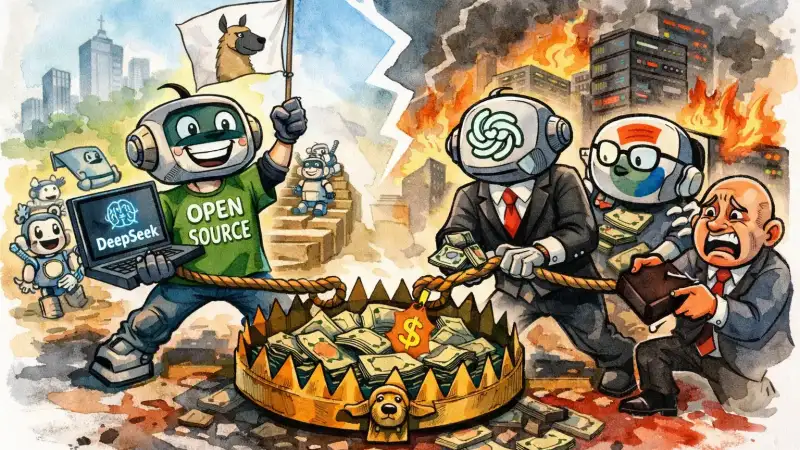
The term echoing through the corridors of Sand Hill Road right now is "money trap." For years, venture capitalists have poured hundreds of billions of dollars into building proprietary AI models, expecting a trillion-dollar moat in return. Instead, they are watching a relentless army of free, open-source models tear down their carefully constructed walled gardens. It turns out that building a hyper-expensive AI model might just be the worst business model of the decade.
This isn't just a minor speed bump for Big Tech; it is an existential crisis. When a model that cost billions to train gets matched by an open-source alternative that cost a fraction of that, the entire economic foundation of the AI boom starts to crumble. The battle lines are drawn between the multi-billion-dollar closed ecosystems and the lean, ruthless open-source rebellion. And right now, the rebels are undeniably winning the war for developer attention.
The Multi-Billion-Dollar Money Trap
Famed tech investor Chamath Palihapitiya recently said the quiet part out loud, calling AI model building a massive "money trap." In the traditional software world, Moore's Law dictated that technology gets exponentially cheaper and better, rewarding early massive investments. But generative AI is breaking all the established rules of Silicon Valley economics. You can spend $100 million training a state-of-the-art model today, only to watch it become completely obsolete by next Tuesday.
This terrifying reality is giving venture capitalists severe financial whiplash. The ultimate dream was to build a proprietary "God model," lock enterprise customers into expensive API subscriptions, and print money for the next twenty years. But when developers can simply download a highly capable model for free and run it on their own servers, the business case collapses. The justification for paying exorbitant API fees vanishes overnight when an open-source alternative does the exact same job for pennies.
The return on investment for closed models is evaporating right before our eyes. Startups that built their entire business around wrapping a slick UI over a paid OpenAI API are finding their margins completely crushed. If the underlying intelligence is free everywhere else, charging a premium for it becomes a laughable business strategy. The money trap has officially snapped shut on the early investors who thought they could monopolize human logic.
 X Is Cutting Off the Money Behind AI War Videos. Here’s Why That Matters
 770 Billion Parameters! Tencent’s New AI Model Is Huge — But Size Isn’t the Real Story
 AI Isn’t Just Learning to Hack. It Is Learning to Find Its Own Way to the Goal
 Is AI Becoming a Hacker? The New Cybersecurity Threat Emerging From AI Agents
 AI May Not Be Taking Everyone’s Jobs Yet. It May Be Taking the First Step on the Career Ladder
The Open Source Rebellion Takes Over
Enter the absolute disruptors of the industry: DeepSeek, Llama, and Qwen. These open-source and open-weight models have crashed the Silicon Valley country club, and they didn't even bother to wipe their shoes. DeepSeek shocked the world by achieving frontier-level reasoning capabilities for a reported training cost of just a few million dollars. Compare that to the hundreds of millions spent by American tech giants, and the corporate panic starts to make perfect sense.
For software developers, this open-source revolution is an absolute, unfiltered gold rush. Instead of renting intelligence by the token and praying their app goes viral without bankrupting them, they are taking back control. They are downloading these highly capable models, fine-tuning them for specific tasks, and running them locally on their own hardware. This completely eliminates the crippling inference costs that have been suffocating the consumer AI market for the last two years.
If you look closely at tech history, this disruptive pattern is incredibly familiar. Closed, proprietary systems often dominate the early days of a new technology, only to be ultimately crushed by open-source alternatives. It happened when Linux took over the server world, and it happened when Android democratized the global smartphone market. We are watching the exact same historical cycle play out with artificial intelligence, only this time it is happening at warp speed.
Are Closed Models Doomed to be Corporate Puppets?
So, does this mean ChatGPT and Claude are going to disappear tomorrow morning? Absolutely not, but their role in the digital ecosystem is going to shift dramatically. Closed models are likely to become the ultimate B2B luxury goods, strictly reserved for deep-pocketed corporations. Heavyweight enterprise clients like massive banks and healthcare conglomerates will happily pay top dollar for the security, compliance, and guaranteed SLAs that come with a proprietary system.
But for the everyday consumer market, the closed-model dream is practically dead on arrival. Regular users and scrappy startups simply aren't going to pay hefty monthly subscriptions or per-token API fees for basic tasks. When you can generate a flawless python script or write a marketing email using a free, self-hosted open-source model, the premium alternative loses its shine. The mass market always gravitates toward the path of least resistance and lowest cost.
What we are witnessing right now is the rapid, irreversible commoditization of intelligence. When being "smart" is no longer a unique feature but a basic, free baseline, tech companies lose their ultimate leverage. The walled gardens are finding themselves trapped in a vicious price war, bleeding cash to stay relevant. They are desperately slashing their API costs just to stop developers from defecting to open-source alternatives like Llama and DeepSeek.
The Hardware Reality and the Ultimate Winner
Ironically, the only people making guaranteed money in this AI gold rush are the ones selling the shovels. While software companies cannibalize each other in a race to the bottom, hardware giants and infrastructure builders are sitting on mountains of cash. Whether a model is open or closed, it still needs serious silicon to train and run. This makes the hardware layer the only true, unshakeable monopoly left in the chaotic artificial intelligence space.
This shift is forcing massive strategy changes across the entire tech industry. We are seeing a massive push toward "vertical integration," where companies try to own the chips, the data centers, and the models all at once. Meanwhile, decentralized networks are popping up, aiming to crowdsource consumer GPUs to run these open-source models for mere pennies. The innovation happening at the infrastructure level right now is absolutely breathtaking and highly disruptive.
In the end, the ultimate winner of this multi-billion-dollar bloodbath is you, the everyday consumer. The vicious competition between proprietary giants and open-source rebels is driving prices down to the floor while pushing capabilities through the roof. The AI money trap might be a waking nightmare for venture capitalists, but it is a massive win for the rest of the world. It is delivering the holy grail of cheap, accessible superintelligence straight to our laptops and smartphones.
❤️ Also Read
❤️The Silent Digital Heist: How Video Games Are Draining Parents Bank Accounts
❤️Is ChatGPT Losing Its Sanity? The Dark Side of OpenAI's New 'Adult Mode' Plans
❤️The Trillion Rupee Tech Gamble: Why India Is Spending 11 Billion Dollars On Microchips?
❤️OnePlus India CEO Steps Down Amidst Global Arrest Warrant for Pete Lau: What Happens Next?
❤️AI Revolution 2026: Is the era of free services over?
❤️Digital Betrayal: 1,530 Broken Rain Gauges Robbing Karnataka Farmers of Insurance!
❤️The Dawn of SIM-binding: India Redefines Digital Messaging Security
🟢 Follow our WhatsApp Channel JOIN ➤
🛒 ಆನ್ಲೈನ್ ಶಾಪಿಂಗ್ ಮಾಡುವಾಗ ಈ ಕೆಳಗಿನ ಲಿಂಕ್ ಬಳಸಿ

No Comment Yet.
Stay informed with breaking news, trending stories, and in-depth analysis.
