Tech Vaidya WhatsApp Channel
Get AI updates, tech news, cybersecurity alerts and useful tech tips directly on WhatsApp.

| Nagaraja Vaidya
Have you ever noticed a bizarre phenomenon while chatting with ChatGPT or any other Artificial Intelligence? Initially, everything goes wonderfully. We spend a solid ten minutes explaining a subject to it in granular detail. We share everything—the brand, its purpose, the exact pulse of the customers. Then the AI replies with extreme sharpness, "Okay, understood. How would you like to proceed further?" At that moment, a subtle smile naturally appears on our faces. A sense of wonder kicks in: "Wow, this thing is genuinely intelligent."
Surely, most of you must have experienced this, right? But by the time you ask the fifth question... everything changes. That tool completely forgets who we are, what that brand is, and what we had initially told it. It derails onto a completely unrelated, new track. You literally feel like pulling your hair out. The question haunts you: "Despite having such massive data, how can it forget so quickly?"
Yes, this is the biggest irony of today's AI. This machine, which has stuffed the entire internet's knowledge—exabytes of data—into itself, cannot even remember the context from just five minutes ago. We are all praising AI as the 'all-knowing'. But if you look at the reality, today's most advanced AI tools are suffering from a severe form of Digital Alzheimer's.
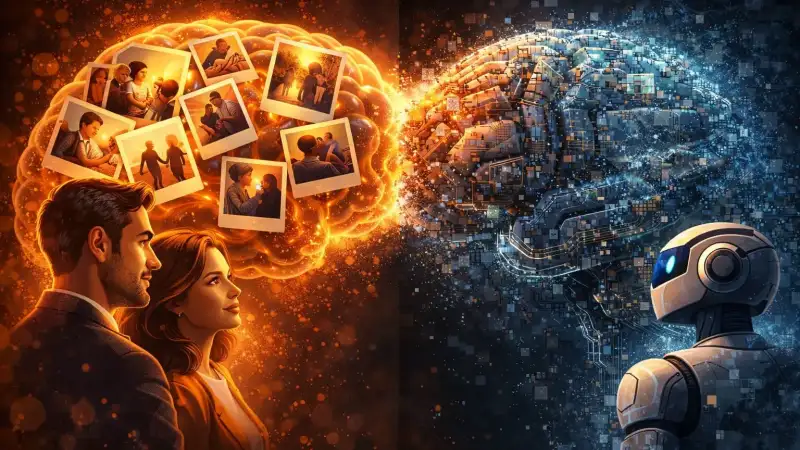
On the other hand, look at our human brain. It is a miraculous camera. The facial expression of a client we met five years ago, the tone in which they spoke, the shadow of worry we saw in their eyes—all of this is remembered today as if it is happening right in front of our eyes. A single line from a book read ten years ago, the aroma of a favorite snack made by our mother in childhood, the sound of raindrops falling in the garden—all of these remain indelibly stored in our brains like a 'photographic memory'.
Such memories definitely exist in your life and mine. The scene of watching a movie with a loved one for the first time still floats like an HD video if you close your eyes. The moment the lights went off in the theater, the first frame that appeared on the screen, the slight touch of the hand of the person sitting next to you, the smile as you came out after the movie and talked over coffee—everything is still fresh today.
Or that moment when you shook hands with a special person for the first time. The color of the sweater they were wearing, its softness, that small dimple that appeared on their lips when they laughed, the emotion that sparkled in their eyes—even after years have passed, these float before your eyes as if they are happening now. The raindrops you played with in the front garden during childhood, the tone of the voice when mother called, the sounds of the first question asked by the manager in your first job interview—everything is stored in our brains as a live photo album.
Not just in personal life, do you know how wonderfully this photographic memory works in our professional lives too? If you place your hand on your heart and think, you will remember... the tea you drank in that small cabin when you first started the office, the advance cheque the first client handed you out of sheer trust, the days you stayed awake all night eating pizza with the whole team to finish a deadline... these are not just data; they are the lifelines of their respective businesses.
 Why Is Typing Kannada on Apple Laptops Still So Difficult? Which Kannada Keyboard Is Best for Apple Computers?
 Apple Finally Folded the iPhone! Why the iPhone Duo Could Change the Smartphone Industry
 TechVaidya: One Year. Over a Thousand Articles. And a long road still ahead...
 NASA Invites ISRO to Join the Moon Base Mission: Why This Could Be a Turning Point for India
 Toxic Review: Yash Owns the Screen, But Does the Film Own the Story?
These memories are not merely pictures. Along with them, emotions, smells, sounds, and the complete 'mood' of the context come attached. When working on a business or a project, it is these old memories, experiences, and emotions combining together that create a wonderful masterpiece. This is humanity's most powerful weapon.
But where does AI have such a photographic memory? In technical language, this is called the Context Window limit. Every single AI model has a limit on the number of words it can remember at one time. Even in 2026, highly advanced models like Gemini 3.1 or GPT-5.4 claim up to 1 million tokens (about 1,300 pages of text). Claude Sonnet 4.6 also has a 1 million token beta. But in reality, during a long conversation, "Context Rot" occurs. The core topics in the middle fade away. It forgets the old and remembers only the new.
This is exactly like the problem the protagonist had in the Hindi movie Ghajini, where he forgot everything old every 15 minutes. No matter how large the context window is, in a long chat or a massive codebase discussion, the AI forgets the logic stated initially and suggests something new. As humans, we understand 'Context'. Once we understand a brand's tone, purpose, and the pulse of the customers, that 'mood' is set in our brains until the project is completed.
AI has no mood. There is only mathematical calculation. It is merely a predictive machine that guesses what the next word should be, but it does not have genuine care for our business. For this exact reason, if you set out to write a large article or a book using AI, there will be a world of difference between the style of the first paragraph and the style of the tenth paragraph. It digresses in between and loses the track of the story. This is the limitation of a machine, not a substitute for human intelligence.
Another dangerous symptom of this amnesiac disease is AI Hallucination. Patients with Alzheimer's have a peculiar trait. When they forget the past, they do not say "I don't know." Instead, to fill that empty space, they fabricate their own baseless stories and tell them with extreme confidence as if they are the real truth. AI does literally the exact same thing.
The best global example of this is an incident that happened in America. New York lawyer Steven Schwartz resorted to ChatGPT to find old case studies needed to present his argument in court. The AI confidently wrote down six old court verdicts, complete with judges' names and dates. The lawyer happily submitted it to the court. But the truth that came out during the hearing was—all six of those cases had never actually happened in reality! To cover up the fact that it didn't know, the machine had created fake cases.
This was an incident that happened in 2023. But even in 2026, this problem continues. Recently, the US 5th Circuit Court fined a lawyer $2,500 for submitting AI-generated fictitious case citations. The court itself stated, "This problem is not diminishing." In India too, content writers, programmers, and marketing teams are blindly copying and pasting the data given by AI. Without human photographic memory and common sense, AI hallucination can push an entire business into a trench.
When an employee who has shed blood and sweat for ten years in a company is fired, and AI is brought into that space, the owners might have the happiness of thinking, 'I saved a salary of one lakh per month'. But in reality, what they are losing is the 'soul' of that company! For an old employee, more than the company's files, they possess the Institutional Memory of the company's culture, the clients' angers and frustrations, and how the market reacts to which product. This is stored securely in their photographic memory. You cannot upload this to any Google Drive or AI cloud. If they leave, it is as if a part of the company's history is erased.
For example, when an old, loyal customer emails out of anger, how does a human react? Remembering their background and the experiences had in previous projects, the human immediately makes a phone call. "Look sir, I understand your disappointment. You have been with us for the last five years, and I will certainly not let that trust be broken," they speak emotionally. By understanding the emotions there, they save the relationship.
But what if you put that email into an AI? It replies mechanically, like a slap to the face, with a template-based, emotionless, "Dear Customer, we apologize for the inconvenience caused. Your ticket number is 404." Here, the customer becomes just a 'ticket number', and a relationship built over years dies in a split second.
AI is excellent for analyzing data, preparing drafts, and doing routine tasks. But to preserve context, emotions, and the 'soul' of the brand, the human brain is definitely needed. Just as you cannot hand the steering wheel of a car to a patient with Alzheimer's and sit in the back seat, owners cannot hand the entire business responsibility to AI and go to sleep.
This is a warning bell for many CEOs in India and abroad who are recently laying off their old and experienced employees and boasting that "AI will take care of everything."
The AI in the office laptop might have the data of the entire world. But it does not know the sensitive issues discussed in the same company's meeting yesterday, or the inclinations and stances of the client. AI has Knowledge, but it lacks Wisdom. Wisdom comes only from those photographic memories, emotions, and years of experience.
Therefore, it is wise to use AI only as a Digital Assistant. When it makes a mistake or forgets, there is an absolute need for an experienced human (Human in the loop) to correct it and bring it back to the track of reality. Human memory (Photographic Memory) is the sole medicine for the forgetfulness of machines (Alzheimer's)!
Let's use AI, but let there be vigilance over it. Let us never abandon the photographic memory and wisdom of humanity. Because no matter how smart machines get, they are still a very long way from reaching the depths of humanity.
Share in the comments what your experiences are regarding this. Have you had such a bizarre experience while chatting with AI? Or is there a wonderful moment of your professional life still fresh in your photographic memory? Let's continue the discussion.
❤️ Also Read
❤️Digital Betrayal: 1,530 Broken Rain Gauges Robbing Karnataka Farmers of Insurance!
❤️In a Hospital, 'Critical' Means Danger; To Scientists, It's a New Birth!
❤️Tragedy on a Reel: How a Teen's Fatal Stunt in Hubballi Exposes the Dark Side of Digital Addiction
❤️OnePlus India CEO Steps Down Amidst Global Arrest Warrant for Pete Lau: What Happens Next?
❤️Private Servers on Military Soil: The US Army’s Unprecedented Tech Gamble!
❤️The AI App Illusion: Why Free Artificial Intelligence is Bankrupting Silicon Valley?
❤️Is ChatGPT Losing Its Sanity? The Dark Side of OpenAI's New 'Adult Mode' Plans
🟢 Follow our WhatsApp Channel JOIN ➤
🛒 ಆನ್ಲೈನ್ ಶಾಪಿಂಗ್ ಮಾಡುವಾಗ ಈ ಕೆಳಗಿನ ಲಿಂಕ್ ಬಳಸಿ

No Comment Yet.
Stay informed with breaking news, trending stories, and in-depth analysis.