Tech Vaidya WhatsApp Channel
Get AI updates, tech news, cybersecurity alerts and useful tech tips directly on WhatsApp.

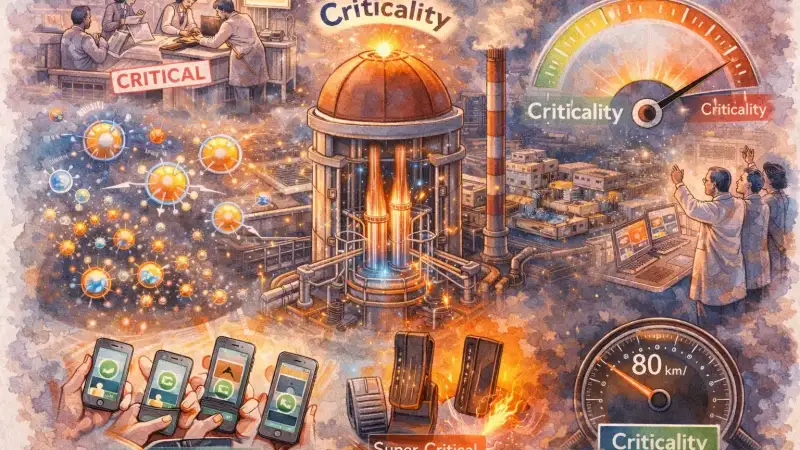
When a doctor steps out of an ICU and says, "The patient's condition is critical," our hearts sink. We hold our breath, knowing it means grave danger and that things are slipping out of control. But in the world of Nuclear Science, when a reactor reaches the 'criticality' stage, those same scientists distribute sweets, jump with joy, and celebrate!
Why does a word that signals danger in medicine bring so much happiness in science? From Prime Minister Modi to everyday scientists, why does hearing this one word give them goosebumps?
What exactly is 'Criticality'? Let's decode this fascinating scientific marvel and explore its thrilling world using everyday examples like WhatsApp messages and driving a car.
The Invisible War Inside the Reactor: Where the Story Begins
To understand criticality, we first need to know what happens inside a nuclear reactor. Think of a reactor as a giant pressure cooker. But it’s not cooking rice; it’s brewing immense power.
Inside this reactor lies heavy nuclear fuel like 'Uranium'. Scientists take a tiny, invisible particle called a 'Neutron' and fire it like a bullet at the massive Uranium atom. What happens when this tiny particle violently collides with a giant atom? The Uranium shudders and violently splits into two halves!
In scientific terms, this splitting process is called 'Fission'. When this atom splits, the heat (or energy) released is unimaginably immense. This exact heat is used to boil water, create high-pressure steam, spin turbines, and generate the electricity that lights up our homes.
One Becomes Three, Three Becomes Nine: The Math of Destruction!
 TechVaidya: One Year. Over a Thousand Articles. And a long road still ahead...
 Hunting from the Sky: The Comprehensive Guide to Satellite and Drone-Based Mineral Exploration
 The Illusion of Algorithms: Read This Before You Get Trapped!
 The 'Breeder' Magic: A Reactor That Generates More Fuel Than It Consumes!
 Digital Betrayal: 1,530 Broken Rain Gauges Robbing Karnataka Farmers of Insurance!
But the story doesn't end there. The real game begins now. When one Uranium atom splits, three brand-new neutrons shoot out from it like fresh bullets.
Imagine what happens next: these three new particles crash into three neighboring Uranium atoms. Now, 9 particles shoot out. Those 9 hit more atoms, releasing 27, 27 become 81, and 81 become 243!
In the blink of an eye—literally a fraction of a microsecond—billions of atoms split continuously, generating a terrifying amount of heat. This is known as a 'Chain Reaction'. It's like a domino effect; tip just one over, and the whole line collapses on its own.
The Surprising Connection Between a Viral WhatsApp Message and an Atom Bomb!
There is no better analogy to understand this chain reaction than our everyday 'WhatsApp messages'.
Suppose you forward a fake news alert or a funny meme (think of this as the first neutron) to 3 of your friends. Those 3 forward it to 3 others (total 9 people). Those 9 send it to 3 more (27 people). In just an hour, the message blasts onto millions of phones. It goes 'viral', and it becomes impossible to track down who started it.
In nuclear science, if a chain reaction goes completely out of control and becomes 'viral' like this, resulting in a massive, unstoppable explosion, it is called an Atom Bomb.
In scientific terminology, this is the Super-critical state! The purpose of a nuclear power plant is not to become a city-destroying bomb, but to provide controlled, steady heat to generate electricity. Therefore, this crazy chain reaction must be kept on a very tight leash.
Control Rods: The Invisible 'Brakes' Inside the Reactor
To prevent billions of particles from spawning and causing an explosion, scientists use a brilliant braking system called 'Control Rods'. Made of materials like Boron or Cadmium, these rods act like giant sponges—they swallow and absorb the extra, dangerous neutrons!
Let's return to our WhatsApp analogy:
Sub-critical: You send a message to 5 people. But nobody reads it, and nobody forwards it. The message dies right there. In reactor terms, the control rods swallowed all the neutrons. The chain reaction stopped entirely, and the reactor shut down. We won't get a single unit of electricity from this.
Super-critical: The message you sent to one person reached millions and caused a blast. The reactor melts down and explodes (like the tragic Chernobyl disaster). We definitely don't want this either.
The Real Magic of 'Criticality': The Perfect 1 = 1 Equation
So, what do we actually want? We want the real magic—Criticality!
Imagine you send a WhatsApp message to 3 people. But two of those accounts are blocked (meaning, the control rods swallowed them). Only one person gets the message and forwards it to another. Even if he tries sending it to three more people, two are blocked again, and only one message successfully gets delivered.
Picture this inside a reactor: Out of the 3 particles born when 1 Uranium atom splits, the reactor's control rods absorb exactly 2. Only 1 particle survives to hit the next atom. That atom splits, producing 3 more particles, but again, 2 are destroyed and only 1 remains.
It flows like this: 1 particle → 1 particle → 1 particle → 1 particle... The process doesn't multiply uncontrollably (preventing a bomb), nor does it decrease and die out (preventing a shutdown). This state of perfect balance, where the reaction sustains itself continuously without human interference, is called 'Criticality'!
It Works Just Like Your Car's 'Cruise Control'!
To make it even simpler for drivers to understand: remember the 'Cruise Control' feature you use on highways.
Suppose you set your car to 80 km/h on a wide expressway using cruise control. The car now drives itself at a constant, steady speed—without wildly accelerating (not going super-critical) or hitting the brakes and stopping (not going sub-critical). Your feet get complete rest!
Achieving 'Criticality' in a nuclear reactor is literally exactly this! Once this stage is reached, the reactor continuously, safely, and steadily generates the precise amount of heat needed. This self-balancing process is what scientists call a 'Self-sustaining chain reaction'.
Conclusion: Not the End of a Patient, but the Birth of Grand Energy!
Now it makes perfect sense, right? Scientists sit in the control room holding their breath. The dials slowly tick upwards. They gently wake the reactor from its sub-critical slumber, carefully adjusting the control rods one millimeter at a time. The moment they hit that perfect balance point of 'criticality', silence fills the room, instantly followed by roaring cheers!
A single tiny pellet of Uranium can provide more electricity than burning tons of coal. Harnessing that immense power and bringing it under our total, flawless control—that exact moment is 'Criticality'.
That is why, when PM Modi tweets that a reactor at Kakrapar or Kalpakkam has reached 'criticality', the entire scientific community celebrates. It means the reactor has successfully "come alive" and is fully ready to provide uninterrupted power to millions of homes and factories!
In short: In the medical world, 'Critical' might mean a dangerous step towards the end. But in nuclear science, it is the birth of new hope and infinite energy!
❤️ Also Read
❤️Doubling Down on AI: Why Investors are Flocking to Palmer Luckey
❤️Forget the iPhone 18 Pro: This 7.8-Inch Foldable Dummy Model Changes Everything!
❤️Tragedy on a Reel: How a Teen's Fatal Stunt in Hubballi Exposes the Dark Side of Digital Addiction
❤️The Silent Digital Heist: How Video Games Are Draining Parents Bank Accounts
❤️Elon Musk Just Recruited a Robotics Genius to xAI and It Changes Everything
❤️OnePlus India CEO Steps Down Amidst Global Arrest Warrant for Pete Lau: What Happens Next?
🟢 Follow our WhatsApp Channel JOIN ➤
🛒 ಆನ್ಲೈನ್ ಶಾಪಿಂಗ್ ಮಾಡುವಾಗ ಈ ಕೆಳಗಿನ ಲಿಂಕ್ ಬಳಸಿ

No Comment Yet.
Stay informed with breaking news, trending stories, and in-depth analysis.