Tech Vaidya WhatsApp Channel
Get AI updates, tech news, cybersecurity alerts and useful tech tips directly on WhatsApp.

| Krishna Bhat
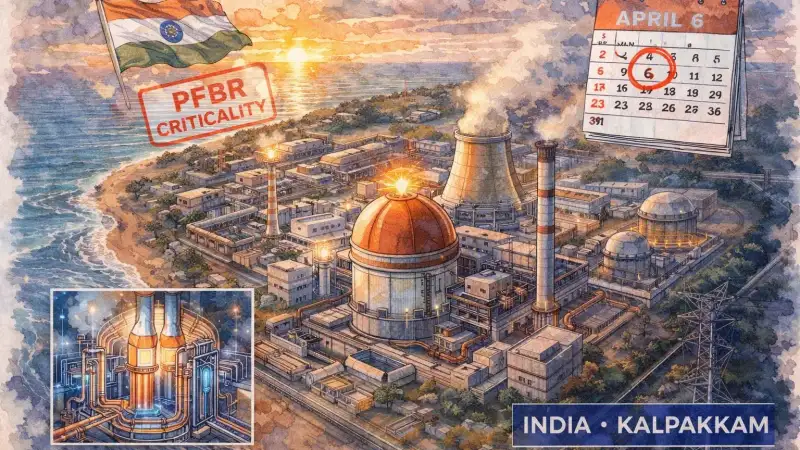
Kalpakkam Beach... April 6, 2026... While most of us were casually sipping tea and catching up on the daily news, a quiet revolution was brewing at Kalpakkam. It was a revolution poised to rewrite India's history for the next 400 years. After limping along for the past 20-25 years, the much-anticipated 'Prototype Fast Breeder Reactor' (PFBR) finally achieved 'criticality' at 08:25 PM.
To the common man, the word 'criticality' might sound like a reason to panic. However, in the realm of nuclear science, it is a monumental victory. It simply means that a nuclear reactor has begun continuously producing energy through a self-sustaining chain reaction, without any external trigger—as if an invisible hand turned the ignition and the engine started running smoothly on its own.
Now, you might be tempted to scroll past this, thinking it's just another power plant project. But wait. This specific dream was seeded back in 1954 by the legendary physicist Dr. Homi J. Bhabha. Today, 72 years later, witnessing that visionary blueprint become a reality is nothing short of awe-inspiring.
What’s even more remarkable is that India is now only the second country in the world to implement this technology on a commercial scale. While Russia already operates fast breeder reactors, global heavyweights like the United States, the UK, and Germany essentially threw in the towel. They didn't abandon it due to pressure from environmentalists or ecological concerns; they backed out because the technology was incredibly complex to master. But India refused to give up and has now taken a decisive step toward the finish line.
To truly understand the magnitude of this achievement, how it will impact your monthly electricity bill, and why it is crucial for India's sovereign self-reliance, we need to dive into Dr. Bhabha's ingenious three-stage nuclear power programme.
India faces a unique challenge when it comes to nuclear power: our reserves of 'Uranium', the standard nuclear fuel, are quite low. However, we sit on a goldmine of 'Thorium'—holding nearly 25% of the world's total deposits in the monazite sands of our coastal regions. If harnessed, this Thorium could power India for the next 400 years. But there's a catch. Thorium isn't fissile; it cannot be used directly as fuel. It is like wet firewood that refuses to catch fire on its own. Dr. Bhabha's three-stage plan is the ultimate masterstroke to transform this "wet firewood" into an ultra-powerful energy source.
In Stage 1, we use imported natural uranium in heavy water reactors to generate electricity, which leaves behind 'Plutonium' as a byproduct. Stage 2 is exactly what has now roared to life at Kalpakkam—the PFBR. The absolute magic of this Fast Breeder Reactor is that it actually produces more fuel than it consumes! It literally "breeds" fuel.
 TechVaidya: One Year. Over a Thousand Articles. And a long road still ahead...
 Hunting from the Sky: The Comprehensive Guide to Satellite and Drone-Based Mineral Exploration
 The Illusion of Algorithms: Read This Before You Get Trapped!
 In a Hospital, 'Critical' Means Danger; To Scientists, It's a New Birth!
 Digital Betrayal: 1,530 Broken Rain Gauges Robbing Karnataka Farmers of Insurance!
Imagine driving your car from Bengaluru to Mysuru. Now imagine arriving in Mysuru to find that your car's fuel tank has more petrol than when you started in Bengaluru! Fascinating, isn't it? That is precisely how a breeder reactor operates. The core is surrounded by a blanket of Uranium-238, which fast neutrons convert into fissile Plutonium-239.
In Stage 3, Thorium blankets will be placed around the reactor to be converted into Uranium-233, an exceptionally potent fuel. Once we hit this third stage, India can completely rely on its own Thorium to generate electricity. We will no longer need to bow to Arab nations for oil or rely on Western powers for Uranium.
So, why is this project notoriously complex? The answer lies in the PFBR's coolant. While conventional thermal reactors use water as a coolant, the PFBR uses 'Liquid Sodium'. While liquid sodium is a brilliant conductor of heat, it is also highly volatile. If it touches water, it explodes; if exposed to air, it aggressively catches fire.
Therefore, engineering the piping system to ensure not even a single drop of sodium leaks was a colossal challenge for Indian scientists. Since liquid sodium is opaque, you cannot simply look inside the pipes to see what’s happening. To solve this, our engineers had to rely on advanced ultrasonic scanners.
The crowning glory is that practically every nut, bolt, and valve was manufactured by Indian industries. Furthermore, the reactor boasts a robust 'passive safety' mechanism—meaning in the rare event of an anomaly, the reactor will safely shut itself down without requiring any human intervention. It is an absolute marvel of indigenous engineering.
A 22-Year Long Struggle
While we celebrate this success and swell with pride for our engineers, we must also swallow a bitter pill. When the PFBR construction commenced in 2004 under the Bharatiya Nabhikiya Vidyut Nigam Limited (BHAVINI), the original plan was to complete it by 2010 at an estimated cost of ₹3,492 crore. But alas, the classic Indian administrative apathy struck. What was supposed to take 6 years dragged on for an agonizing 22 years! The project cost ballooned to a staggering ₹8,181 crore. Frankly, given the massive 22-year delay, the cost escalation seems almost modest!
If you read the Comptroller and Auditor General (CAG) and Parliamentary panel reports presented leading up to March 2026, it is hard not to feel frustrated at the sheer bureaucratic negligence. The reports expose the glaring missteps by BHAVINI. Procurement of massive orders was chronically delayed due to a lack of in-house expertise. Sometimes, moving a single document from one desk to another took three whole years! Despite the complete halt in progress, employees routinely received salary hikes and promotions. For two decades, without generating a single unit of electricity, taxpayers' money was effectively drained. So, while the project is an undisputed engineering marvel, its execution has been a monumental administrative blunder.
Furthermore, while the reactor has gone critical, the overall ecosystem isn't completely ready. If the PFBR is the engine, the Fast Reactor Fuel Cycle Facility (FRFCF) is its dedicated fuel refinery. This facility is essential to reprocess the spent fuel and separate the plutonium. Unfortunately, the FRFCF is still under construction and might not be fully operational until 2027 or 2029. Until it is completed, we cannot fully realize the "breeding" cycle Dr. Bhabha envisioned. However, handling highly radioactive fuel via robotics is a technology India is developing entirely on its own, refusing to rely on foreign aid.
Atmanirbhar Bharat (Self-Reliant India)
The most heartwarming aspect of this saga is that every single brick of this project was laid by Indians. Unlike our smartphones, where parts are imported from China, assembled in an Indian factory, and slapped with a brand logo, the PFBR is a genuine indigenous triumph. Over 200 Indian companies and thousands of MSMEs meticulously crafted its components. From industry giants like BHEL, L&T, and MTAR Technologies to small workshops in Pune and Gujarat, everyone played a role. Ironically, while we often hail China as a tech behemoth, China is currently buying fast breeder technology from Russia. Meanwhile, India, which conceptualized this decades ago, has designed and manufactured it from scratch and is now stepping into the final frontier.
By 2047, India aims to produce a massive 100 Gigawatts (GW) of nuclear power—roughly 12 times our current capacity. The government has rightly realized that government agencies alone cannot shoulder this burden. Hence, the recent push to amend the outdated 1962 Atomic Energy Act to allow private investment in the nuclear sector. This policy shift will eventually enable large private conglomerates to build nuclear reactors.
What Does This Mean for the Common Man?
Why should a farmer in Karnataka or an IT professional in Bengaluru care about a reactor in Kalpakkam?
If we successfully transition to Thorium-based power generation, our crippling dependence on petroleum will drastically reduce. Once the cost of generating electricity plummets, we can aggressively shift from petrol and diesel vehicles to electric ones. Currently, our economy is often held hostage by the geopolitics of the Strait of Hormuz. If we get electricity cheaper than crude oil, we can power our lives using an energy source abundantly available right under our feet.
Once India starts running on Thorium, no global power will be able to blackmail us over energy. If this grand plan succeeds, electricity in India could become incredibly cheap by 2050. It will revolutionize agriculture, manufacturing, and transportation. Best of all? Since these breeder reactors use existing nuclear waste as fuel, it also significantly addresses the headache of environmental pollution.
❤️ Also Read
❤️The AI Money Trap: Open Source Wins, Closed Source Loses
❤️Elon Musk Just Recruited a Robotics Genius to xAI and It Changes Everything
❤️National Security Shift: Why the US is Protecting Crypto Networks?
❤️The Trillion Rupee Tech Gamble: Why India Is Spending 11 Billion Dollars On Microchips?
❤️Android 15 Under 10K? Lava Bold N2 Pro 4G India Launch at 12 PM Today
❤️The AI App Illusion: Why Free Artificial Intelligence is Bankrupting Silicon Valley?
❤️Tragedy on a Reel: How a Teen's Fatal Stunt in Hubballi Exposes the Dark Side of Digital Addiction
❤️Intel Under the Lens: Lawmakers Target Chinese Supply Chain Links
🟢 Follow our WhatsApp Channel JOIN ➤
🛒 ಆನ್ಲೈನ್ ಶಾಪಿಂಗ್ ಮಾಡುವಾಗ ಈ ಕೆಳಗಿನ ಲಿಂಕ್ ಬಳಸಿ

No Comment Yet.
Stay informed with breaking news, trending stories, and in-depth analysis.