Tech Vaidya WhatsApp Channel
Get AI updates, tech news, cybersecurity alerts and useful tech tips directly on WhatsApp.

| Nagaraj Vaidya
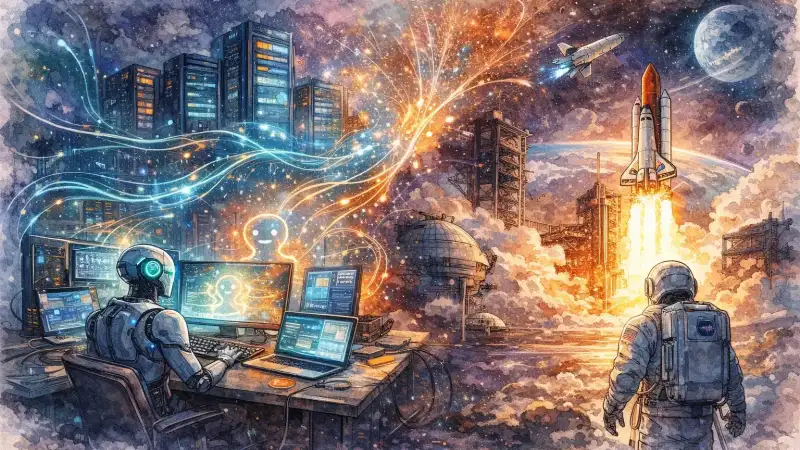
For the world of technology, the year 2026 is not just another year on the calendar; it marks the beginning of a new era. The start of April witnessed the world simultaneously experiencing two massive technological revolutions. On one front, the Cold War between Artificial Intelligence giants escalated dramatically. On the other, space technology began reclaiming its golden age.
Thousands of tech news headlines flash before our eyes every day. Most people read the titles, marvel for a minute or two, and then move on. The internet today is not just a flood of information; it is a noisy, turbulent ocean. But to find the real truth hidden within this noise and to understand the next moves of global tech giants, TechVaidya conducted a unique, massive-scale data analysis.
Using global tech media as a giant digital window, we collected over 2,250 technology news articles published in just the last 72 hours. From late-night leaks in Silicon Valley to official press releases from NASA at dawn, every piece of information was scrutinized. This wasn't a casual reading exercise; it was a deep analysis to measure the very pulse of the global tech market.
As we analyzed this massive dataset, the real picture behind the glossy corporate marketing strategies began to slowly unfold. By setting aside flashy advertisements, the data from these 2,250 reports revealed where billions of dollars are actually flowing and what keeps tech titans awake behind closed doors. A clear connecting link, hidden among thousands of stories, became visible to us.
One statistic we encountered in the final stage of our analysis was truly staggering. Of all the tech news published worldwide, over 40 percent was almost exclusively confined to just two fields! This meant that popular topics like smartphone launches, new gadgets, and social media updates were all pushed to the sidelines. The complete attention of global media had been hijacked by two massive forces.
Those two forces are Artificial Intelligence (AI) and Space Technology. This deep-dive research does not merely point out a few interesting trends. Instead, it provides a clear blueprint for the direction of global technology policy for the next five years. It reveals the shape of the future tech war and contains the precise answer to who will dominate the next era.
The Billion-Dollar Gamble: The Financial War
 Why Is Typing Kannada on Apple Laptops Still So Difficult? Which Kannada Keyboard Is Best for Apple Computers?
 Apple Finally Folded the iPhone! Why the iPhone Duo Could Change the Smartphone Industry
 TechVaidya: One Year. Over a Thousand Articles. And a long road still ahead...
 NASA Invites ISRO to Join the Moon Base Mission: Why This Could Be a Turning Point for India
 Toxic Review: Yash Owns the Screen, But Does the Film Own the Story?
In both AI and space, what is currently unfolding is a literal multi-billion dollar financial war. In the AI sector, Anthropic's revenue surge from 9 billion dollars at the end of 2025 to over 30 billion dollars today is no ordinary feat. Furthermore, Google's deal with Broadcom for 3.5 gigawatts of TPU capacity, set to come online by 2027, signals massive capital pouring into AI infrastructure, creating a high barrier to entry for new startups.
The exact same trend is evident in the space sector. SpaceX's upcoming IPO in 2026 is expected to surpass a 1 trillion dollar valuation. The European Investment Bank extending a 30 million euro loan to companies like PLD Space, and the flood of private and governmental investment into the Artemis II mission, underscores the intensity of the new space race. In both fields, a winner-takes-most dynamic is emerging, where only the strongest and most financially robust companies will dominate.
The Infrastructure Battle: Energy and Hardware
Even with money, the biggest hurdle these companies now face is hardware and power. The demand for GPUs in AI is so immense that it has created a global shortage of RAM and SSDs. Massive AI data centers are now radiating excessive heat, turning into heat islands in urban areas. To maintain control over their technology, companies like Anthropic are tightening payment systems for services like Claude Code. AI has become a ravenous monster, starved for hardware and energy.
Key finding from our analysis: AI companies have now begun direct talks with nuclear power companies to meet their energy needs. In the next two years, we may see Small Modular Reactors co-located with AI data centers. This would be a revolutionary development, signaling a deep fusion of technology and energy sectors.
Turning to space, a similar infrastructure crisis is unfolding. On April 6, 2026, the Artemis II astronauts set a new record by traveling farther from Earth than anyone before. However, future commercial missions will require orbital data centers powered by solar energy and specialized chips that can withstand space radiation. The adage Infrastructure is the new oil applies literally to both these sectors.
Geopolitics and The Rising Security Threat
As technology grows, it begins to directly impact global politics and security, not just the economy. Recently, Iran's IRGC released a chilling video threatening to completely destroy OpenAI's 30 billion dollar Stargate data center being built in Abu Dhabi. Simultaneously, North Korean hackers hijacking open-source code on GitHub and ransomware attacks like Medusa indicate that AI technology is becoming a new weapon of modern warfare. Today's AI data centers are the new oil fields for nations.
Another alarming fact from the 2,250 articles: The very nature of cyberattacks is changing. The goal is no longer just money, but to disable a rival nation's critical AI infrastructure. The digital battlefield has now moved to direct attacks on data centers. This signals a dangerous escalation in cyber conflict between nations.
Meanwhile, the space sector has become a global race to claim new territories. The Moon and Earth's orbit are now the new digital and physical frontiers. NASA and the Canadian Space Agency jointly conducting the Artemis II mission is a part of this geopolitical balancing act. On one hand, there are proposals to cut NASA's budget, while on the other, Elon Musk is rewriting the rules with his billion-dollar empire. Tariffs, export bans, and war are now powerful tools controlling the speed of both tech revolutions.
The Consumerization of Tomorrow's Tech
The most fascinating development amidst all this is that these gigantic technologies are becoming an integral part of everyday life. AI, once confined to scientists and developers, is now available to everyone through consumer apps. Spotify's prompted playlists, Google Photos' AI Enhance, and tools like Adobe Acrobat Spaces put massive computing power in every person's pocket. Platforms like JioHotstar are completely changing daily digital life by implementing conversational search.
Our analysis predicts: In the coming days, AI assistants will become an integral part of our smartphone operating systems. Instead of being separate apps, we will see intelligent assistants woven into all phone functions. This could be the biggest consumer tech revolution in the next two years.
Similarly, the wonders of space are becoming more relatable. The photos of Earth taken by Artemis II astronauts using their iPhone 17 Pro Max are going viral on the internet. People are emotionally connecting with space through these moon selfies. Furthermore, NASA Lego sets and the moon exploration feature in the Fortnite game have brought space science directly into our living rooms. The ultimate success of any new technology lies in this consumerization, a fact proven once again.
Observing the news flow: Within the next three years, private companies are likely to organize trips to the moon's orbit for tourism. While still expensive, it signals the beginning of space travel becoming accessible to ordinary people. It is a powerful example that space technology is no longer confined to government agencies.
The Age of Twin Engines
The period of 2026 and 2027 will undoubtedly be called the Age of Twin Engines in the history of technology. Although AI and Space Tech are different fields, their paths of growth are identical. Massive investment, infrastructure challenges, global security anxieties, and the rush towards consumerization – they are moving together on all these fronts. The news of Anthropic's 30 billion dollar revenue and the success of the Artemis II mission being headlines on the same day is not a coincidence; it is a clear indication of a new world order.
The final stance of our comprehensive analysis is this: Technology has intertwined itself with politics, economics, and the lives of ordinary people in a way never seen before. Whichever nation dominates both AI and space in the coming days will remain the true global power. This is a new kind of Tech Race, and India's role in it is crucial. Significant progress will only be possible if the collaboration between the government and the private sector becomes even stronger.
❤️ Also Read
❤️Elon Musk Just Recruited a Robotics Genius to xAI and It Changes Everything
❤️The Silent Digital Heist: How Video Games Are Draining Parents Bank Accounts
❤️OnePlus India CEO Steps Down Amidst Global Arrest Warrant for Pete Lau: What Happens Next?
❤️Is ChatGPT Losing Its Sanity? The Dark Side of OpenAI's New 'Adult Mode' Plans
❤️The AI PC Era: Why Indian Enterprises are Switching to NPU-Powered Laptops
❤️Digital Betrayal: 1,530 Broken Rain Gauges Robbing Karnataka Farmers of Insurance!
❤️Tragedy on a Reel: How a Teen's Fatal Stunt in Hubballi Exposes the Dark Side of Digital Addiction
🟢 Follow our WhatsApp Channel JOIN ➤
🛒 ಆನ್ಲೈನ್ ಶಾಪಿಂಗ್ ಮಾಡುವಾಗ ಈ ಕೆಳಗಿನ ಲಿಂಕ್ ಬಳಸಿ

No Comment Yet.
Stay informed with breaking news, trending stories, and in-depth analysis.