Tech Vaidya WhatsApp Channel
Get AI updates, tech news, cybersecurity alerts and useful tech tips directly on WhatsApp.
by: Nagaraj Vaidya
Across the internet, a justifiable outrage has erupted against the flood of fake art and writings generated by artificial intelligence. Everywhere you look, machine-written essays and hyper-realistic images that put cameras to shame are reigning supreme. A cry is echoing from all corners that these machines are stealing human creativity, that they are murdering the authenticity of art. It cannot be said that these criticisms lack merit, for this tide of artificiality is indeed alarming.
But amidst the din of this widespread criticism, another face of technology is quietly blossoming. This face is deeply compassionate, revolutionary, and profoundly humane. The voice of this positive development has been almost entirely drowned out by the loud voices of the critics. In our haste to see artificial intelligence solely as a machine that steals jobs or brings ruin to art, we are neglecting its greatest gift.
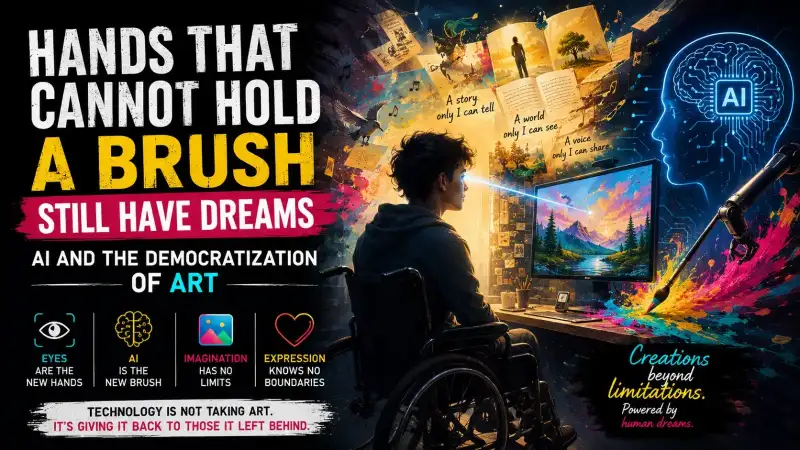
To countless individuals who have no hands to draw with, no fingers to touch a keyboard, and no voice box to speak with, artificial intelligence has opened new doors of expression. For millions of people who have buried their dreams deep within their minds due to physical disabilities, it is as if they have been given a new life. The argument that AI-assisted art is not real art now confronts us with a serious question: could this argument itself be born from a position of privilege?
Only those who take the physical ability to create for granted can so harshly criticize art that emerges with the aid of technology. For someone who is physically able-bodied, holding a brush or gripping a pen to write on paper is an utterly ordinary act. But for those to whom even this small movement is impossible, artificial intelligence has arrived like a divine blessing.
For centuries, art was enslaved to physical ability. No matter how magnificent the conception, physical labour was indispensable to express it. To paint a beautiful picture, one needed steady hands; to play sweet music, nimble fingers; to sing with feeling, a clear voice. For those without these physical capacities, the doors to the world of art were permanently closed. Even if a wonderful poem took shape within the mind, if the body refused to cooperate in writing it down, that poem would die right there. Throughout history, countless unparalleled talents with physical disabilities have been lost in the darkness, unable to express the artistic impulse burning inside them. The paintings and poems born in their minds have turned to dust with them, unseen by anyone.
Imagine a person afflicted with brain paralysis or motor neuron disease. Their body completely refuses to cooperate in telling the world the wonderful story residing in their mind. They can see the world, hear it, and comprehend it, but their muscles will not allow them to react. It is impossible to even fathom the hellish torment of those living with locked-in syndrome. For such souls, artificial intelligence is not a crutch; rather, it becomes their lost voice. It has become their sole path to liberation. Technology has built a miraculous bridge today, allowing a mind that has been silent for decades to finally speak to the world. This is not merely a technological advancement; it is a magnificent confluence of medicine and the art world.
We live in a miraculous era where an artist with no hands can control software through the movement of their eyes alone, bringing the dreamscapes they envision to life on a screen. Technology has advanced so much today that even with no movement of any bodily limbs, an entire computer can be controlled solely through one's gaze. For the specially-abled, this is a monumental step towards freedom. When eye-tracking technology, which detects the movement of the pupil, is combined with artificial intelligence, that person's gaze itself transforms into a brush. Wherever their eyes look on the screen, colours bloom and shapes emerge. The human eye ceases to be a mere organ of sight and becomes a powerful weapon for expressing thought.
Using image generation tools like Midjourney or DALL-E, these individuals issue small commands solely with their eyes, creating stunning oil paintings right before them. They are expressing the scenes they imagined and the pain they have endured with astonishing accuracy through these images. When one looks at these pictures, it does not feel like they were created by some machine.
 The Power of Symbolism vs. The Calculus of Risk: Evaluating the PM’s Convoy Cut
 Six Months in the Digital Wilderness: The Tragic Isolation of the Windows 10 "Holdouts."
 Why Is Typing Kannada on Apple Laptops Still So Difficult? Which Kannada Keyboard Is Best for Apple Computers?
 Apple Finally Folded the iPhone! Why the iPhone Duo Could Change the Smartphone Industry
 TechVaidya: One Year. Over a Thousand Articles. And a long road still ahead...
For them, this technology is certainly not a symbol of laziness; it is the ultimate symbol of freedom. For an able-bodied artist, technology might be a shortcut that simplifies work, but for a disabled person, it is the only medium to connect with the world. This is not just the creation of art; it is an unprecedented leap of the human spirit, freed from its physical shackles.
Furthermore, the miracles occurring when Brain-Computer Interface technology joins forces with artificial intelligence are changing the very direction of future art. Chips being developed by organizations like Neuralink are directly translating the brainwaves of a human being into machine language. This is a technological breakthrough beyond imagination, and it is redefining the very act of artistic creation. People afflicted with paralysis, using a chip implanted in their head, are converting their mere thoughts into beautiful poems through tools like ChatGPT. They simply have to imagine the letters in their mind, and those letters appear on the screen. Artificial intelligence then weaves those scattered words together, shaping them into a meaningful poem.
Here, the machine is not writing the poem. Instead, it is working as a supremely faithful scribe, capable of giving the form of words to the emotions of a human being imprisoned within their own body. The machine merely looks after the grammar and the arrangement of words; the pain, love, and despair behind the poem belong entirely to that human being.
From this perspective, the fundamental question of who an artist is begins to haunt us. Is an artist only the one who physically holds the brush and applies the paint? Or is the one who sees the composition of those colours clearly in their mind also an artist? To call only physical effort 'art' would be an extremely narrow definition of it. Art is not born on a canvas or a keyboard; it is born in the realm of human experience, suffering, and imagination. If artificial intelligence serves as a medium to give physical form to that inner vision, what is wrong with that? We must not forget that paint and brushes were themselves once considered technology.
A picture created by a disabled person yearning to tell the world of their pain and joy can be far more artistic than a work created by a famous artist using a set of pre-determined formulas. This is because the disabled person's picture has life in it; it has a genuine longing. These machine-created images may possess a greater purity than the handmade paintings created for commercial purposes.
Authenticity and emotional honesty are the very lifeblood of art. The medium is merely a vehicle. Artificial intelligence is performing the task of this vehicle with great fidelity and speed. This technology has completely dismantled the physical barriers that once stood between the human mind and the world.
It is not only for those with physical disabilities; artificial intelligence technology has also opened new dimensions of inspiration for healthy, experienced, and renowned artists. Instead of seeing technology solely as an enemy, artists who have embraced it as a companion on their artistic journey are conducting wonderful experiments. A painter who has been stuck in the same style for years now has the opportunity to feed their own works to a machine and create expanded, surrealistic versions of their own style. The machine, having learned their unique style, presents them with thousands of new possibilities within that very idiom. This helps the artist see themselves from a completely new perspective.
This is not erasing the artist's original talent; rather, it is giving it new wings. It is an excellent platform to reach new horizons of creativity. When the machine reveals a combination of colours they had never imagined, the artist takes it as inspiration and uses it for their next real, physical artwork. The ability to see, in an instant, combinations that seemed impossible in the physical world of canvas and paint—simply by giving a small prompt—can become the foundation for new creation. The trend now is growing where, the moment an idea strikes, an artist views its draft form through a machine and then develops it further in their own style.
The greatest enemy of creativity is not artificial intelligence; it is the vacuum of ideas, the creative block. No matter how great a writer or painter someone is, there comes a point when their ideas run dry. In such moments, these machines can be an excellent partner in thought, capable of striking a tiny spark for new ideas. By giving strange prompts like, "Paint this scene in the style of a 19th-century propaganda poster," or "Write this poem from the perspective of an ancient physician," one can get unexpected results. Only artificial intelligence has the power to give precise form to such wild imaginings. The results might make us laugh or leave us in awe.
This result may not be the final artwork itself, but it creates new neural connections in the human brain. It acts as a catalyst for generating entirely new ideas. To a mind that has been thinking within a single framework, the machine introduces vastly different, sometimes illogical, dimensions.
Perhaps our outrage should not be against the technology itself, but against its misuse. Technology is not inherently evil; the intention of the user determines its nature. The real culprits here are those who mislead society and spread fake news. The real problem lies in the actions that fill websites with trash and create fake profiles on social media. This is not a flaw in the technology, but a reflection of the greed and excessive lust for profit of the humans wielding it. We must condemn the trend of flooding the internet with synthetic content just to get clicks, not the technology itself.
A sword can be used for a life-saving surgery, or for a murder that takes a life. Similarly, artificial intelligence is an incredibly powerful tool. There are those who use it to kill art, and similarly, there are those who use it to breathe new life into art for people with physical disabilities. Which group we belong to is our choice.
Ultimately, this technology represents the greatest step towards the democratization of art. Art is no longer the sole property of the physically able. Hands that cannot hold a brush still have dreams, and artificial intelligence is now lovingly filling those dreams with colour. More than the hands it steals from, the fact that technology is shaping itself into a shoulder of support is humanity's greatest triumph.
❤️ Also Read
❤️David Attenborough at 100: The Century-Old Voice That Brought Nature to Our Living Rooms
❤️The Ultimate Leak: What Happens When Your Ancestry Report Ends Up on the Dark Web?
❤️The Illusion of Algorithms: Read This Before You Get Trapped!
❤️Are Aliens Real? The Pentagon's 160 Declassified Files Hold the Clues
❤️From Coder to Creator: The Brutal Reality of Making Money in the AI Era
❤️Hunting from the Sky: The Comprehensive Guide to Satellite and Drone-Based Mineral Exploration
❤️Let This 'Remake' Fever in Politics End; May the Soil of Karnataka Never Succumb to Glamour!
❤️Silicon Hubris vs. Regulatory Reality: Why Being a Tech Giant Didn’t Save Paytm from the RBI’s Axe
🟢 Follow our WhatsApp Channel JOIN ➤
🛒 ಆನ್ಲೈನ್ ಶಾಪಿಂಗ್ ಮಾಡುವಾಗ ಈ ಕೆಳಗಿನ ಲಿಂಕ್ ಬಳಸಿ

No Comment Yet.
Stay informed with breaking news, trending stories, and in-depth analysis.