Tech Vaidya WhatsApp Channel
Get AI updates, tech news, cybersecurity alerts and useful tech tips directly on WhatsApp.

by: Nagaraj Vaidya, Editor, TechVaidya Global
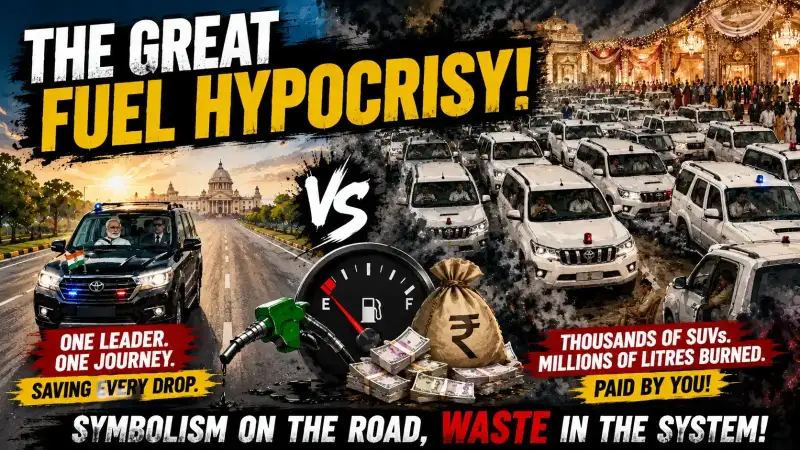
The news that Prime Minister Narendra Modi has decided to significantly reduce his security convoy to save fuel and set an example for the nation is currently dominating national headlines. Historically, the symbolic gestures of national leaders carry immense psychological weight. When former Prime Minister Lal Bahadur Shastri asked the nation to skip a meal during a food crisis, his own adherence to the rule galvanized millions. In that context, PM Modi’s decision to personally lead the charge on fuel conservation is a powerful optical statement aimed at fostering a culture of austerity. However, when we strip away the emotional appeal and analyze this from a lens of national security and macroeconomic reality, this decision appears dangerously lopsided.
The Prime Minister of India is not just a political figure; he is the ultimate institutional symbol of the nation’s sovereignty and democratic stability. Prime ministerial security is not a lifestyle choice dictated by ego; it is a rigid, mathematical matrix of threat perception governed by the Special Protection Group (SPG) Blue Book. A standard Prime Ministerial convoy includes advance pilot vehicles, heavy-duty jammers to neutralize IEDs, heavily armed Quick Reaction Teams (QRTs), an ambulance, and identical decoy vehicles designed to confuse potential attackers.
When you reduce the size of this convoy to save a few liters of fuel, you inherently dilute this protective shield. You remove the decoys, you widen the reaction time for the QRTs, and you expose the core vehicle. We live in a volatile geopolitical era where the Prime Minister faces complex threats from hostile neighboring states, global terror syndicates, and internal extremists. The tragic assassination of former Japanese Prime Minister Shinzo Abe served as a chilling global reminder of what happens when a split-second security gap occurs. While India’s SPG protocols are vastly different and far more layered than Japan’s civilian security, willfully shrinking that protective layer for a public relations victory regarding fuel savings is a terrifying risk. India is not so poor that its leader must gamble with his life to balance the petroleum import bill.
If the government genuinely wishes to tackle India's fuel crisis and the burgeoning foreign exchange drain caused by crude oil imports, it needs to perform deep systemic surgery, not just apply a symbolic band-aid. The real "oil wells" of the nation are being drained by the vast, unchecked machinery of the Indian state. India has over 4,000 MLAs, 700-plus MPs, and tens of thousands of bureaucrats ranging from IAS officers to municipal commissioners. A quick glance at state legislations reveals that an average MLA or minister receives anywhere between Rs 20,000 to Rs 50,000 per month solely as a conveyance or fuel allowance, alongside free rail and air travel coupons.
When you aggregate the salaries, fuel allowances, and the maintenance costs of the fleets provided to this massive political and bureaucratic army, the annual bill runs into thousands of crores of taxpayer money. In a recent controversy in the Nagpur Municipal Corporation, it was revealed that just the fuel and maintenance bill for city corporators' vehicles would cross Rs 1 crore annually. If the government had the political will, slashing these limitless VIP fuel allowances by just 20 percent across the board would save exponentially more foreign exchange in a single day than the Prime Minister’s reduced convoy could save in an entire decade.
To be fair and nuanced, not all government vehicle usage is wasteful. A District Magistrate navigating flooded rural roads during a monsoon rescue, or a Superintendent of Police rushing to a riot-hit area, absolutely requires a heavy-duty, reliable SUV. The issue is not the legitimate, emergency use of state resources. The core problem lies in the brazen entitlement of using these powerful, fuel-guzzling vehicles for mundane urban commutes and personal errands.
This misuse is so normalized it has blended seamlessly into our daily lives. Take, for instance, a recent scene I witnessed at a local Taluk office. Hundreds of common citizens—elderly farmers and daily wage laborers—were waiting under the scorching sun for basic pension approvals. Suddenly, a high-ranking woman official emerged, announced she was urgently "rushing to court," jumped into her government-issued jeep, and zoomed off. She did not go to court; she went to a private wedding. The fuel burned, the driver’s salary, and the mechanical wear and tear on that vehicle were all paid for by the hardworking taxpayer. This is how India's economy bleeds—drip by drip, in thousands of illegal "wedding runs" every single day.
 Hands That Cannot Hold a Brush Still Have Dreams: The True Human Face of AI
 Six Months in the Digital Wilderness: The Tragic Isolation of the Windows 10 "Holdouts."
 Why Is Typing Kannada on Apple Laptops Still So Difficult? Which Kannada Keyboard Is Best for Apple Computers?
 Apple Finally Folded the iPhone! Why the iPhone Duo Could Change the Smartphone Industry
 TechVaidya: One Year. Over a Thousand Articles. And a long road still ahead...
This systemic abuse is deeply rooted in a psychological colonial hangover. The government formally banned the use of the red beacon (Lal Batti) a few years ago to end VIP culture. However, the bureaucracy simply adapted. The red beacon was replaced by the massive, intimidating white SUV—usually a Scorpio or an Innova—adorned with a bold government board. These officials seem to require the physical dominance of these vehicles to feel authoritative and separate themselves from the tax-paying public.
The absurdity of this waste is highly visible in sprawling institutions like the GKVK campus in Bengaluru. On any given working day, one can spot dozens of government vehicles sitting idle under the shade of trees. I have personally observed an official who uses a massive Scorpio exclusively for "home drops." The heavy SUV drives him home, returns to the office just to park, and repeats the cycle the next morning. Why does a simple commute require a heavy-duty, off-road vehicle? A compact electric vehicle (EV) or a simple hatchback could perform the exact same task at a fraction of the cost.
The obsession with luxury reached new heights when our Assembly Speaker was provided with a brand-new Toyota Fortuner. The Speaker travels almost exclusively on the most well-paved, high-quality VIP asphalt roads of the city. Why on earth does an urban official need a 4x4 (Four-Wheel Drive) vehicle intended for rugged mountains and deep mud? Providing a 4x4 to navigate Bengaluru traffic is the equivalent of using a sledgehammer to crack a peanut.
Beyond the financial cost, there is a massive environmental tragedy playing out quietly on our streets: the epidemic of the idling engine. Walk past any luxury hotel, marriage hall, or government secretariat, and you will see fleets of white government SUVs parked with their engines running. The drivers keep the vehicles idling for hours solely to keep the air conditioning blasting, ensuring the cabin is perfectly chilled whenever the "Sahib" decides to step out. The carbon footprint and the volume of toxic emissions generated by these idling vehicles make a complete mockery of India's global climate change commitments.
To truly stop this hemorrhage of national resources, we do not need the Prime Minister to risk his life on the road; we need the government to deploy ruthless technological oversight. Every single government vehicle must be fitted with mandatory GPS tracking, geofencing technology, and a digital logbook. If a vehicle leaves the official's authorized jurisdiction or remains parked at a shopping mall or wedding venue for hours, the system should trigger an automatic alert to a central AI auditor.
Furthermore, physical fuel allowances must be replaced with smart fuel cards linked directly to official duty rosters. If the system determines that a trip was for a non-official errand, the cost of the burned fuel should be automatically and irreversibly deducted from the official's monthly salary. When there is an unforgiving digital eye watching, the so-called devotion to public service suddenly increases.
Reducing the Prime Minister’s security convoy is a bold headline, but it remains a hollow gesture as long as thousands of white SUVs are idling outside luxury venues on the taxpayer’s dime. We must stop falling for symbolic political theater and start demanding aggressive administrative accountability. True leadership isn't about compromising safety for a headline; it's about holding the entire machinery accountable to the very same standards of austerity.
❤️ Also Read
❤️The "Independent" Illusion: Who Actually Controls Your News Feed?
❤️Nature Meets Robotics: How Honeybees Are Guiding the Next Generation of Drones
❤️Dhruva Nakshatra: A Mythological Tale or a 5000-Year-Old Astronomical Wonder?
❤️David Attenborough at 100: The Century-Old Voice That Brought Nature to Our Living Rooms
❤️Let This 'Remake' Fever in Politics End; May the Soil of Karnataka Never Succumb to Glamour!
❤️Are Aliens Real? The Pentagon's 160 Declassified Files Hold the Clues
❤️Our 'Photographic Memory' and AI's 'Digital Alzheimer's'!
❤️Why Apple EarPods Are Still My Favorite in the TWS Era?
🟢 Follow our WhatsApp Channel JOIN ➤
🛒 ಆನ್ಲೈನ್ ಶಾಪಿಂಗ್ ಮಾಡುವಾಗ ಈ ಕೆಳಗಿನ ಲಿಂಕ್ ಬಳಸಿ

No Comment Yet.
Stay informed with breaking news, trending stories, and in-depth analysis.