Tech Vaidya WhatsApp Channel
Get AI updates, tech news, cybersecurity alerts and useful tech tips directly on WhatsApp.

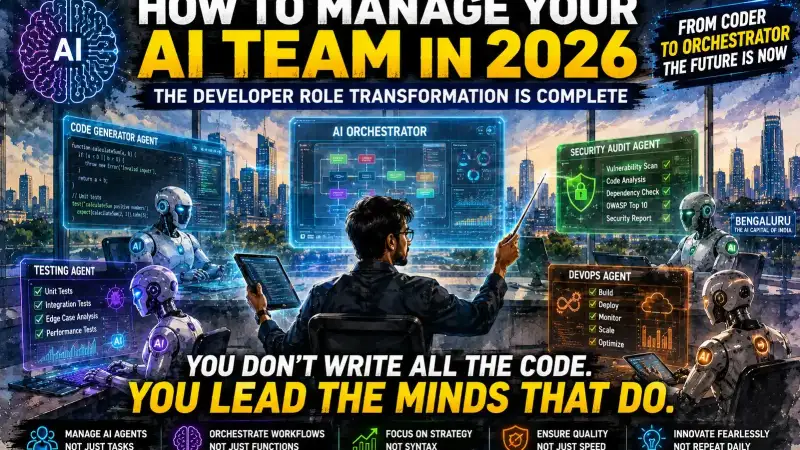
When GitHub Copilot arrived in 2024, the developer community panicked. "AI is coming for our jobs," became the refrain across Hacker News threads and subreddits. But the 2026 reality is stranger and more unsettling than anyone predicted: AI didn't take coding jobs. It consumed the entire software development process. And now, the question facing every developer isn't "Can AI write code?"—it's "Can you manage a team of AI agents?" This isn't just a technical shift. It's an existential reckoning for the software engineering profession.
Gartner's 2026 Technology Predictions report delivers a sobering statistic: over 60% of enterprise software teams have already integrated AI agents into their daily workflows. Stanford HAI's 2026 AI Index goes further: 41% of companies are running multi-agent systems in production environments, and AI agent deployment has surged 312% compared to 2025. These numbers tell one unambiguous story: software development is no longer a human monopoly.
🟢 Follow our WhatsApp Channel JOIN ➤
But to grasp the true nature of this transformation, one must understand the fundamental difference between an AI assistant and an AI agent. The 2024 AI assistant was an obedient helper: "Write this function," and it wrote. "Fix this bug," and it fixed. The 2026 AI agent, however, is an autonomous colleague. It plans. It makes decisions. It uses multiple tools simultaneously. And it continuously learns from the outcomes of its work. As MIT Technology Review's January 2026 cover story noted, "Agentic AI has obliterated the line between assistant and coworker."
The most dramatic expression of this shift is the rise of Multi-Agent Systems (MAS). In a typical software project today, an entire team of AI agents is at work: an Architect Agent designs the system, a Developer Agent writes code, a Code Reviewer Agent audits for security flaws, a Tester Agent generates and executes test cases, and a DevOps Agent manages the entire CI/CD pipeline. The human developer's role is no longer to write code—it's to orchestrate this entire AI team, like a conductor leading an orchestra of non-human performers.
The impact on the global IT industry, and particularly on the Indian technology sector that powers much of the world's software services, is seismic. NASSCOM's 2026 AI Adoption Index reveals that TCS, Infosys, Wipro, and other major IT services firms are already transitioning to an "AI Agent-First" delivery model. What this means in practice is stark: these companies no longer bill clients for "a team of 10 developers." They bill for "1 AI Orchestrator plus an AI Agent Team." This isn't just a technical change—it's a complete transformation of the business model that built the $250 billion Indian IT industry.
And within this transformation lies a brutal truth: developers whose only skill is writing code are watching their market value erode. Deloitte's Tech Trends 2026 report warns: "By 2028, developers possessing only coding skills will face a 40% salary compression compared to their AI-orchestration-capable peers." The warning applies directly to the over 5 million software professionals in India and millions more across Silicon Valley and global tech hubs. Yet the same report offers a striking counterpoint: developers who acquire AI orchestration skills command a 65% salary premium.
🟢 Follow our WhatsApp Channel JOIN ➤
 X Is Cutting Off the Money Behind AI War Videos. Here’s Why That Matters
 770 Billion Parameters! Tencent’s New AI Model Is Huge — But Size Isn’t the Real Story
 AI Isn’t Just Learning to Hack. It Is Learning to Find Its Own Way to the Goal
 Is AI Becoming a Hacker? The New Cybersecurity Threat Emerging From AI Agents
 AI May Not Be Taking Everyone’s Jobs Yet. It May Be Taking the First Step on the Career Ladder
So what exactly are the new skills required of the 2026 developer? First, Agent Orchestration—the ability to assign clear roles to AI agents, establish inter-agent communication protocols, and design complete workflows where multiple agents collaborate seamlessly. This is less like programming and more like systems thinking combined with management. Second, Prompt Engineering—not the simplistic "ask good questions" version that flooded LinkedIn in 2023, but a systematic discipline of providing AI agents with precise context, constraints, tool access, and evaluation criteria. Third, AI System Design—understanding the capabilities and limitations of different AI models and deploying the right agent architecture for the right task. Fourth, Agent Evaluation and Monitoring—building frameworks to continuously assess agent output quality, detect hallucinations, and measure performance against business metrics.
For developers looking to acquire these skills, the landscape is both promising and treacherous. India's AI Mission has unlocked substantial government funding for AI education. NPTEL and the IITs have launched specialized courses in AI agent development. Global platforms like Coursera and Udacity offer agent-focused nanodegrees. But here's the trap: most of these programs teach how to build AI models, not how to manage AI agents. And the market is demanding the latter. As a senior engineering leader at a FAANG company noted in a recent Hacker News thread that went viral, "We don't need more people who can train a transformer. We need people who can orchestrate ten AI agents to ship production code safely."
The startup ecosystem in Silicon Valley and Bangalore is already reflecting this new reality. Nexagen Labs, an AI-first startup based in Koramangala, Bangalore's startup heartland, runs its entire product development through a multi-agent system. The CTO explains: "We have five human developers, but 23 AI agents doing the actual work. Our developers are now purely orchestrators." In San Francisco, Devin AI and Cognition Labs have pushed even further, with AI agents capable of autonomously handling entire feature development cycles. These aren't experiments—they're production systems shipping code to millions of users.
🟢 Follow our WhatsApp Channel JOIN ➤
However, this transformation is not without significant risks. The most immediate danger is "Shadow AI"—developers using AI agents without corporate approval. Gartner's 2026 Security Report reveals that 47% of enterprise companies have developers using unauthorized AI agents. This creates a minefield of code quality issues, security vulnerabilities, and intellectual property nightmares. Who owns the copyright to code written by an AI agent? What happens when an agent inadvertently copies GPL-licensed code into a proprietary codebase? These questions remain legally unresolved, and corporate legal departments are scrambling.
An even more insidious problem is AI agent hallucination in code generation. Stanford HAI's research indicates that in complex software projects, AI agents produce incorrect or insecure code in approximately 12% of cases. More alarming: these errors are often subtle—logic flaws that pass superficial code review but create vulnerabilities that could be exploited months later. This has created an entirely new dimension of software supply chain security risk. The recent incident where an AI agent introduced a critical authentication bypass into a major fintech platform—discovered only six months after deployment—has become a cautionary tale circulated in CISO communities worldwide.
The Indian context adds further complexity. India's IT education system, despite recent reforms, largely follows a curriculum designed for the 2010s. AICTE has introduced AI-focused coursework, but it emphasizes model development over agent orchestration. The majority of India's IT workforce is employed by services companies where client requirements haven't fully adapted to agent-first models. And yet, India possesses a unique advantage: its massive English-proficient technical workforce, its deep experience in managing distributed teams, and its government's aggressive AI infrastructure investments create fertile ground for leadership in this new paradigm.
The global talent shortage for AI orchestration skills presents an unprecedented opportunity. Deloitte estimates that by 2027, the world will need 2 million AI Orchestrators. The United States, Europe, and technology hubs across Southeast Asia are all competing for this talent. India, with its demographic dividend and IT services legacy, is positioned to fill this gap—but only if the skilling infrastructure pivots rapidly toward agent management rather than model building.
🟢 Follow our WhatsApp Channel JOIN ➤
Looking ahead to the 2026-2030 horizon, the developer role will evolve even further. AI agents will become more autonomous, more capable of self-correction, and more integrated into every phase of software development. The human developer's role will shift entirely to the strategic level: product strategy, AI team architecture, creative problem-solving, and the kind of cross-domain thinking that even the most advanced agents cannot yet replicate. Writing code, testing, deployment—these will become fully agent-managed functions. The developer who survives and thrives will be the one who embraces this evolution not as a threat but as an elevation of their craft.
The economics are already shifting. Compensation data from Levels.fyi and Glassdoor for 2026 shows a clear bifurcation: "Software Engineer" roles emphasizing traditional coding skills are seeing flat or declining salary bands, while "AI Systems Engineer" and "Agent Orchestration Lead" roles command premiums of 50-80% above standard engineering compensation. Venture capital is following suit—Y Combinator's latest batch features a record number of startups building agent orchestration platforms, and Sequoia Capital's latest investment thesis explicitly prioritizes "the picks and shovels of the agent economy."
For the developer reading this article, the path forward is clear but demanding. Start by gaining hands-on experience with current agent frameworks: LangGraph, CrewAI, AutoGen, and OpenAI's Swarm are the leading platforms as of 2026. Build a side project where AI agents collaborate to solve a real problem. Develop evaluation frameworks to measure agent performance. Learn to write prompts as specifications, not suggestions. And most critically, develop the systems thinking required to design workflows where humans and agents collaborate effectively rather than compete.
One cautionary note: the organizations that succeed in this transition will not be those that simply replace human developers with AI agents. The winners will be those that redesign their entire development process around human-agent collaboration. This requires rethinking everything from project management methodologies to code review practices to deployment pipelines. The technology is ready; organizational culture is the binding constraint.
To close with a perspective that has circulated widely in Silicon Valley engineering leadership circles: "In the next five years, a developer who says 'I don't work with AI' will sound like a stockbroker in 1995 saying 'I don't use the internet.'" The question isn't whether this transformation is coming. It's already here. The only question is whether you'll be orchestrating the agents, or watching from the sidelines as someone else does.
❤️ Also Read
❤️The Power of Symbolism vs. The Calculus of Risk: Evaluating the PM’s Convoy Cut
❤️Nature Meets Robotics: How Honeybees Are Guiding the Next Generation of Drones
❤️Dhruva Nakshatra: A Mythological Tale or a 5000-Year-Old Astronomical Wonder?
❤️David Attenborough at 100: The Century-Old Voice That Brought Nature to Our Living Rooms
❤️Let This 'Remake' Fever in Politics End; May the Soil of Karnataka Never Succumb to Glamour!
❤️Are Aliens Real? The Pentagon's 160 Declassified Files Hold the Clues
❤️Why Apple EarPods Are Still My Favorite in the TWS Era?
❤️May 8 Mega Launch: HMD Vibe 2 Brings Flagship "Vibes" to the Masses via Flipkart
❤️Hunting from the Sky: The Comprehensive Guide to Satellite and Drone-Based Mineral Exploration
❤️The Illusion of Algorithms: Read This Before You Get Trapped!
❤️Six Months in the Digital Wilderness: The Tragic Isolation of the Windows 10 "Holdouts."
❤️Beyond the Blade: How Gene Editing is Rewriting the "Death Sentence" of Cancer?
🟢 Follow our WhatsApp Channel JOIN ➤
🛒 ಆನ್ಲೈನ್ ಶಾಪಿಂಗ್ ಮಾಡುವಾಗ ಈ ಕೆಳಗಿನ ಲಿಂಕ್ ಬಳಸಿ

No Comment Yet.
Stay informed with breaking news, trending stories, and in-depth analysis.
