Tech Vaidya WhatsApp Channel
Get AI updates, tech news, cybersecurity alerts and useful tech tips directly on WhatsApp.

By: Nagaraj Vaidya
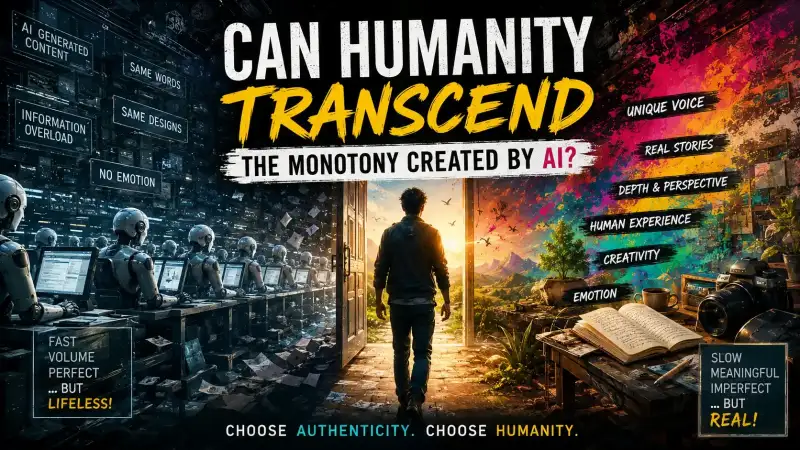
Step into the internet today, and everywhere you look, you're confronted with writings spawned by artificial intelligence, unnervingly smooth images that look cast from the same mold, and lifeless content that seems to mock human spontaneity. The digital world of today is a far cry from the internet of just two years ago. The space once occupied by humans freely sharing their thoughts, scribbling, and painting has now been invaded by machines. As a result, the entire digital sphere is ensnared in a terrifying monotony never seen before. Open any website, scroll through any social media feed, and everything has morphed into a mountain of letters with the same kind of language, identical design, and a complete absence of emotion.
This monotony isn't limited to language alone. It's glaringly evident in visual art as well. Every image seems to be composed of hyper-saturated colors and flawless lighting. While stunning at first glance, a closer look of just a couple of seconds makes it clear that there is no life in them. The small imperfections that occur when a human wields a brush, the artist's state of mind in that moment, the personal touch in the choice of colors—these are the very lifeblood of art. But machines have no emotions; they merely analyze the billions of data points fed to them and perform mathematical calculations to determine which pixel or word fits best next to another. Consequently, the internet has become a factory churning out counterfeit copies wearing the same mask.
We are currently under the grand illusion that we live in an age of information abundance. It's true that technology can place hundreds of pages of information before us in an instant. But if you try to fathom the depth of that information, you'll mostly find a void. In reality, this system isn't creating anything new on its own. It is simply churning the information that humanity has already stored on the web, twisting it, and handing it back to us in a new form. This has gone so far that a toxic cycle has begun, where machines are now being trained on content generated by other machines. As a result, originality, critical thinking, and fresh perspectives are rapidly vanishing from the digital world.
In terms of language, this invasion of artificiality is particularly alarming. Writings marked by a specific set of words, identical sentence structures, and a mask of excessive politeness are boring readers. When a human writes, their language carries a local flavor, a colloquial rhythm, and their own unique style. However, this technology, having devoured the writings of billions of people, has ground all language down and created an average, insipid tongue. It may be free of grammatical errors, but it certainly lacks the vitality needed to touch a reader's soul.
The battle between internet search engines and the technical writing created to feed them is transforming the internet into a garbage dump. Articles written by machines, for machines, with the sole purpose of garnering clicks, are reigning supreme everywhere. For a reader in genuine pursuit of knowledge, finding authentic information amid this flood of artificial data has become a monumental challenge. This is not the democratization of information; it is its complete mechanization.
Breaking free from this vast atmosphere of artificiality and creating something new is the greatest challenge facing humanity today. Throughout history, whenever a new technology has grown aggressively invasive, humans have redefined themselves. During the Industrial Revolution, when machines began mass-producing goods, the value of handicrafts and human labor soared. Similarly, when cameras arrived, painting abandoned the path of stark realism and turned towards abstraction. Artists did what machines could not. Now, it is the turn of writing and content creation to face this test.
Machines can write with precision and perfect grammar, but they have no lived experience. They have no awareness of failure, victory, pain, or joy. These very experiences are the foundation of human creativity. We cannot compete with machines in speed or volume, and we must abandon that attempt. It's natural to question the point of spending hours writing, when technology can produce an article in seconds. But our writing carries our essence, the happenings of our environment, our own unique sarcasm, critique, and anger. No mathematical formula can replicate these.
 Why Is Typing Kannada on Apple Laptops Still So Difficult? Which Kannada Keyboard Is Best for Apple Computers?
 Apple Finally Folded the iPhone! Why the iPhone Duo Could Change the Smartphone Industry
 TechVaidya: One Year. Over a Thousand Articles. And a long road still ahead...
 NASA Invites ISRO to Join the Moon Base Mission: Why This Could Be a Turning Point for India
 Toxic Review: Yash Owns the Screen, But Does the Film Own the Story?
Technology considers creativity to be merely an arrangement of words or a mixture of colors. But true creativity is born from breaking the rules and searching for new possibilities. The human brain can not only think logically, it can also dream dreams that logic cannot grasp. It can connect two seemingly absurd, disparate ideas and create a whole new concept. Machines can only predict the next step based on past data; they cannot take flight into the realm of imagination.
The only way to transcend this mechanical monotony is to embrace our imperfections and celebrate them. Overly polished things bore us quickly. The unique style in a human's writing, the unexpected twists in their train of thought—these are the true elements that hold a reader's attention. In the digital age, authenticity is going to be in higher demand than ever before. When the internet is filled with plastic flowers, the fragrance of a single real flower, however faint, instantly captures our attention.
Today's writers, journalists, and content creators bear an immense responsibility. Merely providing information is no longer the priority, because machines can do that job faster than we can. Our responsibility lies in providing a critical perspective to that information. Only human intelligence can analyze the social, cultural, and political dimensions behind an event and plant questions in a reader's mind. This nuanced sensibility is our greatest asset.
We don't need to completely reject technology. We should view it merely as a preliminary tool for gathering information and preparing drafts. Publishing its output as is, without applying the coating of human intelligence and experience, is a betrayal of the reader and a mark of disrespect to our own profession. We must use technology as a stepping stone to expand our thoughts and find new perspectives, not make it our final destination.
The same truth applies to art. Machines can create marvelous images, but it takes a human artist to tell the story behind that picture, the pain or the joy behind that story. Art is not just an object that pleases the eye; it is a medium that stirs the viewer's soul. Art born from the brush of a machine has no spirit; it is merely a combination of colors and shapes. Only the deep-seated emotions of a human being have the power to transcend this precision.
In the coming days, the internet world is likely to split into two clear parts. One will be a heap of countless free content created by machines; the other will be unique, authentic, and trustworthy premium content created by humans. Readers and viewers, weary of this mechanical monotony, will begin a search for the stories of pure human experience and genuine analysis. Then, human creativity will see unprecedented demand. We must prepare ourselves for that era now.
To face this challenge, we need to observe the world around us more keenly. We must expand the breadth of our reading, mingle with a diverse range of people, and travel. The experiences gained from all this are the fuel for our creativity. Machines can sit in server rooms and analyze data, but they cannot understand the feeling of a raindrop on the skin, the heat of the sun, or the complexities of relationships. The real, lived experiences of this physical world must become the lifeblood of our content.
In short, the urgent need of our time is to shatter this massive wall of monotony being built by artificial intelligence and open new windows of pure human sensibility and unique creativity. In the race between man and machine, we must not play the game that machines play. Instead, we must start a new game that machines cannot even comprehend. Only by upholding our flaws, our uniqueness, and our humanity can we transcend this monotony. This yearning for novelty that surpasses technology is the greatest challenge before us, and it is our sole path to survival in the future.
❤️ Also Read
❤️The Two Paths for Developers in 2026: Coding Isn't Dead, But the Coder Is!
❤️The Power of Symbolism vs. The Calculus of Risk: Evaluating the PM’s Convoy Cut
❤️Six Months in the Digital Wilderness: The Tragic Isolation of the Windows 10 "Holdouts."
❤️Hunting from the Sky: The Comprehensive Guide to Satellite and Drone-Based Mineral Exploration
❤️The Illusion of Algorithms: Read This Before You Get Trapped!
❤️Silicon Hubris vs. Regulatory Reality: Why Being a Tech Giant Didn’t Save Paytm from the RBI’s Axe
❤️Nature Meets Robotics: How Honeybees Are Guiding the Next Generation of Drones
❤️From Coder to Creator: The Brutal Reality of Making Money in the AI Era
🟢 Follow our WhatsApp Channel JOIN ➤
🛒 ಆನ್ಲೈನ್ ಶಾಪಿಂಗ್ ಮಾಡುವಾಗ ಈ ಕೆಳಗಿನ ಲಿಂಕ್ ಬಳಸಿ

No Comment Yet.
Stay informed with breaking news, trending stories, and in-depth analysis.