It has been roughly seven years since the first 5G networks were switched on in the United States. Back in 2019, the promise was revolutionary: download full 4K movies in seconds, perform remote surgery, and enjoy zero-latency gaming on the bus.
Fast forward to 2026, and the "5G" icon is a permanent fixture in the status bar of almost every smartphone in America. But if you are like most users, you have probably noticed something confusing. Sometimes, that 5G icon means your internet is blazing fast—faster than your home Wi-Fi. Other times, despite showing full bars of "5G," your data feels sluggish, barely loading a webpage.
Why is there such a massive inconsistency? The answer lies in the physics of radio waves. In 2026, "5G" is not just one thing; it is three very different technologies wearing the same trench coat. We call these the "Layer Cake" of connectivity: Low-band, Mid-band (Sub-6), and High-band (mmWave). Understanding the difference between them is the key to understanding why your phone behaves the way it does on Verizon, T-Mobile, or AT&T.
The Foundation: Low-Band and Sub-6 5G
When 5G first launched, carriers needed to claim they had "Nationwide Coverage" immediately. To do this, they used Low-band spectrum.
Think of Low-band 5G as a very loud drummer. The sound (signal) travels a very long distance and can easily pass through walls, trees, and buildings. This is great for coverage. You can get a signal in the basement of your house or out on a rural highway. However, a low drum beat cannot carry much information complexity.
In technical terms, this is Sub-6GHz spectrum (specifically, the lower frequencies below 1GHz). In 2026, this is the "baseline" 5G. It is reliable, but it is not fast. In fact, in many rural areas, Low-band 5G is barely faster than the old 4G LTE networks. It is just more efficient at handling many users at once. If you see a standard "5G" icon (without any extra letters like UW or UC) on your iPhone or Android, you are likely on this layer. It is good for browsing, GPS, and music, but do not expect to download a 100GB game in minutes.
The Sweet Spot: Mid-Band (C-Band)
The biggest change in the US network landscape between 2022 and 2026 was the massive rollout of Mid-band 5G, often referred to as "C-Band."
If Low-band is a loud drummer, Mid-band is a guitarist. It doesn't travel as far as the drums, but it can play much faster notes. It offers the perfect balance between coverage and speed.
T-Mobile was the first to dominate this space with its "5G Ultra Capacity" (5G UC), using 2.5GHz spectrum acquired from Sprint. Verizon and AT&T spent billions to catch up, rolling out their C-Band networks (labeled as 5G UW and 5G+, respectively).
In 2026, Mid-band is the standard for city and suburban life. When you are in a grocery store, a coffee shop, or at home in the suburbs, you are likely connected to this. Speeds here are genuinely impressive, consistently ranging from 300 Mbps to 1 Gbps. This is faster than what most Americans have for home cable internet. This layer is what makes 5G finally feel "worth it." It allows for smooth 4K video streaming and lag-free video calls without the connection dropping the moment you walk indoors.
The Ferrari: mmWave (High-Band)
Then, we have the technology that was originally hyped in all the commercials: millimeter Wave (mmWave).
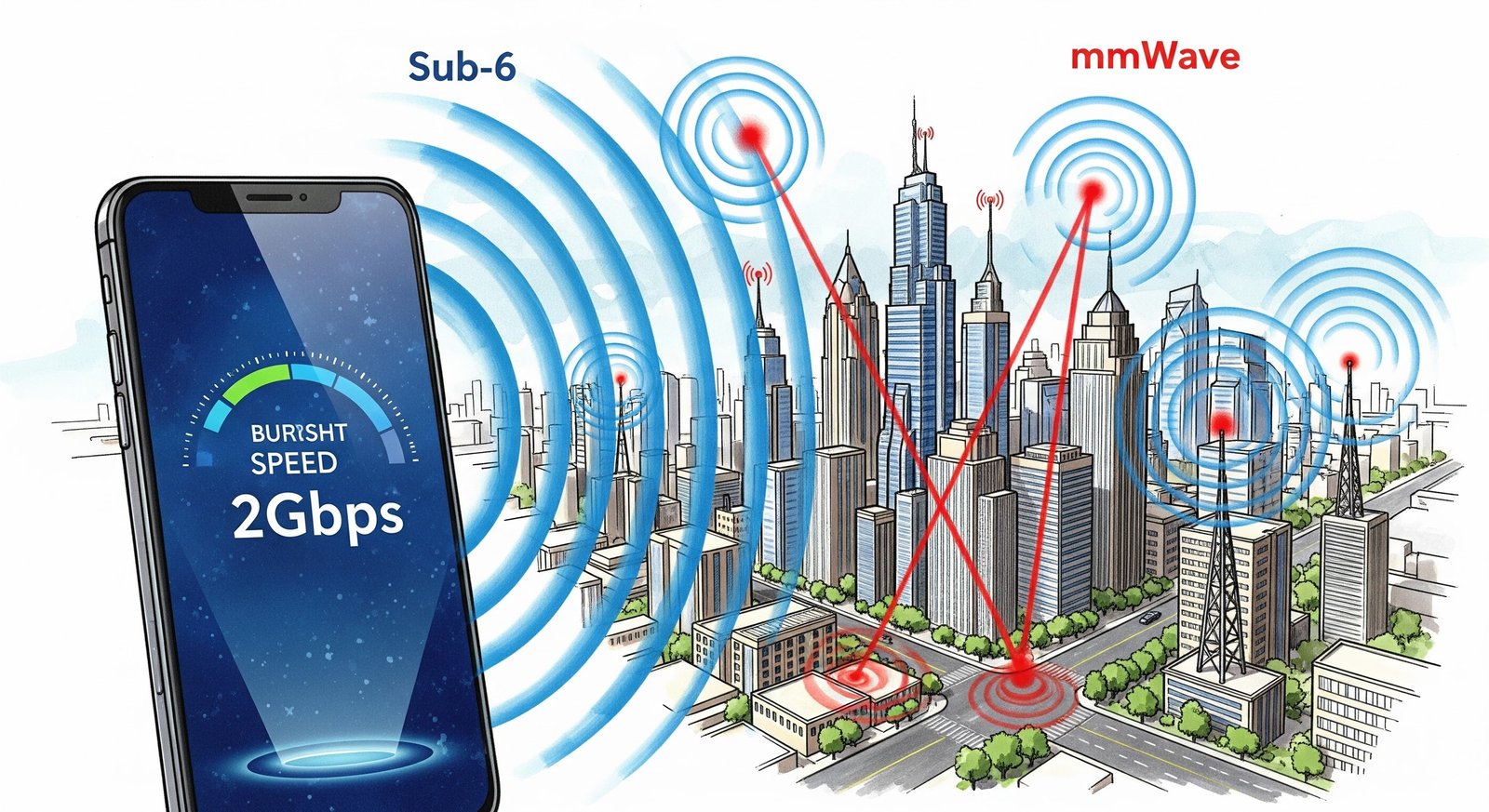
If Low-band is a drum and Mid-band is a guitar, mmWave is a high-pitched whistle. It carries an incredible amount of data—speeds of 4 Gbps or even 5 Gbps are common—but the signal is incredibly fragile. A mmWave signal struggles to travel more than a city block. It cannot penetrate walls. It cannot go through glass. Even a heavy rainstorm or the leaves on a tree can block it.
In the early days, Verizon bet heavily on this, trying to put mmWave nodes on every street corner. It proved too expensive and impractical for general coverage. However, in 2026, mmWave has found its true calling: Crowds.
You will find mmWave in specific, high-density locations: NFL stadiums, airports, convention centers, and busy downtown plazas like Times Square. When 80,000 people are in a stadium trying to upload videos to social media simultaneously, normal networks collapse. mmWave has so much bandwidth that it can handle that traffic effortlessly.
If you are walking down a street in Chicago or New York and you suddenly see your download speeds jump to 3000 Mbps, you have caught a mmWave signal. But the moment you turn the corner or walk into a shop, you will drop back down to Mid-band.
The Branding Decoder Ring: 2026 Edition
Carriers love to use confusing marketing terms. Here is what the icons on your phone actually mean in 2026:
Verizon:
"5G": This is the slow, Low-band network.
"5G UW" (Ultra Wideband): This now includes BOTH the super-fast mmWave and the fast Mid-band (C-Band). If you see this, you are in a good speed zone.
T-Mobile:
"5G": The standard Low-band network.
"5G UC" (Ultra Capacity): This is their Mid-band and mmWave network. Because T-Mobile has so much Mid-band spectrum, you will see this icon more often than any other carrier's premium icon.
AT&T:
"5G": The standard Low-band network.
"5G+": This indicates you are connected to C-Band or mmWave.
The Arrival of "5G Advanced" (5.5G)
As we settled into 2026, a new term started appearing in marketing materials: "5G Advanced."
This is not 6G (which is expected around 2029 or 2030). Think of it as 5G perfected. 5G Advanced uses AI and Machine Learning directly inside the network towers. The network creates a "spatial map" of the radio environment. It knows that a train is approaching, so it directs a beam of data specifically at the train windows to ensure the passengers get a good signal, then moves the beam away once the train passes.
For the consumer, 5G Advanced means better upload speeds. Historically, 5G was great at downloading but mediocre at uploading. 5G Advanced balances this out, which is crucial for the creators livestreaming in 4K or professionals sending massive files from the field.
Battery Drain: The Hidden Cost of Speed
One question remains constant: Does 5G kill your battery?
The physics haven't changed. Sending and receiving data at extremely high frequencies (like mmWave) requires more energy. Keeping a modem active to hunt for these elusive signals drains power.
However, in 2026, smartphone modems (like the Qualcomm Snapdragon X90 series or Apple's custom modems) have become incredibly efficient. They use "Smart Switching." They sit on the Low-band network (low power) when your phone is in your pocket. The millisecond you open a video app or start a download, they ramp up to Mid-band or mmWave, blast the data down quickly, and then immediately drop back to sleep.
Because the data comes in so fast, the radio is active for less time. Downloading a 1GB file on 4G might take the radio 2 minutes of constant work. On 5G Mid-band, it takes 10 seconds. Even though 5G uses more power per second, it finishes the job faster, often resulting in net neutral battery usage.
However, if you are in an area with "weak" 5G signal, your phone will drain rapidly. This is because the modem has to "shout" (increase power) to maintain the connection with the tower. In these fringe scenarios, turning off 5G in your settings and forcing LTE can still save you battery life, even in 2026.
Which Carrier is Best for You?
In 2026, the gap has narrowed, but distinctions remain.
T-Mobile: Still holds the crown for the widest availability of fast speeds. Their "5G UC" is everywhere, covering rural highways and suburbs that other carriers missed. If you travel significantly across the US, they often offer the most consistent high-speed experience.
Verizon: The king of reliability and peak speeds in cities. Their C-Band rollout is now mature, and their mmWave network in cities is unmatched. If you live in a major metro area or attend a lot of sporting events, Verizon's network feels the most robust.
AT&T: The consistent middle ground. They focus heavily on enterprise and business stability. While they may not always win the "fastest speed test" awards, their network is known for fewer dropped calls and consistent performance.
Do You Need a "Pro" Plan?
To access these super-fast mmWave and C-Band networks (UW, UC, 5G+), carriers often force you onto their "Premium" or "Plus" unlimited plans. The cheaper "Start" or "Essentials" plans are often restricted to the slower Low-band 5G.
Is it worth the extra $10 or $20 a month in 2026? If you live in a city or a dense suburb, the answer is a resounding yes. The difference between the congested Low-band network and the wide-open freeway of the Mid-band network is night and day. However, if you live in a very rural area where C-Band towers haven't reached yet, sticking to the basic plan is a smart financial move. The "5G" icon is on everyone's screen, but the quality of the experience depends entirely on which layer of the cake you are paying to eat.

No Comment Yet.
Stay informed with breaking news, trending stories, and in-depth analysis.